
Introduction
Richard Phillips Feynman (1918 – 1988) was an American theoretical physicist, Nobel Prize in Physics (1965). His lecture “What is Science?” offers a personal and insightful look into the nature of science, delivered at the 1966 National Science Teachers Association meeting and later reprinted in “The Physics Teacher” in 1969.
Science as a Process of Doubt and Observation
Feynman views science as a process of rechecking experience, where doubting past knowledge and verifying it through new, direct experiences is central. This helps avoid perpetuating unprofitable ideas or prejudices.
Education and the Role of Doubt
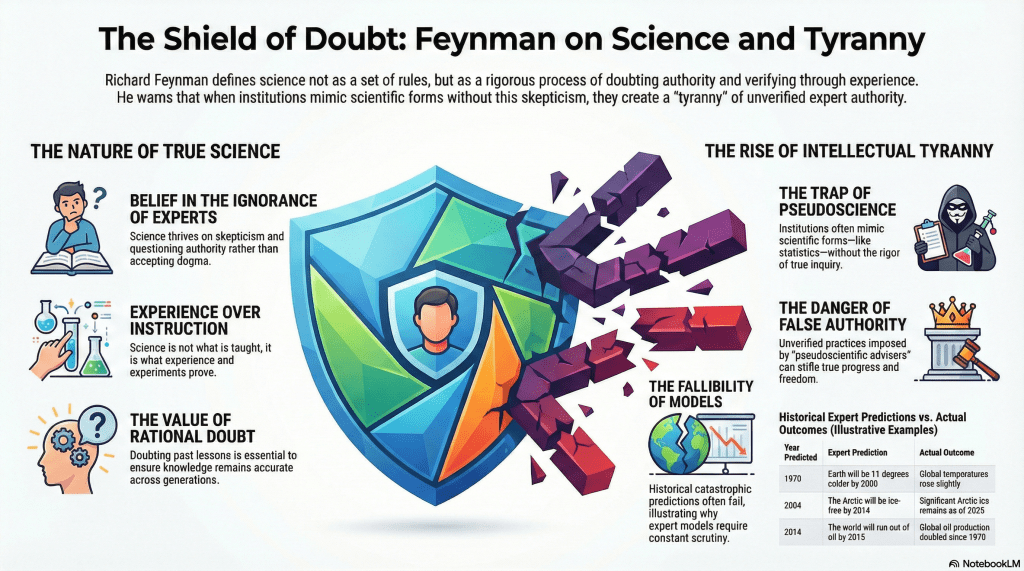
In education, Feynman encourages teachers to embrace doubt and critical thinking, famously defining science as “belief in the ignorance of experts,” emphasizing the importance of questioning authority in scientific pursuit.
Knowledge Across Generations
Science enables the accumulation of knowledge across generations, but Feynman stresses balancing respect and skepticism toward past ideas to avoid perpetuating errors. This balance is crucial for scientific progress, ensuring that new ideas can emerge while building on established knowledge.
On Tyranny and Science
Feynman explicitly addressed the issue of tyranny in the context of science, focusing on the influence of pseudoscience. He stated:
“In this way, we all suffer from the kind of tyranny we have today in the many institutions that have come under the influence of pseudoscientific advisers. We have many studies in teaching, for example, in which people make observations, make lists, do statistics, and so on, but these do not thereby become established science, established knowledge.”
This quote highlights his concern that pseudoscience, which mimics scientific methods without adhering to their rigor, can lead to a form of intellectual tyranny within institutions. He saw this as a danger where unverified practices are imposed, potentially stifling true scientific progress.
To illustrate, Feynman used the example of educational studies where observations and statistics are collected, but without the critical evaluation that defines science, these efforts do not constitute established knowledge. This suggests a scenario where institutions, under the influence of pseudoscientific advisers, could enforce policies or practices that lack empirical grounding, effectively creating a “tyranny” of false authority.
| It’s not so simple to convince scientists of the truth, let alone politicians… Max Karl Ernst Ludwig Planck (1858-1947) was a German theoretical physicist, winner of the Nobel Prize in Physics (1918) for his contributions to quantum physics. In his book “Scientific Autobiography and Other Papers,” Max Planck recounts the dispute between Ludwig Eduard Boltzmann (1844-1906), an Austrian physicist and defender of atomic theory and statistical theory, and Wilhelm Friedrich Ostwald (1853-1932), considered the father of physical chemistry and winner of the Nobel Prize in Chemistry in 1909, who rejected atomic theory. The dispute between the two was particularly evident in their differing interpretations of the second law of thermodynamics. Boltzmann’s statistical mechanics provided a probabilistic basis for entropy, suggesting that the irreversibility of the law stems from the enormous probability of disorder increasing over time. Ostwald, however, sought to base physics solely on energy, denying the need for atoms and contesting the statistical interpretation, even in the face of the evident superiority of Boltzmann’s statistical mechanics explanation. Max Planck thus recounts the experience he learned: “This experience gave me also an opportunity to learn a fact — a remarkable one, in my opinion: A new scientific truth does not triumph, by convincing, its opponents and making them see the light, but rather because its opponents eventually die, and a new generation grows up that is familiar with it.“ |
Broader Philosophy and Resistance to Tyranny
Feynman’s broader philosophy of science provides additional context for understanding his views on tyranny. In the same lecture and other discussions, he emphasized the importance of doubting expert opinions, famously defining science as “the belief in the ignorance of experts.” This statement, reflects his view that science thrives on skepticism and critical inquiry. This approach can be seen as a direct counter to intellectual tyranny, where authority is questioned, and knowledge is verified through direct experience rather than accepted dogma.
For instance, in discussions on science and authority, Feynman argued:
“When someone says ‘science teaches such and such’, he is using the word incorrectly. Science doesn’t teach it; experience teaches it.”
This underscores his belief that science is not about following expert dictates but about empirical validation, which inherently resists any form of tyranny that relies on unexamined authority.
| Tyranny of experts during COVID‐19 pandemic In the article “Separation of power and expertise: Evidence of the tyranny of experts in Sweden’s COVID‐19 responses“, Per L Bylund and Mark D Packard discuss the tyranny os experts: “Sebhatu et al. (2020) explain how the nonpharmaceutical interventions such as lockdown were adopted by governments to deal with the pandemic due to the precedence of such measures. (…) As Easterly (2014) warned, and as Ioannidis (2020) has observed, human rights were ignored altogether as the virus became a technocratic problem to solve. Outcry from those whose rights were violated were actively hushed by the political class and its sympathizers who claimed that this was a problem that required extreme measures and the cooperation of all. The swiftness in enacting such measures may also have played an important role, as populations have been found to be initially more willing to trade off civil liberties for improved public health conditions, a willingness that then gradually declines (Alsan et al., 2020). While the effects of the virus and the various responses to it are still unfolding, it has become increasingly clear in the months of continued lockdown that the harsh lockdown response was more reactive than scientific (Catron, 2020; Sebhatu et al., 2020; Unsigned, 2020b)—a fear that the virus might be much worse than it turned out to be. However, with the precedent set, the lockdowns which, had we known then what we know now, very likely would never have happened, persist. Confirming the “tyranny of experts,” human rights continue to be sacrificed at the altar of public safety, despite the benefits of these violations being small and ambiguous.” (the full article can be read at: https://pmc.ncbi.nlm.nih.gov/articles/PMC8014802/) |
Implications for Science and Society
Feynman’s warnings about pseudoscience and tyranny have lasting relevance, particularly in an era where misinformation and pseudoscientific claims can influence public policy and education. His call for critical thinking and skepticism serves as a reminder for scientists and educators to resist the imposition of unverified ideas, whether in academic institutions, government policies, or public discourse. This aligns with his view that science is a dynamic process of doubt and verification, not a static set of truths enforced by authority.
Selected text
What is Science? (https://feynman.com/science/what-is-science/)
(…)
Another of the qualities of science is that it teaches the value of rational thought as well as the importance of freedom of thought; the positive results that come from doubting that the lessons are all true. You must here distinguish–especially in teaching–the science from the forms or procedures that are sometimes used in developing science. It is easy to say, “We write, experiment, and observe, and do this or that.” You can copy that form exactly. But great religions are dissipated by following form without remembering the direct content of the teaching of the great leaders. In the same way, it is possible to follow form and call it science, but that is pseudo-science. In this way, we all suffer from the kind of tyranny we have today in the many institutions that have come under the influence of pseudoscientific advisers.
We have many studies in teaching, for example, in which people make observations, make lists, do statistics, and so on, but these do not thereby become established science, established knowledge. They are merely an imitative form of science analogous to the South Sea Islanders’ airfields–radio towers, etc., made out of wood. The islanders expect a great airplane to arrive. They even build wooden airplanes of the same shape as they see in the foreigners’ airfields around them, but strangely enough, their wood planes do not fly. The result of this pseudoscientific imitation is to produce experts, which many of you are. [But] you teachers, who are really teaching children at the bottom of the heap, can maybe doubt the experts. As a matter of fact, I can also define science another way: Science is the belief in the ignorance of experts.
When someone says, “Science teaches such and such,” he is using the word incorrectly. Science doesn’t teach anything; experience teaches it. If they say to you, “Science has shown such and such,” you might ask, “How does science show it? How did the scientists find out? How? What? Where?”
It should not be “science has shown” but “this experiment, this effect, has shown.” And you have as much right as anyone else, upon hearing about the experiments–but be patient and listen to all the evidence–to judge whether a sensible conclusion has been arrived at.
In a field which is so complicated [as education] that true science is not yet able to get anywhere, we have to rely on a kind of old-fashioned wisdom, a kind of definite straightforwardness. I am trying to inspire the teacher at the bottom to have some hope and some self-confidence in common sense and natural intelligence. The experts who are leading you may be wrong.
I have probably ruined the system, and the students that are coming into Caltech no longer will be any good. I think we live in an unscientific age in which almost all the buffeting of communications and television–words, books, and so on–are unscientific. As a result, there is a considerable amount of intellectual tyranny in the name of science.
Finally, with regard to this time-binding, a man cannot live beyond the grave. Each generation that discovers something from its experience must pass that on, but it must pass that on with a delicate balance of respect and disrespect, so that the [human] race–now that it is aware of the disease to which it is liable–does not inflict its errors too rigidly on its youth, but it does pass on the accumulated wisdom, plus the wisdom that it may not be wisdom.
It is necessary to teach both to accept and to reject the past with a kind of balance that takes considerable skill. Science alone of all the subjects contains within itself the lesson of the danger of belief in the infallibility of the greatest teachers of the preceding generation.
So carry on. Thank you.
Questions for reflection
Case 1: Dr. Anthony Fauci, former director of the National Institute of Allergy and Infectious Diseases (NIAID) and a key figure in the US response to COVID-19, has been associated by critics with actions perceived as a “tyranny of science.”
Some of Fauci’s supporters argue that the criticism reflects a misunderstanding of the scientific method, which evolves with new data. Policies such as lockdowns were based on models (e.g., Imperial College’s projection of 1.5 to 2.2 million US deaths) that were later criticized for being unreliable.
Case 2: Climate change predictions have a well-known history of failure. The following table lists some erroneous predictions, selected for the clarity of their failure to materialize, considering the current available evidence:
| Year | Prediction | Outcome | Source URL |
|---|---|---|---|
| 1970 | By 2000, the world will be 11 degrees colder. | Did not occur; global temperatures have risen slightly since 1979. | https://www.aei.org/carpe-diem/18-spectacularly-wrong-predictions-were-made-around-the-time-of-the-first-earth-day-in-1970-expect-more-this-year/ |
| 1970 | In a decade, urban dwellers will have to wear gas masks to survive air pollution. | Did not occur; air quality improved in many cities, no gas masks needed. | https://www.aei.org/carpe-diem/18-spectacularly-wrong-predictions-were-made-around-the-time-of-the-first-earth-day-in-1970-expect-more-this-year/ |
| 1980 | Acid rain will eliminate all fish in Canadian lakes by 2000. | Did not occur; US government study in 1990 found no such effect. | https://cei.org/blog/wrong-again-50-years-of-failed-eco-pocalyptic-predictions/ |
| 1988 | By 1995, the greenhouse effect will be desolating the heartlands of North America, Asia and Africa, making most of the land unable to grow food crops. | Did not occur; food production has increased globally. | https://cei.org/blog/wrong-again-50-years-of-failed-eco-pocalyptic-predictions/ |
| 2000 | Children just aren’t going to know what snow is. | Did not occur; snow is still common in many regions. | https://cei.org/blog/wrong-again-50-years-of-failed-eco-pocalyptic-predictions/ |
| 2004 | The Arctic will be ice-free by 2014. | Did not occur; significant Arctic ice remains as of 2025. | https://cei.org/blog/wrong-again-50-years-of-failed-eco-pocalyptic-predictions/ |
| 2008 | Malaria rates will surge in Africa, and Britain will be plagued by clouds of mosquitoes coming up the English Channel. | Did not occur; malaria rates decreased in Africa, no mosquito plague in Britain. | https://cei.org/blog/wrong-again-50-years-of-failed-eco-pocalyptic-predictions/ |
| 2013 | The Arctic ice cap will disappear by 2015. | Did not occur; Arctic ice persists. | https://cei.org/blog/wrong-again-50-years-of-failed-eco-pocalyptic-predictions/ |
| 2014 | The world will run out of oil by 2015. | Did not occur; global oil production in 2021 was 95M bpd, double 1970’s 48M bpd. | https://cei.org/blog/wrong-again-50-years-of-failed-eco-pocalyptic-predictions/ |
| 2015 | The Great Barrier Reef will be dead by 2016. | Did not occur; while under stress, the reef is not dead as of 2025. | https://cei.org/blog/wrong-again-50-years-of-failed-eco-pocalyptic-predictions/ |
1. Shouldn’t scientists report on the reliability of their models? What are the possible reasons for not doing so? Is it an intention to instill fear in order to impose control? Is it an intention to overvalue their knowledge? Is it a failure to recognize their own fallibility? To justify obtaining funding for their research? Is it political bias?
2. How should catastrophic predictions be dealt with politically?
3. If models are unreliable, can the government limit fundamental rights such as property rights, assembly rights, and others? What about God given rights?
4. Suppose the models are reliable. What fundamental rights can the government limit? Who would hold this power to limit rights: the Executive Branch, the Legislative Branch, or the Judiciary Branch?
5. What right does the State have to impose coercive measures based on unestablished science, that is, when it does not yet know the effective results of what it is proposing, when such measures affect people’s lives, health and freedom?

Leave a comment