
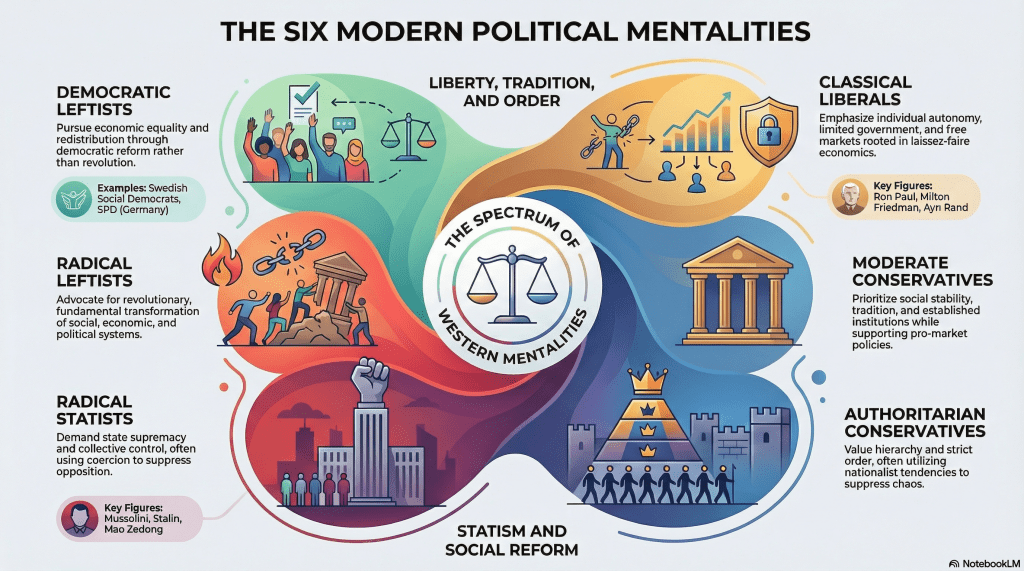
Each group in the circular diagram has distinct characteristics, based on historical and theoretical principles that we will detail throughout the subsequent chapters (we will also detail some of their subdivisions). However, some of the basic ideas are already exposed here.
Classical Liberals
• Core Principles: They emphasize individual autonomy, limited government, free markets and civil liberties. They advocate for economic freedom and minimal government intervention, rooted in thinkers such as John Locke, Adam Smith and John Stuart Mill.
• Historical Context: They emerged in the 18th and 19th centuries as a progressive left-wing movement (to the left of authoritarian conservatives). This change reflects changing political landscapes, with a focus on laissez-faire economics against state expansion (in the diagram, it corresponds to a 180º turn in the diagram, in which Western civilization moves from authoritarian political models to democratic models).
• Modern Examples: Politicians such as Ronald “Ron” Paul and his son Rand Paul (American congressmen). Authors such as Friedrich Hayek; Milton Friedman; Ayn Rand; James McGill Buchanan Jr.; Hans-Hermann Hope and Murray Rothbard.
Moderate Conservatives:
• Core Principles: Value tradition, social stability and gradual change, and the defense of established institutions. May support liberal economic policies, but prioritize social order.
• Historical Context: Developed in contexts where secular conservative parties were weak, such as parts of Europe, mixing conservative and liberal elements.
• Modern Examples: Mainstream conservative parties, such as the Conservative Party in the United Kingdom in the recent past but no longer today (in the UK, conservative thought is now much better represented in the Reform UK party) or part of the Republican Party in the US, balancing tradition with pro-market policies. Politicians such as Ronald Reagan and Margaret Thatcher. Authors such as Michael Oakshot; Russell Kirk and Roger Scruton.
Authoritarian Conservatives:
• Core Principles: They see the world as chaotic and demand order. Therefore, they favor strong government control, hierarchy, and traditional values, often with nationalist tendencies. They are more rigid than moderate conservatives.
• Historical Context: Exemplified by regimes such as Franco’s Spain – often as conservative responses to instability, prioritizing order over ideology, combining conservative values with authoritarian governance.
• Modern Examples: Nationalist movements, such as Fidesz in Hungary under Viktor Orbán (Prime Minister of Hungary since 2010), emphasizing state control and traditionalism. Authors such as Carl Smith in Germany and Ramiro de Maeztu in Spain. Military dictatorships in Latin America – for example, Augusto Pinochet (president of Chile between 1974 and 1990) – and in Asia – for example, Park Chung-hee (president of South Korea between 1963 and 1979) adopted statism to impose stability and development. In Brazil, this was the case of the military regime (1964-1985).
Radical statists:
• Core Principles: State supremacy, centralized control, suppression of dissident groups, collectivism as opposed to individualism, use of coercion, propaganda and ideological control, erosion of the rule of law.
• Historical Context: Historically a model that has endured for centuries in many civilizations (and still endures), it re-emerged in the early 20th century in a new guise, characterized by suppression of opposition and state-controlled economies, as opposed to liberal democracy.
• Modern Examples: Mussolini’s fascism (Prime Minister of Italy between 1922 and 1943) exemplifies radical statism, with extreme nationalism and suppression of freedoms. It shares authoritarianism with authoritarian conservatives, but opposes classical liberals, rejecting individual freedom. The Bolshevik Revolution (1917) and the consolidation of power under Joseph Stalin (General Secretary of the Communist Party of the USSR from 1922 to 1953) exemplified radical leftism turning into radical statism, with the state controlling the economy, culture, and personal life under Marxist-Leninist ideology.
The China of Mao Zedong (Chairman of the Central Committee of the Chinese Communist Party from 1945 to 1976; Chairman of the Central People’s Government of China from 1949 to 1954; 1st President of the People’s Republic of China from 1954 to 1959) extended this model, combining totalitarianism with agrarian revolution, culminating in policies such as the Cultural Revolution (1966–1976).
Authoritarian regimes originating from authoritarian conservatives have proliferated in Europe – such as Francisco Franco (Spanish caudillo from 1936 to 1975) and António Salazar (Portuguese Prime Minister from 1932 to 1968) – often as conservative responses to instability, prioritizing order over ideology and approaching or becoming radical statists.
Military dictatorships in Latin America – for example, Augusto Pinochet (President of Chile from 1974 to 1990) – and in Asia – for example, Park Chung-hee (President of South Korea from 1963 to 1979) – adopted statism to impose stability and development, often with the support of the United States or the Soviet Union.
Radical statism was fueled by ideologies such as nationalism (fascism), class struggle (communist totalitarianism) or anti-liberalism (authoritarianism).
Crises—war, economic collapse, or social upheaval—have legitimized state intervention and control, often framed as protecting the “greater good.”
Radical Leftists:
• Core Principles: Advocate for fundamental transformation of social, economic, and political systems, often through revolutionary means. Include Marxists, anarchists, and other anti-capitalist movements.
• Historical Context: Rooted in socialist movements of the 19th and 20th centuries, with significant influence during events such as the Russian Revolution.
• Modern Examples: Anti-capitalist movements, some green movements, identitarian progressivism, and various other far-left factions.
Democratic Leftists:
• Core Principles: Support redistribution of property and income (they call this social justice), greater economic equality, and democratic governance through reform, not revolution. Aligned with social democracy or democratic socialism.
• Historical Context: Prominent in post-World War II Europe, with examples such as the Swedish Social Democrats, focusing on welfare states within democratic frameworks.
• Modern Examples: Parties such as the Social Democratic Party of Germany (SozialdemokratischeParteiDeutschlands, SPD), advocating for social welfare and democratic reforms.
Key Point
• Research suggests that political mindsets can be grouped into six categories, forming a circular diagram: classical liberals, moderate conservatives, authoritarian conservatives, fascists, radical leftists, and democratic leftists.

Leave a comment