
The proposed circular diagram suggests a continuum where adjacent groups share ideological overlap, while opposing groups are fundamentally opposed. This can be visualized in the following table, with the sequence forming a circle:
| Group | Overlap with Adjacent Groups | Opposition with Opposing Groups |
| Classical Liberals | Individual liberties (Democratic Leftists); free markets and moderate government (Moderate Conservatives); democratic elections (Democratic Leftists and Moderate Conservatives). | Totalitarianism, controls (Radical statists) |
| Moderate Conservatives | Free markets, democratic elections, and moderate government (Classical Liberals); tradition (Authoritarian Conservatives) | Revolution (Radical Leftists) |
| Authoritarian Conservatives | Tradition (Moderate Conservatives); authority, strong government, and militarism (Radical statists) | Democracy (Democratic Leftists) |
| Radical statists | Authority, strong government, and militarism (Authoritarian Conservatives); revolution, extreme control, and violence (Radical Leftists) | Freedom (Classical Liberals) |
| Radical Leftists | Revolution, extreme control, and violence (Radical statists); Economic equality and opposition to free markets (Democratic Leftists) | Tradition, Elections (Moderate Conservatives) |
| Democratic Leftists | Economic equality and opposition to free markets (Radical Leftists); Individual liberties and democratic elections (Classical Liberals) | Hierarchy, control (Authoritarian Conservatives) |
This table illustrates how the circle works: for example, classical liberals and democratic leftists value individual freedoms and democratic institutions, although they differ on economics (free markets vs. welfare states). Similarly, radical leftists and authoritarian conservatives favor strong government, but radical statists are more extreme in their nationalism and control.
Figure 2 illustrates such relationships in a concrete case of opposition. In the poster, the German Social Democratic Party, SPD (a democratic leftist party) opposed reactionary conservatism (here called authoritarian conservatism), Nazism (a type of radical statism), and communism (a type of radical leftism), and with the slogan “Against Papen, Hitler, Thälmann.” The order of the politicians mentioned is suggestive of greater opposition from the first to the third: the first is Papen (authoritarian conservative); the second is Hitler (radical statist); and the third is Thälmann (radical leftist).
Figure 2: Election poster of the German Social Democratic Party – SPD (1932).
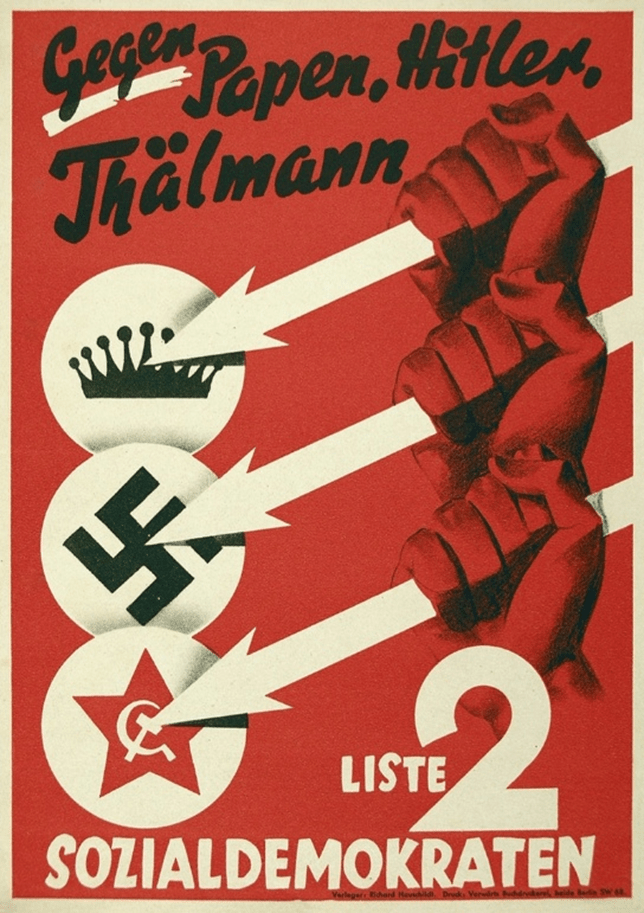
Autor:Plakatsammlung Karl Fritz.
Key Points
- Adjacent groups in the circle diagram share ideas. Thus, classical liberals and democratic leftists value freedoms
- Opposing groups, such as classical liberals and radical statists, are fundamentally opposed.
Additional suggested texts:
- Political Spectrum (https://www.britannica.com/topic/political-spectrum)
- Understanding the political spectrum (https://www.unifrog.org/know-how/understanding-the-political-spectrum)
- The Theory of the Political Spectrum (https://mises.org/journal-libertarian-studies/theory-political-spectrum)
- The Political Typology Quiz (https://www.pewresearch.org/politics/quiz/political-typology/)
- Horseshoe Theory (https://study.com/academy/lesson/horseshoe-theory-meaning-history-examples.html)
- Thinking Outside the Circle (https://fee.org/articles/thinking-outside-the-circle/)


Leave a comment