
Introduction: Moses, the mediator of Divine Law
Moses is one of the central figures of the Bible, known as the liberator of the people of Israel and the mediator of God’s laws. Born into a time of oppression, when the Israelites were enslaved in Egypt, Moses was miraculously saved from death and raised as an Egyptian prince (Exodus 2:1-10). After killing an Egyptian in defense of a Hebrew, he fled to Midian, where God called him through the burning bush, a bush that caught fire but was not consumed (Exodus 3:1-10), commissioning him to free His people. Under Moses’ leadership, the Israelites crossed the Red Sea and received the promise of a new life in the Promised Land.
Figure 3. Moses

Author. Jusepe de Ribera, Public domain, via Wikimedia Commons
Source: https://commons.wikimedia.org/w/index.php?curid=2411717
At Mount Sinai, Moses became the channel of divine revelation, receiving the laws that would guide Israel as a nation. His life, marked by obedience, humility, and intercession for the people (Numbers 12:3; Exodus 32:11-14), established him as a model of leadership and faithfulness. The Mosaic laws, including the Ten Commandments (Exodus 20:1-17) and the detailed instructions in the book of Leviticus, were not just legal norms but a reflection of God’s character, which values justice, truth, and human dignity. This chapter explores how the laws given by Moses establish fundamental rights and promote a justice that transcends time, serving as the foundation for harmonious coexistence and mutual respect.
The Ten Commandments: The Foundation of Justice
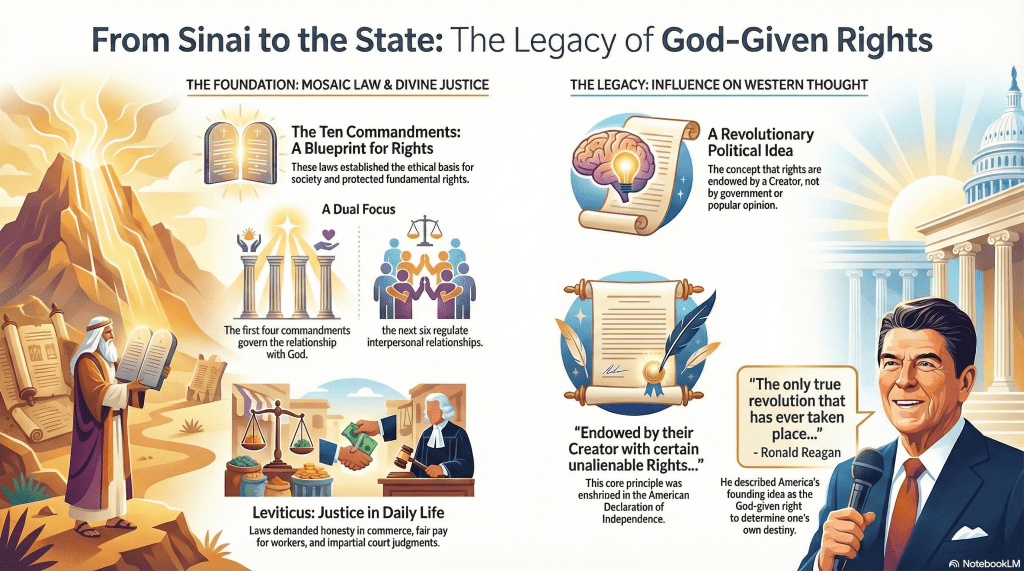
At the heart of the Mosaic law are the Ten Commandments, described in Exodus 20:1-17. Engraved on stone tablets, these commandments form the ethical and moral basis for man’s relationship with God and with his fellow man. The first four (Exodus 20:3-11) emphasize reverence for God, establishing the divine right to be worshipped exclusively. The others (Exodus 20:12-17) regulate interpersonal relationships, establishing children’s obligations towards their parents (“Honor your father and your mother, …” , Exodus 20:12), protecting rights such as life (“You shall not murder“, Exodus 20:13), property (“You shall not steal“, Exodus 20:15), family honor (“You shall not commit adultery“, Exodus 20:14) and truth (“You shall not bear false witness“, Exodus 20:16).
These commandments guarantee fundamental rights: the right to life, security, property and dignity, among others. For example, “You shall not steal” protects property, while “You shall not covet” (Exodus 20:17) promotes contentment by avoiding social conflicts.
It is important to understand how God-given rights guide the formation of a peaceful and prosperous society, reserving for each person what he or she has earned through his or her own merit or inherited from others (property rights), avoiding conflicts arising from envy (a guideline that will be adopted by classical liberals and moderate American conservatives, and rejected by radical leftist movements), as well as seeking to preserve trust between people.
| Values of the Judeo-Christian tradition Dennis Mark Prager (1948) is an American conservative and one of the co-founders of PragerU. In an interview about the values of the Judeo-Christian tradition, he mentioned, among others, the following: “No. 1: There is one God. That God is the God introduced to the world by the Hebrew Bible — the source of one universal morality. No. 2: The Hebrew Bible (the only Bible Jesus knew and which he frequently cited) introduced the most revolutionary moral idea in history: that there are objective moral truths just as there are mathematical and scientific truths. Without God as the source of moral standards, there is no moral truth; there are only moral opinions. No. 3: Because there are moral truths, good and evil are the same for all people. No. 4: God — not man, not government, not popular opinion, not a democratic vote — is the source of our rights. All men “are endowed by their Creator with certain unalienable Rights,” declares the American Declaration of Independence. No. 5: The human being is “created in the image of God.” Therefore, each human life is precious. Therefore, race is of no significance, since we are all created in God’s image and God has no race. (…) No. 7: Man is not basically good. Christians speak of “original sin” in referring to man’s sinful nature; Jews cite God Himself in Genesis: “The will of man’s heart is evil from his youth” (Genesis 8:21). They are not identical beliefs, but they are both worlds apart from the naive Enlightenment belief that man is basically good. And they come to the same conclusion: we need God-based rules to keep us from our natural inclination to do evil. (…) No. 10: Human beings have free will. In the secular world, there is no free will because all human behavior is attributed to biology and environment. Only a religious worldview, because it posits the existence of a divine soul — something independent of biology and environment — allows for free will.” (The full interview can be read at: https://nsjonline.com/article/2023/02/prager-what-are-judeo-christian-values/) |
Leviticus and Justice in Social Relations
While the Ten Commandments offer general principles, Leviticus details their practical application. Leviticus 19:11, 13, and 15 emphasize justice in social and economic interactions. For example:
Leviticus 19:11 (“You shall not steal, nor lie, nor deal falsely with your neighbor“) prohibits dishonesty, guaranteeing the right to mutual trust.
Leviticus 19:13 (“You shall not oppress your neighbor or rob him; the wages of a hired servant shall not remain with you until morning“) protects vulnerable workers, ensuring fair and punctual payment.
Leviticus 19:15 (“You shall not do injustice in judgment, nor show partiality to the poor, nor show partiality to the great. With righteousness you shall judge your neighbor“) demands impartiality, ensuring fair judgments (justice is the same for everyone, rich and poor).
These verses show that divine justice is applicable to everyday, practical life, applied to commerce, work and courts, ensuring equal rights for all.
Other Relevant Texts: Protection of the Vulnerable
Other passages in the Holy Bible expand the concept of justice. Deuteronomy 24:17-18 protects foreigners, orphans, and widows, reminding Israel of its own history of slavery. Exodus 22:21-24 reinforces this protection, with God promising to hear the cries of the oppressed.
Justice as a Reflection of God’s Character
The Mosaic laws reflect God’s character, which is “just and righteous” (Deuteronomy 32:4). Micah 6:8 summarizes God’s mandate: “To do justice, to love mercy, and to walk humbly with God.” Mosaic justice combines ethical rigor with compassion, as in the principle of “an eye for an eye” (Exodus 21:24), which establishes retribution and limits retaliation, and in the laws of restitution (Exodus 22:1-15), which seek reparation and reconciliation.
Contemporary application
The existence of rights given by God, with the State and its laws being below divine law, is a central element of John Locke’s political thought (Second Treatise of Government). It was present at the creation of the United States and is still present today in political speeches and, occasionally, even in the speeches of some justices of the American Supreme Court.
Examples include the American Declaration of Independence (“We hold these truths to be self-evident, that all men are created equal, that they are endowed by their Creator with certain unalienable Rights, that among these are Life, Liberty and the pursuit of Happiness“) and the text “A Nation Under God” by Supreme Court Justice Antonin Scalia (1936-2016), which will be studied in later chapters.
On the other hand, despite the existence of laws that are still applicable today, such as “Thou shalt not kill“, there are anachronistic laws given by God, such as Leviticus 1
| Ronald Reagan and God-given rights Ronald Wilson Reagan (1911-2004) served as the 40th President of the United States of America. In his speech at the National Affairs Briefing on August 22, 1980, in Dallas, Texas, he stated: “Our Founding Fathers, here in this country, brought about the only true revolution that has ever taken place in man’s history. Every other revolution simply exchanged one set of rulers for another set of rulers. But only here did that little band of men so advanced beyond their time that the world has never seen their like since, evolve the idea that you and I have within ourselves the God-given right and the ability to determine our own destiny.” |
Selected excerpts:
Holy Bíble (KJV)
Exodus, 20
20 And God spake all these words, saying,
2 I am the Lord thy God, which have brought thee out of the land of Egypt, out of the house of bondage.
3 Thou shalt have no other gods before me.
4 Thou shalt not make unto thee any graven image, or any likeness of any thing that is in heaven above, or that is in the earth beneath, or that is in the water under the earth.
5 Thou shalt not bow down thyself to them, nor serve them: for I the Lord thy God am a jealous God, visiting the iniquity of the fathers upon the children unto the third and fourth generation of them that hate me;
6 And shewing mercy unto thousands of them that love me, and keep my commandments.
7 Thou shalt not take the name of the Lord thy God in vain; for the Lord will not hold him guiltless that taketh his name in vain.
8 Remember the sabbath day, to keep it holy.
9 Six days shalt thou labour, and do all thy work:
10 But the seventh day is the sabbath of the Lord thy God: in it thou shalt not do any work, thou, nor thy son, nor thy daughter, thy manservant, nor thy maidservant, nor thy cattle, nor thy stranger that is within thy gates:
11 For in six days the Lord made heaven and earth, the sea, and all that in them is, and rested the seventh day: wherefore the Lord blessed the sabbath day, and hallowed it.
12 Honour thy father and thy mother: that thy days may be long upon the land which the Lord thy God giveth thee.
13 Thou shalt not kill.
14 Thou shalt not commit adultery.
15 Thou shalt not steal.
16 Thou shalt not bear false witness against thy neighbour.
17 Thou shalt not covet thy neighbour’s house, thou shalt not covet thy neighbour’s wife, nor his manservant, nor his maidservant, nor his ox, nor his ass, nor any thing that is thy neighbour’s.
18 And all the people saw the thunderings, and the lightnings, and the noise of the trumpet, and the mountain smoking: and when the people saw it, they removed, and stood afar off.
19 And they said unto Moses, Speak thou with us, and we will hear: but let not God speak with us, lest we die.
20 And Moses said unto the people, Fear not: for God is come to prove you, and that his fear may be before your faces, that ye sin not.
21 And the people stood afar off, and Moses drew near unto the thick darkness where God was.
22 And the Lord said unto Moses, Thus thou shalt say unto the children of Israel, Ye have seen that I have talked with you from heaven.
23 Ye shall not make with me gods of silver, neither shall ye make unto you gods of gold.
24 An altar of earth thou shalt make unto me, and shalt sacrifice thereon thy burnt offerings, and thy peace offerings, thy sheep, and thine oxen: in all places where I record my name I will come unto thee, and I will bless thee.
25 And if thou wilt make me an altar of stone, thou shalt not build it of hewn stone: for if thou lift up thy tool upon it, thou hast polluted it.
26 Neither shalt thou go up by steps unto mine altar, that thy nakedness be not discovered thereon.
Leviticus 19
19 And the Lord spake unto Moses, saying,
2 Speak unto all the congregation of the children of Israel, and say unto them, Ye shall be holy: for I the Lord your God am holy.
3 Ye shall fear every man his mother, and his father, and keep my sabbaths: I am the Lord your God.
4 Turn ye not unto idols, nor make to yourselves molten gods: I am the Lord your God.
5 And if ye offer a sacrifice of peace offerings unto the Lord, ye shall offer it at your own will.
6 It shall be eaten the same day ye offer it, and on the morrow: and if ought remain until the third day, it shall be burnt in the fire.
7 And if it be eaten at all on the third day, it is abominable; it shall not be accepted.
8 Therefore every one that eateth it shall bear his iniquity, because he hath profaned the hallowed thing of the Lord: and that soul shall be cut off from among his people.
9 And when ye reap the harvest of your land, thou shalt not wholly reap the corners of thy field, neither shalt thou gather the gleanings of thy harvest.
10 And thou shalt not glean thy vineyard, neither shalt thou gather every grape of thy vineyard; thou shalt leave them for the poor and stranger: I am the Lord your God.
11 Ye shall not steal, neither deal falsely, neither lie one to another.
12 And ye shall not swear by my name falsely, neither shalt thou profane the name of thy God: I am the Lord.
13 Thou shalt not defraud thy neighbour, neither rob him: the wages of him that is hired shall not abide with thee all night until the morning.
14 Thou shalt not curse the deaf, nor put a stumblingblock before the blind, but shalt fear thy God: I am the Lord.
15 Ye shall do no unrighteousness in judgment: thou shalt not respect the person of the poor, nor honor the person of the mighty: but in righteousness shalt thou judge thy neighbour.
16 Thou shalt not go up and down as a talebearer among thy people: neither shalt thou stand against the blood of thy neighbour; I am the Lord.
17 Thou shalt not hate thy brother in thine heart: thou shalt in any wise rebuke thy neighbour, and not suffer sin upon him.
18 Thou shalt not avenge, nor bear any grudge against the children of thy people, but thou shalt love thy neighbour as thyself: I am the Lord.
19 Ye shall keep my statutes. Thou shalt not let thy cattle gender with a diverse kind: thou shalt not sow thy field with mingled seed: neither shall a garment mingled of linen and woollen come upon thee.
20 And whosoever lieth carnally with a woman, that is a bondmaid, betrothed to an husband, and not at all redeemed, nor freedom given her; she shall be scourged; they shall not be put to death, because she was not free.
21 And he shall bring his trespass offering unto the Lord, unto the door of the tabernacle of the congregation, even a ram for a trespass offering.
22 And the priest shall make an atonement for him with the ram of the trespass offering before the Lord for his sin which he hath done: and the sin which he hath done shall be forgiven him.
23 And when ye shall come into the land, and shall have planted all manner of trees for food, then ye shall count the fruit thereof as uncircumcised: three years shall it be as uncircumcised unto you: it shall not be eaten of.
24 But in the fourth year all the fruit thereof shall be holy to praise the Lord withal.
25 And in the fifth year shall ye eat of the fruit thereof, that it may yield unto you the increase thereof: I am the Lord your God.
26 Ye shall not eat any thing with the blood: neither shall ye use enchantment, nor observe times.
27 Ye shall not round the corners of your heads, neither shalt thou mar the corners of thy beard.
28 Ye shall not make any cuttings in your flesh for the dead, nor print any marks upon you: I am the Lord.
29 Do not prostitute thy daughter, to cause her to be a whore; lest the land fall to whoredom, and the land become full of wickedness.
30 Ye shall keep my sabbaths, and reverence my sanctuary: I am the Lord.
31 Regard not them that have familiar spirits, neither seek after wizards, to be defiled by them: I am the Lord your God.
32 Thou shalt rise up before the hoary head, and honour the face of the old man, and fear thy God: I am the Lord.
33 And if a stranger sojourn with thee in your land, ye shall not vex him.
34 But the stranger that dwelleth with you shall be unto you as one born among you, and thou shalt love him as thyself; for ye were strangers in the land of Egypt: I am the Lord your God.
35 Ye shall do no unrighteousness in judgment, in meteyard, in weight, or in measure.
36 Just balances, just weights, a just ephah, and a just hin, shall ye have: I am the Lord your God, which brought you out of the land of Egypt.
37 Therefore shall ye observe all my statutes, and all my judgments, and do them: I am the Lord.
Questions for reflection:
1. Consider the following text from Leviticus 13:1-8:
“13 And the Lord spake unto Moses and Aaron, saying,
2 When a man shall have in the skin of his flesh a rising, a scab, or bright spot, and it be in the skin of his flesh like the plague of leprosy; then he shall be brought unto Aaron the priest, or unto one of his sons the priests:
3 And the priest shall look on the plague in the skin of the flesh: and when the hair in the plague is turned white, and the plague in sight be deeper than the skin of his flesh, it is a plague of leprosy: and the priest shall look on him, and pronounce him unclean.
4 If the bright spot be white in the skin of his flesh, and in sight be not deeper than the skin, and the hair thereof be not turned white; then the priest shall shut up him that hath the plague seven days:
5 And the priest shall look on him the seventh day: and, behold, if the plague in his sight be at a stay, and the plague spread not in the skin; then the priest shall shut him up seven days more:
6 And the priest shall look on him again the seventh day: and, behold, if the plague be somewhat dark, and the plague spread not in the skin, the priest shall pronounce him clean: it is but a scab: and he shall wash his clothes, and be clean.
7 But if the scab spread much abroad in the skin, after that he hath been seen of the priest for his cleansing, he shall be seen of the priest again.
8 And if the priest see that, behold, the scab spreadeth in the skin, then the priest shall pronounce him unclean: it is a leprosy.“
Are such commands of God eternal laws or are they circumstantial commands for that time and circumstance?
2. To what extent do contemporary political systems still depend on transcendent foundations for their legitimacy, even in secular societies? In what political circumstances is the defense of the existence of God-given rights useful, even today?
3. If the existence of God-given rights is admitted, in an essentially Christian country, what would those rights be?
4. What lessons can Moses’ reception of the Ten Commandments offer for understanding the role of religion in modern constitutions?
5. In what ways do the concepts of justice outlined in Mosaic law, such as protections for the vulnerable, parallel or diverge from contemporary social welfare policies in democratic societies?
6. Reflect on the idea of god-given rights as presented through Moses’ teachings—how might this influence current debates on inalienable human rights versus rights granted by governments?
7. If the Mosaic model justified resistance to authorities who contradicted divine principles of justice, how does this relate to contemporary movements of civil disobedience and resistance to authoritarian regimes?
8. How did mosaic concepts of “inalienable” rights conferred by higher authority influence modern founding documents like the American Declaration of Independence?

Leave a comment