
Introduction: Samuel, the Prophet and Judge of Israel
Samuel is a central figure in the Old Testament, a prophet, judge, and priest who led Israel through a period of spiritual and political transition (approximately 1070-1010 B.C.). Dedicated to God from childhood by his mother Hannah (1 Samuel 1:20-28), Samuel grew up in the temple under the tutelage of Eli and was called by God at a young age (1 Samuel 3:1-10). As a judge, he judged with integrity, guided the people spiritually, and promoted obedience to divine law. However, in his old age, the people of Israel demanded a king to rule them, rejecting the theocratic leadership mediated by Samuel (1 Samuel 8:4-5). This chapter examines Samuel’s warning in 1 Samuel 8:10-22 about the dangers of rulers abusing their power.
Figure 4. Samuel anoints David as king. Synagogue of Dura Europo (3rd century)
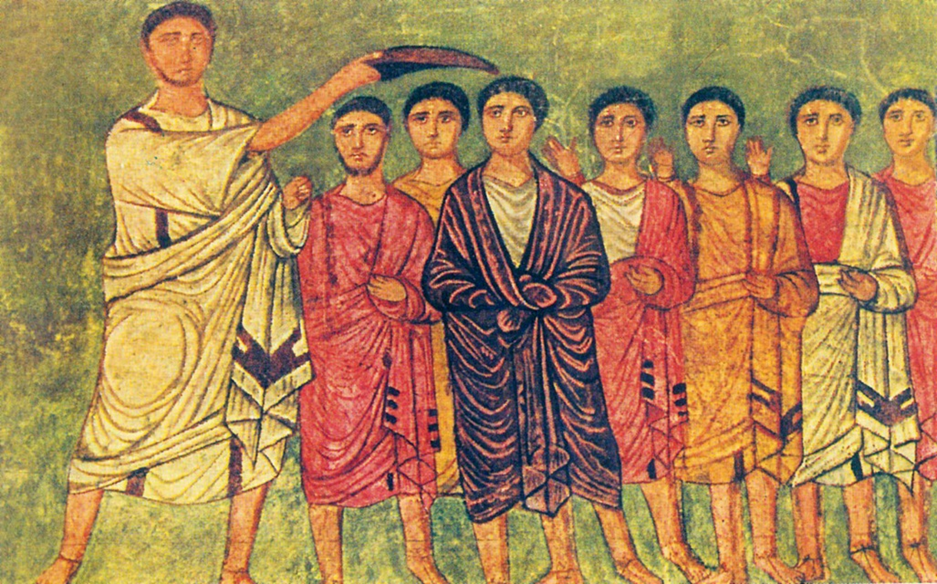
Author: reworked by Marsyas, Public domain, via Wikimedia Commons
Source: https://commons.wikimedia.org/w/index.php?curid=5107843
The Demand for a King and the Divine Warning
In 1 Samuel 8:10-22, Samuel, at God’s command, warns the Israelites of the consequences of having a human king after they insisted on being ruled “like other nations” (1 Samuel 8:5). The people saw a monarchy as a solution to the political instability and corruption of Samuel’s sons, who accepted bribes and perverted justice (1 Samuel 8:3). However, God interpreted this demand as a rejection of His sovereignty (1 Samuel 8:7).
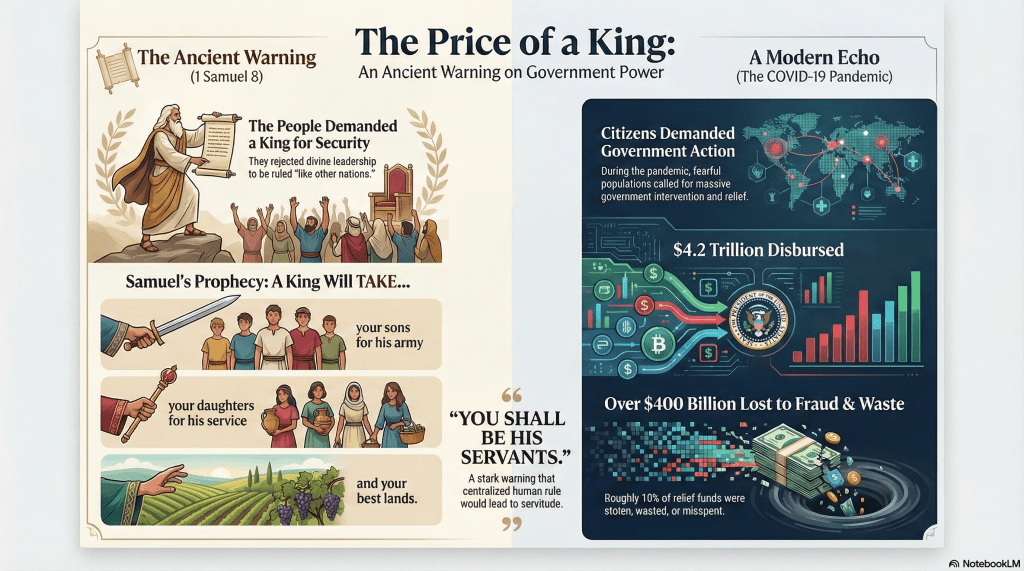
Samuel vividly describes the cost of monarchy: a king would take their sons for his army, their daughters for his service, their lands and crops for his officials, and even their servants and possessions for his personal use (1 Samuel 8:11-17). He warns, “You shall be his servants” (1 Samuel 8:17), and when they cry out to God for relief, “the Lord will not answer you in that day” (1 Samuel 8:18). Despite this, the people persist, saying, “There will be a king over us” (1 Samuel 8:19). This text reveals the human tendency to seek security in earthly leaders, ignoring the risks of centralization of power and the abuses that may arise. On the other hand, there is the divine warning that governments are necessary when the people reject God as their leader (and God should not be confused here with His churches). Or, in other words, a virtuous people does not need government; government is a demand of a people who do not wish to obey God (1 Samuel 8:7).
| Pandemic, calls for more government, abuses of power. During the Covid pandemic, many people demanded government action to protect them from the pandemic (we will see in later chapters that people who are afraid have their capacity for rational analysis reduced and demand more government). In response, the US government implemented extensive economic relief programs to mitigate the economic consequences. The Coronavirus Aid, Relief, and Economic Security (CARES) Act and subsequent measures, including the American Rescue Plan, disbursed more than $4.2 trillion to support businesses, individuals, and state governments. Research suggests that the scale of fraud and waste was substantial, with estimates including: An Associated Press analysis found that fraudsters potentially stole more than $280 billion in COVID-19 relief money, with another $123 billion wasted or misspent, totaling more than $400 billion, or roughly 10 percent of the $4.2 trillion disbursed. The Government Accountability Office has reported that hundreds of billions of dollars were likely lost to fraud, with estimates ranging from tens of billions to potentially more than $100 billion, as noted by Michael Horowitz, noting the difficulty of accurate measurement due to the deceptive nature of fraud. Further reading: https://apnews.com/article/pandemic-fraud-waste-billions-small-business-labor-fb1d9a9eb24857efbe4611344311ae78 https://www.gao.gov/products/gao-25-107746 |
Biblical Principles against the Abuse of Power
In addition to 1 Samuel 8, other biblical texts reinforce the need for just and responsible leaders. Deuteronomy 17:14-20, which regulates the monarchy, instructs that the king must be chosen by God, avoid accumulating wealth and military power, and study divine law in order to rule with humility. This text contrasts with Samuel’s description (1 Samuel 8), highlighting that abuse of power arises when leaders ignore the limits set by God.
The prophet Jeremiah also condemns unjust rulers, saying, “Woe to the shepherds who destroy and scatter the sheep of my pasture!” (Jeremiah 23:1). He exalts leaders who “execute justice and righteousness in the land” (Jeremiah 23:5). These principles show that leadership should be a service to the people, not an opportunity for exploitation.
Conclusion: A Timeless Lesson
Samuel’s warning in 1 Samuel 8:10-22 remains relevant, reminding us of the dangers of abusing power. Leaders who prioritize personal interests or who accumulate authority without accountability tend to oppress, as Samuel warned. Samuel’s life challenges us to seek leaders who reflect divine justice (kings who came to serve) and to resist the temptation to trust blindly in human systems.
Selected excerpt:
Holy Bible, KJV
8 And it came to pass, when Samuel was old, that he made his sons judges over Israel.
2 Now the name of his firstborn was Joel; and the name of his second, Abiah: they were judges in Beersheba.
3 And his sons walked not in his ways, but turned aside after lucre, and took bribes, and perverted judgment.
4 Then all the elders of Israel gathered themselves together, and came to Samuel unto Ramah,
5 And said unto him, Behold, thou art old, and thy sons walk not in thy ways: now make us a king to judge us like all the nations.
6 But the thing displeased Samuel, when they said, Give us a king to judge us. And Samuel prayed unto the Lord.
7 And the Lord said unto Samuel, Hearken unto the voice of the people in all that they say unto thee: for they have not rejected thee, but they have rejected me, that I should not reign over them.
8 According to all the works which they have done since the day that I brought them up out of Egypt even unto this day, wherewith they have forsaken me, and served other gods, so do they also unto thee.
9 Now therefore hearken unto their voice: howbeit yet protest solemnly unto them, and shew them the manner of the king that shall reign over them.
10 And Samuel told all the words of the Lord unto the people that asked of him a king.
11 And he said, This will be the manner of the king that shall reign over you: He will take your sons, and appoint them for himself, for his chariots, and to be his horsemen; and some shall run before his chariots.
12 And he will appoint him captains over thousands, and captains over fifties; and will set them to ear his ground, and to reap his harvest, and to make his instruments of war, and instruments of his chariots.
13 And he will take your daughters to be confectionaries, and to be cooks, and to be bakers.
14 And he will take your fields, and your vineyards, and your oliveyards, even the best of them, and give them to his servants.
15 And he will take the tenth of your seed, and of your vineyards, and give to his officers, and to his servants.
16 And he will take your menservants, and your maidservants, and your goodliest young men, and your asses, and put them to his work.
17 He will take the tenth of your sheep: and ye shall be his servants.
18 And ye shall cry out in that day because of your king which ye shall have chosen you; and the Lord will not hear you in that day.
19 Nevertheless the people refused to obey the voice of Samuel; and they said, Nay; but we will have a king over us;
20 That we also may be like all the nations; and that our king may judge us, and go out before us, and fight our battles.
21 And Samuel heard all the words of the people, and he rehearsed them in the ears of the Lord.
22 And the Lord said to Samuel, Hearken unto their voice, and make them a king. And Samuel said unto the men of Israel, Go ye every man unto his city.
Questions for reflection:
1. Can we trust our government? If so, under what circumstances? If not, what should we do?
2. Is it possible to live in freedom (understood as the possibility of living under a government that taxes little, regulates little and interferes little in people’s lives) without having moral values? Or, to what extent do freedom and responsibility of the people go hand in hand?
3. How can we make the government observe the limits established by God?
4. How does Samuel’s resistance to the popular demand for a king illustrate the contemporary tension between populist demands for “strongmen” and the need to preserve constitutional limitations on executive power?
5. If Samuel warned that kings “will take your sons… your daughters… your fields,” how do these concerns manifest themselves today in debates about state expansion and limitations on property rights?
6. Discuss the biblical principle from Deuteronomy 17 that kings should avoid accumulating wealth and study divine law—how could this inform current efforts to impose term limits or financial disclosure requirements on political leaders?
7. In what ways does the narrative of transitioning from judges to monarchy warn against the erosion of individual liberties under centralized power, and how does this relate to ongoing discussions about federal versus state authority in federated systems like the EU or the U.S.?
8. The text suggests that a virtuous people need no government (or at least less government), arising from the rejection of divine leadership; how might this idea challenge modern libertarian views on minimal government, especially in contexts of moral decay or rising authoritarianism?

Leave a comment