
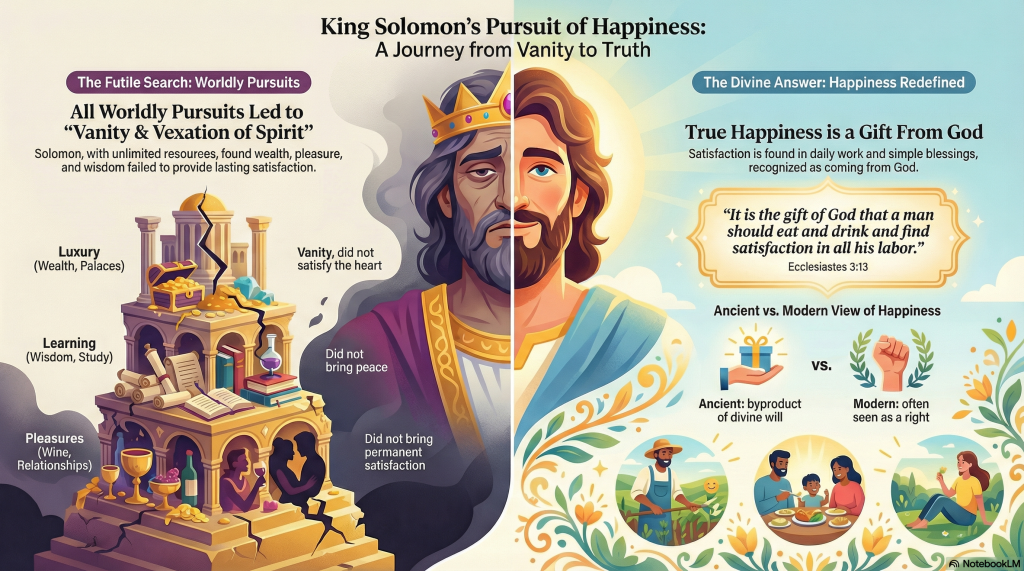
Introduction: Solomon and his pursuit for happiness
Solomon, son of David and third king of Israel, ruled from approximately 990 to 931 B.C., a period of great prosperity. Known for his wisdom (1 Kings 4:29-34) and wealth (1 Kings 10:14-23), he had access to every pleasure and resource. However, in Ecclesiastes, Solomon reflects on his search for meaning and happiness, concluding that life without God is “vanity” (Ecclesiastes 1:2). This search is central to understanding how happiness was perceived in antiquity, an understanding that still resonates in contemporary political thought today.
Figure 5. The Queen of Sheba’s visit to King Solomon.
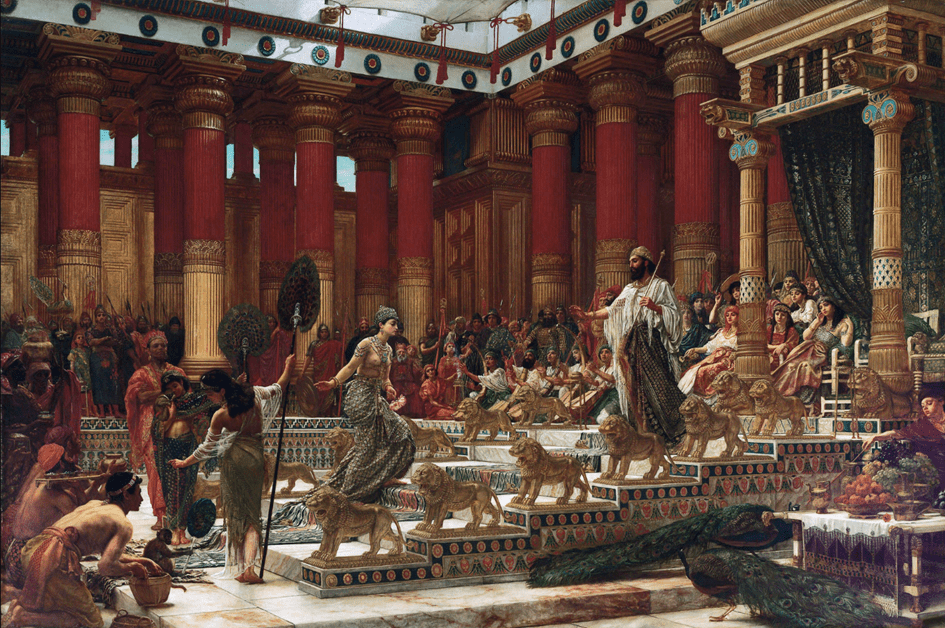
Author: Sir Edward John Poynter (1836 – 1919), Art Gallery of New South Wales, Public domain, via Wikimedia Commons.
Solomon’s Journey: From Vanity to Truth
In Ecclesiastes 2:1-11, Solomon describes his attempts to find happiness through sensual pleasures, building palaces, accumulating wealth and engaging in amusements. He experimented with wisdom, pleasure, work and even fame, but all of these pursuits led to dissatisfaction, being described as “vanity and vexation of spirit” (Ecclesiastes 2:11). This journey reflects an intense quest, typical of a king with unlimited resources, but also reveals the limitation of finding happiness in human achievement. Solomon, despite his privileged position, realised that happiness lay not in conventional markers of success, such as wealth or fame, but in something deeper. He sought satisfaction in luxury, knowledge, pleasures and relationships, but considered all these attempts futile, concluding that existence devoid of divine purpose is marked by ephemerality.
Happiness as a Gift from God
The crucial point is in Ecclesiastes 3:12-13, where Solomon states: “I know that there is nothing better for a man than to rejoice and to do good in his lifetime. And it is the gift of God that a man should eat and drink and find satisfaction in all his labor.” Here, he recognizes that true happiness is not something achieved by human efforts, but a gift from God. Happiness is in finding joy in work and in daily blessings, such as eating, drinking and enjoying, seeing everything as coming from God.
Solomon, in Ecclesiastes 3:12-15, summarizes that the best thing is to be happy, do good and find satisfaction in work, seeing this as a divine gift. This contrasts with the initial pessimism, which turns into optimism when the secular quest is replaced by the theistic one.
Table: Comparison of Solomon’s Quests
| Pursuit | Description | Result | Relevant Verse |
| Luxury | He accumulated riches, built palaces | Vanity, did not satisfy the heart | Ecclesiastes 2:4-11 |
| Learning | Studied nature, sought wisdom | Did not bring peace, insufficient learning | Ecclesiastes 1:17-18 |
| Alcohol | He drank wine, sought temporary pleasure | It did not bring permanent satisfaction | Ecclesiastes 2:3 |
| Relationships | Married 700 wives, 300 concubines | Dissatisfaction, guilt 1 | Kings 11:1-3 |
| Turning to God | Recognized happiness as a divine gift | Peace in fearing and serving God | Ecclesiastes 8:12, 12:13 |
This chart illustrates how each attempt failed, leading Solomon to conclude that happiness lies in the fear of God.
Happiness in Antiquity: A Gift, Not a Right
In ancient times, especially in the biblical context, the pursuit of happiness was not seen as an individual right to pursue one’s own desires. Nor was it a materialistic [1], humanistic [2] ou hedonistic [3] pursuit. Solomon made it clear that seeking these things was meaningless vanity (Ecclesiastes 12).
Instead, happiness is a state of bliss resulting from obedience to God. Texts such as Psalm 1:1-2 describe the happy man as one who delights in the law of the Lord.
Happiness, then, is synonymous with divine blessing. It is not a claim or an end in itself, but a byproduct of living in alignment with divine will. It is a gift that reflects divine goodness amidst the vanity of existence.
Contrast with the Modern View
The “right to pursue happiness“, expressed for example in the American Declaration of Independence, is often interpreted as the freedom to pursue pleasures and possessions, often without moral limits, as an end in itself.
However, the path to happiness is often a tortuous path, like Solomon’s, who first had to try to find happiness in luxury, knowledge, drink and relationships, and only then understood that happiness was fearing God and living with gratitude. It is in order to allow this search for happiness in God that American law guarantees the possibility of the tortuous path of pleasures and riches (such a tortuous path is not an end in itself).
| Laws of England and the pursue happiness Willian Blackstone (1723-1780) was an English jurist and politician. In his Commentaries on the Laws of England he wrotes: “As therefore the creator is a being, not only of infinite power, and wisdom, but also of infinite goodness, he has been pleased so to contrive the constitution and frame of humanity, that we should want no other prompter to inquire after and pursue the rule of right, but only our own self-love, that universal principle of action. For he has so intimately connected, so inseparably interwoven the laws of eternal justice with the happiness of each individual, that the latter cannot be attained but by observing the former; and, if the former be punctually obeyed, it cannot but induce the latter. In consequence of which mutual connection of justice and human felicity, he has not perplexed the law of nature with a multitude of abstracted rules and precepts, referring merely to the fitness or unfitness of things, as some have vainly surmised; but has graciously reduced the rule of obedience to this on one paternal precept, “that man should pursue his own true and substantial happiness”. This is the foundation of what we call ethics, or natural law. For the several articles into which it is branched in our systems, amount to no more than demonstrating, that this or that action tends to man’s real happiness, and therefore very justly concluding that the performance of it is a part of the law of nature; or, on the other hand, that this or that action is destructive of man’s real happiness, and therefore that the law of nature forbids it. This law of nature, being coeval with mankind and dictated by God himself, is of course superior in obligation to any other. It is binding over all the globe in all countries, and at all times: no human laws are of any validity, if contrary to this; an such of them as are valid derive all their force, and all their authority, mediately or immediately, from this original.” The text can be read in full at: https://www.laits.utexas.edu/poltheory/blackstone/cle.int.s02.html |
Key points:
- Solomon’s journey in Ecclesiastes reveals that happiness, far from being a right conquered by human merits, and which is not to be confused with material pleasures or unrestricted autonomy, is a divine gift that emerges from obedience and gratitude.
- Such ideals influenced the modern concept of the pursuit of happiness, established as a God-given right in the American Declaration of Independence, so that each individual, freely and responsibly, can follow his or her path, sometimes tortuous like Solomon’s, towards God.
Selected excerpts
Holy Bible, KJV
Ecclesiastes 1
1 The words of the Preacher, the son of David, king in Jerusalem.
2 Vanity of vanities, saith the Preacher, vanity of vanities; all is vanity.
3 What profit hath a man of all his labour which he taketh under the sun?
4 One generation passeth away, and another generation cometh: but the earth abideth for ever.
5 The sun also ariseth, and the sun goeth down, and hasteth to his place where he arose.
6 The wind goeth toward the south, and turneth about unto the north; it whirleth about continually, and the wind returneth again according to his circuits.
7 All the rivers run into the sea; yet the sea is not full; unto the place from whence the rivers come, thither they return again.
8 All things are full of labour; man cannot utter it: the eye is not satisfied with seeing, nor the ear filled with hearing.
9 The thing that hath been, it is that which shall be; and that which is done is that which shall be done: and there is no new thing under the sun.
10 Is there any thing whereof it may be said, See, this is new? it hath been already of old time, which was before us.
11 There is no remembrance of former things; neither shall there be any remembrance of things that are to come with those that shall come after.
12 I the Preacher was king over Israel in Jerusalem.
13 And I gave my heart to seek and search out by wisdom concerning all things that are done under heaven: this sore travail hath God given to the sons of man to be exercised therewith.
14 I have seen all the works that are done under the sun; and, behold, all is vanity and vexation of spirit.
15 That which is crooked cannot be made straight: and that which is wanting cannot be numbered.
16 I communed with mine own heart, saying, Lo, I am come to great estate, and have gotten more wisdom than all they that have been before me in Jerusalem: yea, my heart had great experience of wisdom and knowledge.
17 And I gave my heart to know wisdom, and to know madness and folly: I perceived that this also is vexation of spirit.
18 For in much wisdom is much grief: and he that increaseth knowledge increaseth sorrow.
Ecclesiastes 2
2 I said in mine heart, Go to now, I will prove thee with mirth, therefore enjoy pleasure: and, behold, this also is vanity.
2 I said of laughter, It is mad: and of mirth, What doeth it?
3 I sought in mine heart to give myself unto wine, yet acquainting mine heart with wisdom; and to lay hold on folly, till I might see what was that good for the sons of men, which they should do under the heaven all the days of their life.
4 I made me great works; I builded me houses; I planted me vineyards:
5 I made me gardens and orchards, and I planted trees in them of all kind of fruits:
6 I made me pools of water, to water therewith the wood that bringeth forth trees:
7 I got me servants and maidens, and had servants born in my house; also I had great possessions of great and small cattle above all that were in Jerusalem before me:
8 I gathered me also silver and gold, and the peculiar treasure of kings and of the provinces: I gat me men singers and women singers, and the delights of the sons of men, as musical instruments, and that of all sorts.
9 So I was great, and increased more than all that were before me in Jerusalem: also my wisdom remained with me.
10 And whatsoever mine eyes desired I kept not from them, I withheld not my heart from any joy; for my heart rejoiced in all my labour: and this was my portion of all my labour.
11 Then I looked on all the works that my hands had wrought, and on the labour that I had laboured to do: and, behold, all was vanity and vexation of spirit, and there was no profit under the sun.
12 And I turned myself to behold wisdom, and madness, and folly: for what can the man do that cometh after the king? even that which hath been already done.
13 Then I saw that wisdom excelleth folly, as far as light excelleth darkness.
14 The wise man’s eyes are in his head; but the fool walketh in darkness: and I myself perceived also that one event happeneth to them all.
15 Then said I in my heart, As it happeneth to the fool, so it happeneth even to me; and why was I then more wise? Then I said in my heart, that this also is vanity.
16 For there is no remembrance of the wise more than of the fool for ever; seeing that which now is in the days to come shall all be forgotten. And how dieth the wise man? as the fool.
17 Therefore I hated life; because the work that is wrought under the sun is grievous unto me: for all is vanity and vexation of spirit.
18 Yea, I hated all my labour which I had taken under the sun: because I should leave it unto the man that shall be after me.
19 And who knoweth whether he shall be a wise man or a fool? yet shall he have rule over all my labour wherein I have laboured, and wherein I have shewed myself wise under the sun. This is also vanity.
20 Therefore I went about to cause my heart to despair of all the labour which I took under the sun.
21 For there is a man whose labour is in wisdom, and in knowledge, and in equity; yet to a man that hath not laboured therein shall he leave it for his portion. This also is vanity and a great evil.
22 For what hath man of all his labour, and of the vexation of his heart, wherein he hath laboured under the sun?
23 For all his days are sorrows, and his travail grief; yea, his heart taketh not rest in the night. This is also vanity.
24 There is nothing better for a man, than that he should eat and drink, and that he should make his soul enjoy good in his labour. This also I saw, that it was from the hand of God.
25 For who can eat, or who else can hasten hereunto, more than I?
26 For God giveth to a man that is good in his sight wisdom, and knowledge, and joy: but to the sinner he giveth travail, to gather and to heap up, that he may give to him that is good before God. This also is vanity and vexation of spirit.
Eclesiastes 3
3 To every thing there is a season, and a time to every purpose under the heaven:
2 A time to be born, and a time to die; a time to plant, and a time to pluck up that which is planted;
3 A time to kill, and a time to heal; a time to break down, and a time to build up;
4 A time to weep, and a time to laugh; a time to mourn, and a time to dance;
5 A time to cast away stones, and a time to gather stones together; a time to embrace, and a time to refrain from embracing;
6 A time to get, and a time to lose; a time to keep, and a time to cast away;
7 A time to rend, and a time to sew; a time to keep silence, and a time to speak;
8 A time to love, and a time to hate; a time of war, and a time of peace.
9 What profit hath he that worketh in that wherein he laboureth?
10 I have seen the travail, which God hath given to the sons of men to be exercised in it.
11 He hath made every thing beautiful in his time: also he hath set the world in their heart, so that no man can find out the work that God maketh from the beginning to the end.
12 I know that there is no good in them, but for a man to rejoice, and to do good in his life.
13 And also that every man should eat and drink, and enjoy the good of all his labour, it is the gift of God.
14 I know that, whatsoever God doeth, it shall be for ever: nothing can be put to it, nor any thing taken from it: and God doeth it, that men should fear before him.
15 That which hath been is now; and that which is to be hath already been; and God requireth that which is past.
16 And moreover I saw under the sun the place of judgment, that wickedness was there; and the place of righteousness, that iniquity was there.
17 I said in mine heart, God shall judge the righteous and the wicked: for there is a time there for every purpose and for every work.
18 I said in mine heart concerning the estate of the sons of men, that God might manifest them, and that they might see that they themselves are beasts.
19 For that which befalleth the sons of men befalleth beasts; even one thing befalleth them: as the one dieth, so dieth the other; yea, they have all one breath; so that a man hath no preeminence above a beast: for all is vanity.
20 All go unto one place; all are of the dust, and all turn to dust again.
21 Who knoweth the spirit of man that goeth upward, and the spirit of the beast that goeth downward to the earth?
22 Wherefore I perceive that there is nothing better, than that a man should rejoice in his own works; for that is his portion: for who shall bring him to see what shall be after him?
Questions for reflection:
1. What is the meaning of the pursuit of happiness referred to in the American Declaration of Independence?
2. If happiness can only be found in God, can the State force people to follow that path?
3. If the path to happiness is often tortuous, to what extent can the State intervene to prevent abuses?
4. In what ways does Solomon’s pursuit of happiness through wealth, pleasures, and achievements—ultimately deemed vanity—parallel contemporary critiques of consumerism and materialism in capitalist societies?
5. How does the theme of “vanity of vanities” in Ecclesiastes challenge the pursuit of endless economic growth in contemporary politics, particularly in debates over sustainable development and environmental policies?
6. In what ways does Solomon’s emphasis on fearing God and keeping commandments as the path to fulfillment relate to ongoing debates about the role of religious values in secular governance, such as in policies on education or social justice?
7. How could Solomon’s critique of hedonistic pursuits apply to contemporary issues like social media addiction or the opioid crisis, and what policy reforms might governments implement to promote more meaningful sources of happiness?
End Notes
[1] Materialism is understood here as the philosophy of life devoted to the acquisition of material goods and values.
[2] Humanism is the philosophy that human beings should seek to give meaning to their own lives.
[3] Hedonism is the philosophy of seeking pleasure, considered the supreme good in life. Hedonê is a goddess in Greek mythology, a symbol of pleasure.


Leave a comment