
Introduction: Sophocles and his Contribution to Literature and Western Thought
Sophocles, born around 497/496 BC in Colonus, near Athens, was one of the most renowned playwrights of Ancient Greece. As one of the three great Athenian tragedians, alongside Aeschylus and Euripides, Sophocles played a fundamental role in the development of Western theater and literature. His life and work reflect the classical period of Athens, an era of great cultural and political transformation. The son of a wealthy family, he received a refined education and participated actively in public life, serving as treasurer and general, as well as being a priest of the god of healing, Asclepius.
Sophocles is credited with significant theatrical innovations, such as the introduction of a third actor in plays, which allowed for greater complexity in narratives and character development. He also increased the number of chorus members from twelve to fifteen and utilized painted sets, enriching the visual experience of the plays. He wrote over 120 tragedies, but only seven survive complete: Ajax, Antigone, Women of Trachis, Oedipus Rex, Electra, Philoctetes, and Oedipus at Colonus. His works are known for exploring profound moral dilemmas, such as the conflict between human duty and divine laws, themes that remain relevant today. Among his most famous plays are the so-called “Theban plays,” which include Antigone and Oedipus Rex. These tragedies address universal questions such as fate, morality, and the tension between human and divine laws, central themes in the discussion of natural rights versus positive law. Sophocles not only dominated the theater of his time, winning 24 of the 30 dramatic competitions he entered, but also left a lasting legacy, profoundly influencing philosophy, ethics, and legal thought throughout the centuries.
Historical and Literary Context
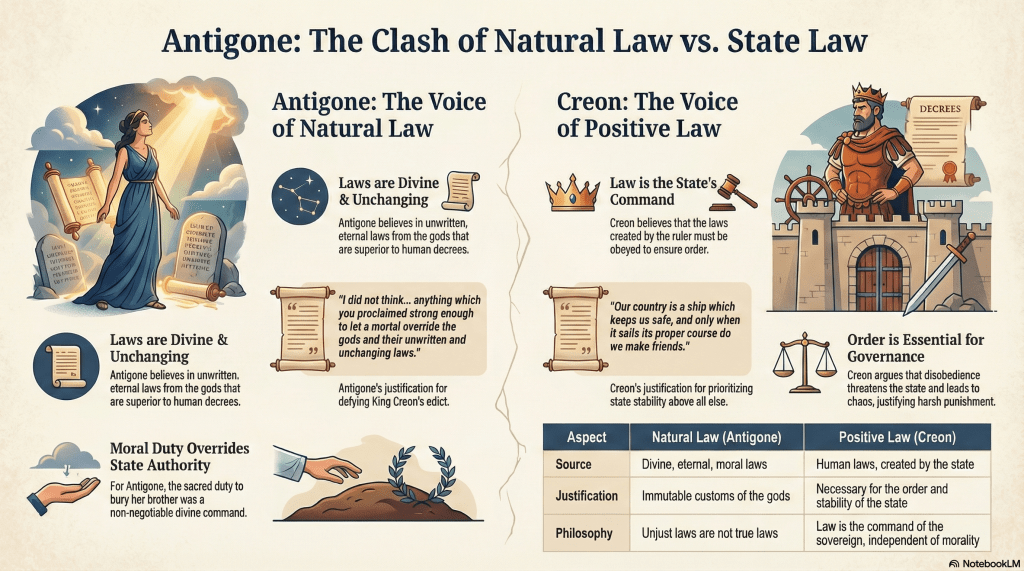
Antigone, written by Sophocles around 441 BC, is a Greek tragedy that explores the tension between moral duty (obedience to divine and eternal laws) and obedience to the laws of the state (created by men and enforced by the state). The play centers on Antigone, who defies the decree of Creon, King of Thebes, prohibiting the burial of her brother Polyneices, labeled a traitor.
The Conflict: Natural Law vs. Positive Law
Natural law, for Antigone, refers to universal laws derived from human nature or divinity, while positive law, defended by positivists, consists of laws created and enforced by human authorities, regardless of their morality. In Antigone, this conflict is dramatized by Antigone’s decision to bury Polyneices, her brother, against the edict of Creon, King of Thebes. Antigone expresses her view in a famous speech (available at johnstoniatexts.x10host.com):
I did not think 510
anything which you proclaimed strong enough
to let a mortal override the gods
and their unwritten and unchanging laws.
They’re not just for today or yesterday,
but exist forever, and no one knows
where they first appeared.
This passage, shows Antigone appealing to eternal, divine laws, which she considers superior to Creon’s human laws.
On the other hand, Creon represents positive law, defending the authority of the state. He argues that his laws are necessary to maintain order:
And a man who thinks
more highly of a friend than of his country,
well, he means nothing to me. Let Zeus know,
the god who always watches everything,
I would not stay silent if I saw disaster 210
moving here against the citizens,
a threat to their security. For anyone
who acts against the state, its enemy,
I’d never make my friend. For I know well
our country is a ship which keeps us safe,
and only when it sails its proper course [190]
do we make friends. These are the principles
I’ll use in order to protect our state.
This view emphasizes obedience to state laws, even if they are morally questionable.
Analysis of the Crucial Dialogue
The dialogue between Antigone and Creon, when he confronts her about her disobedience, is central to understanding the conflict. Creon asks:
And yet you dared to break those very laws?
Antigone responds:
Yes. Zeus did not announce those laws to me. [450]
And Justice living with the gods below
sent no such laws for men. I did not think 510
anything which you proclaimed strong enough
to let a mortal override the gods
and their unwritten and unchanging laws.
They’re not just for today or yesterday,
but exist forever, and no one knows
where they first appeared. So I did not mean
to let a fear of any human will
lead to my punishment among the gods.
I know all too well I’m going to die— [460]
how could I not?—it makes no difference 520
what you decree. And if I have to die
before my time, well, I count that a gain.
When someone has to live the way I do,
surrounded by so many evil things,
how can she fail to find a benefit
in death? And so for me meeting this fate
won’t bring any pain. But if I’d allowed
my own mother’s dead son to just lie there,
an unburied corpse, then I’d feel distress.
What’s going on here does not hurt me at all. 530
If you think what I’m doing now is stupid,
perhaps I’m being charged with foolishness [470]
by someone who’s a fool.
This excerpt clearly illustrates Antigone’s defense of natural rights, placing her moral duty above human laws.
The expression “Justice living with the gods below” refers to the goddess Dike, the personification of Justice in Greek mythology, associated with divine order and eternal laws. In the context of Antigone’s speech, this Justice is on the side of the chthonic gods (the gods and deities of the underworld), including Hades, the god of the underworld. That is, Justice is on the side of the duty to bury the dead. In Greek culture, the burial of the dead was a sacred duty, necessary to ensure the peace of the deceased’s soul and avoid the wrath of the underworld gods.
Figure 6. Antigone condemned to death by Creon (1845).
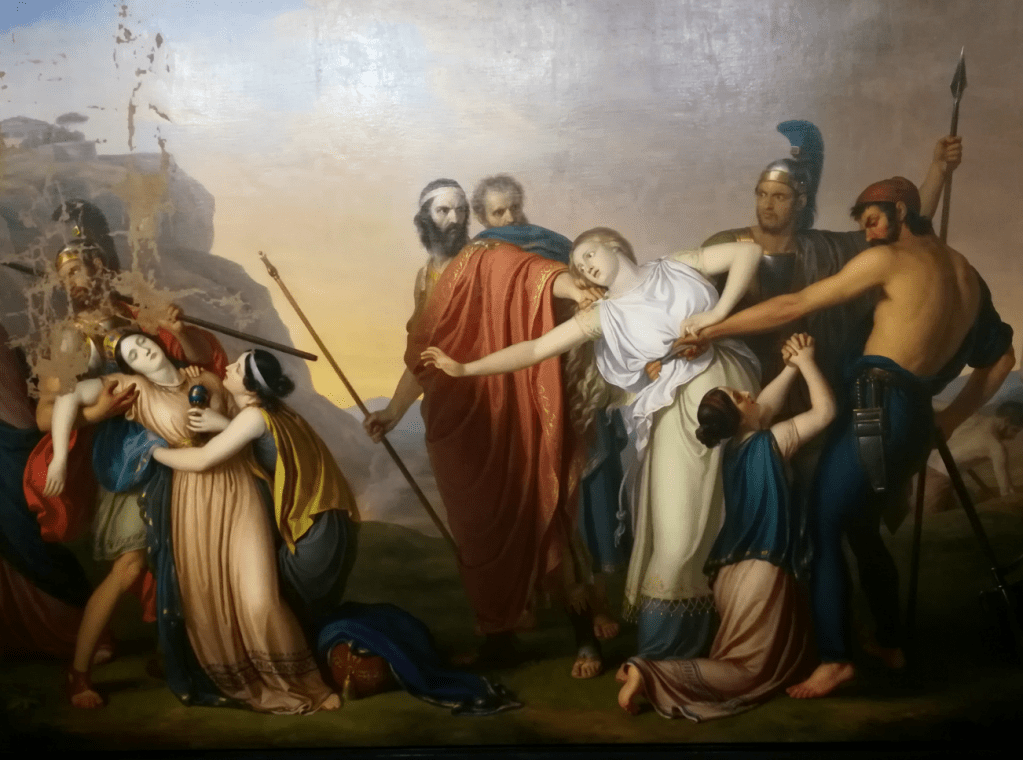
Author: Giuseppe Diotti
Source: https://commons.wikimedia.org/wiki/File:Antigone_condannata_a_morte_da_Creonte.jpg
Creon, in turn, insists on the authority of the state, criticizing Antigone’s insolence:
This girl here was already very insolent [480]
in contravening laws we had proclaimed.
Here she again displays her proud contempt—
having done the act, she now boasts of it.
She laughs at what she’s done. Well, in this case,
if she gets her way and goes unpunished,
then she’s the man here, not me. No. She may be 550
my sister’s child, closer to me by blood
than anyone belonging to my house
who worships Zeus Herkeios in my home,
but she’ll not escape my harshest punishment—
This contrast highlights the clash between individual morality (natural law) and the arrogance of state authority (positive law), which seeks to impose itself even if it violates precepts of justice.
Philosophical and Legal Implications
The conflict in Antigone raises fundamental questions about the legitimacy of laws. Antigone represents natural law, where unjust laws are not true laws. Her response to Creon reflects the view that divine and natural laws precede human laws, a worldview that would be embraced by classical liberals and moderate American conservatives.
On the other hand, Creon embodies positivism, where law is the sovereign’s command, backed by sanctions, and sees the need for order and observance of hierarchy as fundamental to governance. Therefore, Creon condemns Antigone to death for not following his orders, believing that liberality would disturb Thebes, aligning with the statist mentality according to which state order precedes justice (for some statist authors, such as Hans Kelsen, state order is synonymous with justice) and the validity of the law is separate from its moral content.
Modern Relevance
Antigone’s themes remain relevant, especially in times of crisis and violations of rights by the state, usually legitimized by state law itself.
Table: Comparison between Natural Law and Positive Law in Antigone
| Aspect | Natural Law (Antigone) | Positive Law (Creon) |
| Source | Divine, eternal, moral laws; | Human laws, created by the state, imposed |
| Example | Burial of Polynices, by divine duty | Decree prohibiting burial, backed by sanctions |
| Justification | Immutable customs of the gods, alive forever | Seen as necessary for the order and stability of the state |
| Consequence | The duty to bury the dead is condemned by Creon, but has the moral support of the chorus | Death of Antigone and the resulting personal tragedy of Creon (death of Haemon, Eurydice) |
| Philosophical Perspective | Unjust laws are not true laws | Law is the command of the sovereign, independent of morality |
| Our Freedoms Came from God Tulsi Gabbard (1981), a former U.S. Army Reserve officer, is an American politician. In a 2022 speech, she stated: “Our freedom comes from God—not from any other person or government. To recognize others as God’s children is to recognize that we belong to God—and no one else. Therefore, no one has the right to take away the intrinsic freedom God has given us.” Watch the full speech at: https://youtu.be/EOJB_IUB5ko |
Conclusion
Antigone, a wonderful play by Sophocles, offers a profound exploration of the conflict between natural rights and positive law. Through the dialogue between Antigone and Creon, but not limited to it, the play dramatizes the struggle between moral duty and legal obligation, with Antigone defending divine laws and Creon insisting on state authority. This tension continues to resonate, challenging us to reflect on opposing political mindsets: one that recognizes God-given rights and natural rights as antecedents of positive rights and therefore cannot be taken away by the state, as opposed to statist political mindsets that see the state as the sole creator of rights and to which all must submit.
Selected Text
SOPHOCLES. ANTIGONE. Translated by Ian Johnston Vancouver Island University Nanaimo, British Columbia, Canada. 2005. http://johnstoniatexts.x10host.com/sophocles/antigonehtml.html
[Exit the Guard. Creon turns to interrogate Antigone.]
Tell me briefly—not in some lengthy speech—
were you aware there was a proclamation
forbidding what you did?
ANTIGONE
I’d heard of it.
How could I not? It was public knowledge.
CREON
And yet you dared to break those very laws?
ANTIGONE
Yes. Zeus did not announce those laws to me. [450]
And Justice living with the gods below
sent no such laws for men. I did not think 510
anything which you proclaimed strong enough
to let a mortal override the gods
and their unwritten and unchanging laws.
They’re not just for today or yesterday,
but exist forever, and no one knows
where they first appeared. So I did not mean
to let a fear of any human will
lead to my punishment among the gods.
I know all too well I’m going to die— [460]
how could I not?—it makes no difference 520
what you decree. And if I have to die
before my time, well, I count that a gain.
When someone has to live the way I do,
surrounded by so many evil things,
how can she fail to find a benefit
in death? And so for me meeting this fate
won’t bring any pain. But if I’d allowed
my own mother’s dead son to just lie there,
an unburied corpse, then I’d feel distress.
What’s going on here does not hurt me at all. 530
If you think what I’m doing now is stupid,
perhaps I’m being charged with foolishness [470]
by someone who’s a fool.
CHORUS LEADER
It’s clear enough
the spirit in this girl is passionate—
her father was the same. She has no sense
of compromise in times of trouble.
CREON [to the Chorus Leader]
But you should know the most obdurate wills
are those most prone to break. The strongest iron
tempered in the fire to make it really hard—
that’s the kind you see most often shatter. 540
I’m well aware the most tempestuous horses
are tamed by one small bit. Pride has no place
in anyone who is his neighbour’s slave.
This girl here was already very insolent [480]
in contravening laws we had proclaimed.
Here she again displays her proud contempt—
having done the act, she now boasts of it.
She laughs at what she’s done. Well, in this case,
if she gets her way and goes unpunished,
then she’s the man here, not me. No. She may be 550
my sister’s child, closer to me by blood
than anyone belonging to my house
who worships Zeus Herkeios in my home,
but she’ll not escape my harshest punishment—
her sister, too, whom I accuse as well.(4)
She had an equal part in all their plans [490]
to do this burial. Go summon her here.
I saw her just now inside the palace,
her mind out of control, some kind of fit.
[Exit attendants into the palace to fetch Ismene.]
When people hatch their mischief in the dark 560
their minds often convict them in advance,
betraying their treachery. How I despise
a person caught committing evil acts
who then desires to glorify the crime.
ANTIGONE
Take me and kill me—what more do you want?
CREON
Me? Nothing. With that I have everything.
ANTIGONE
Then why delay? There’s nothing in your words
that I enjoy—may that always be the case! [500]
And what I say displeases you as much.
But where could I gain greater glory 570
than setting my own brother in his grave?
All those here would confirm this pleases them
if their lips weren’t sealed by fear—being king,
which offers all sorts of various benefits,
means you can talk and act just as you wish.
CREON
In all of Thebes, you’re the only one
who looks at things that way.
ANTIGONE
They share my views,
but they keep their mouths shut just for you.
CREON
These views of yours—so different from the rest—
don’t they bring you any sense of shame? 580 [510]
ANTIGONE
No—there’s nothing shameful in honouring
my mother’s children.
CREON
You had a brother
killed fighting for the other side.
ANTIGONE
Yes—from the same mother and father, too.
CREON
Why then give tributes which insult his name?
ANTIGONE
But his dead corpse won’t back up what you say.
CREON
Yes, he will, if you give equal honours
to a wicked man.
ANTIGONE
But the one who died
was not some slave—it was his own brother.
CREON
Who was destroying this land—the other one 590
went to his death defending it.
ANTIGONE
That may be,
but Hades still desires equal rites for both.(5)
(5) Hades, a brother of Zeus, is god of the underworld, lord of the dead
CREON
A good man does not wish what we give him [520]
to be the same an evil man receives.
ANTIGONE
Who knows? In the world below perhaps
such actions are no crime.
CREON
An enemy
can never be a friend, not even in death.
ANTIGONE
But my nature is to love. I cannot hate.
CREON
Then go down to the dead. If you must love,
love them. No woman’s going to govern me— 600
no, no—not while I’m still alive.
Questions for reflection:
1. In a country where everything is regulated by the State, what is the use of defending the existence of natural rights?
2. Under what circumstances does positive law become abusive, and how can its abuse be limited?
3. Can natural law be used as an instrument of resistance to state despotism? Given that civil disobedience movements from Gandhi to Martin Luther King Jr. have been inspired by Antigone, what criteria should determine when peaceful resistance to laws is morally justifiable?
4. Is a thesis in a lawsuit based on natural rights legal? If not, should it be? Under what circumstances?
5. How does Antigone’s appeal to “unwritten and unchanging laws” of the gods challenge the authority of state decrees, and what implications does this have for contemporary debates on whether governments can override universal human rights in the name of national security?
6. Reflect on Creon’s justification for his edict by emphasizing the state’s role as a “ship which keeps us safe”—in what ways might this mirror modern political rhetoric around emergency powers or anti-terrorism laws that prioritize order over individual freedoms?
7. The page highlights the moral support Antigone receives from the chorus—how might this reflect the role of public opinion in upholding natural justice, and how does it relate to social media-driven movements challenging government overreach today?
8. The box “Our Freedoms Came from God” connects Antigone’s themes to Tulsi Gabbard’s speech on God-given freedoms—how might this perspective influence current political discussions on religious liberty versus state mandates, like vaccine requirements or censorship policies?
9. If Antigone represents the “foundational text of civil disobedience” that still inspires resistance movements, how should democratic societies balance public order with the right to conscious dissent?


Leave a comment