
Introduction
Antonio Gramsci (1891–1937) was an Italian Marxist philosopher, journalist, and political leader who co-founded theItalian Communist Party. Imprisoned by Benito Mussolini’s Fascist regime from 1926 until his death, Gramsci produced his most influential work in the Prison Notebooks, a series of writings smuggled out of prison.
Figure 21. Antonio Gramsci
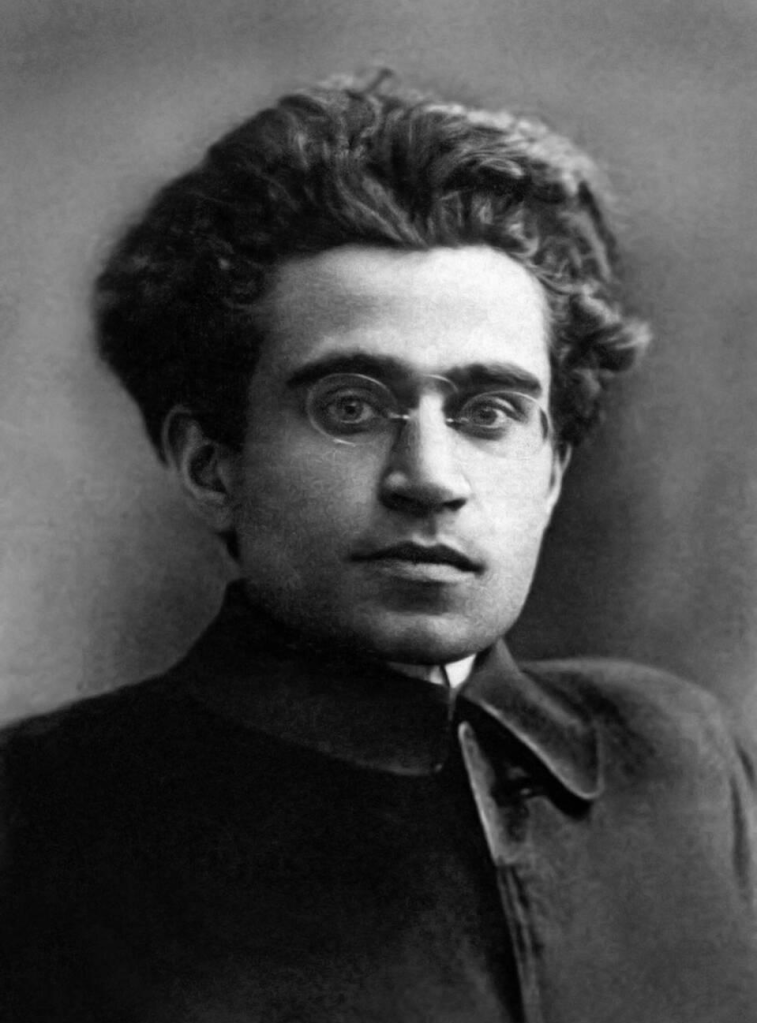
Source: https://commons.wikimedia.org/wiki/File:Gramsci.png
Gramsci’s Break with Traditional Marxism and Revolutionary Strategy
A common characteristic of Marxists is that they all know that Marx was wrong in his theories and predictions, but (even if they disagree on the points of error) they try to save socialism, either by correcting Marx’s theses or by seeking alternative paths to socialism.
Gramsci diverged from Marx, who emphasized economic contradictions (e.g., class conflict driven by capitalist crises) that would lead to a proletarian revolution through the seizure of the means of production. In contrast, he observed that, in Western capitalist democracies, strong civil societies and cultural institutions protected against such upheavals, as seen in the failure of communist revolutions outside Russia after World War I.
To address this, he proposed a two-pronged strategy:
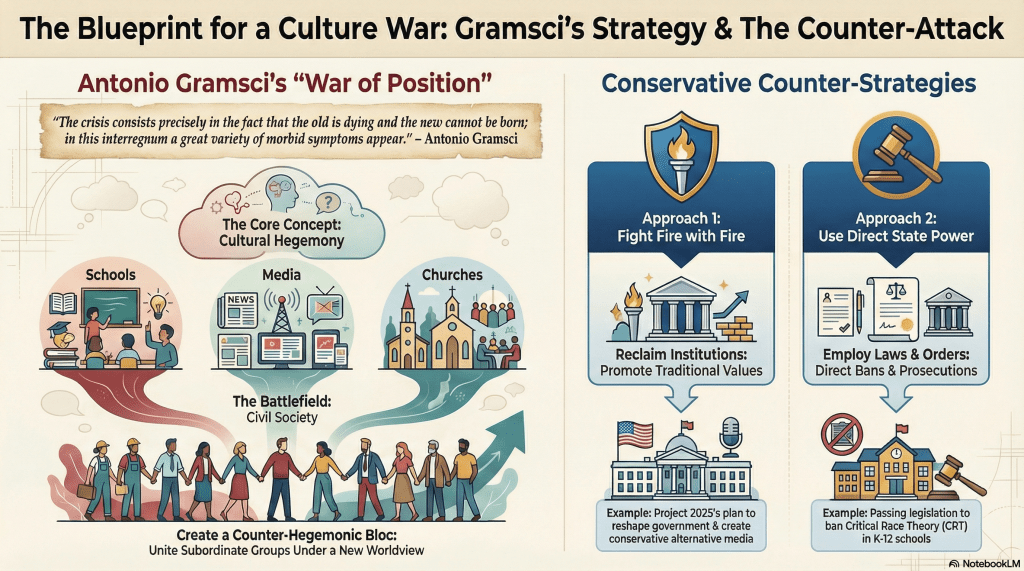
- War of Position: a gradual, long-term cultural and intellectual battle to erode what he called “bourgeois hegemony” (the cultural hegemony of the bourgeoisie). This involves infiltrating and transforming the institutions of civil society to build a “proletarian culture,” raise “class consciousness,” and create a “counter-hegemonic bloc.” It is similar to trench warfare: patient, positional gains through education, media, and ideology.
- Maneuver warfare: The most direct and violent phase of revolution (like the Bolshevik model), which should only occur after the conquest of cultural dominance to ensure broad support and sustainability.
This shift prioritized culture over pure economics, arguing that true revolution requires, first and foremost, the winning of hearts and minds. The revolutionary party, which Gramsci compared to Machiavelli’s “Modern Prince,” would act as a collective organizer, awakening a “national-popular” will that transcends petty class interests.
Cultural Hegemony: Gramsci’s Core Concept
Gramsci introduced the idea of cultural hegemony to explain how ruling classes in advanced capitalist societies maintain power not just through coercion (e.g., police or military force) but primarily through ideological and cultural means. He argued that the dominant class shapes society’s beliefs, values, norms, perceptions, and common sense to make their worldview appear natural, inevitable, and beneficial to all. This creates a form of “consensual domination,” where subordinate classes (like the working class or proletariat) accept the status quo as legitimate, even when it perpetuates inequality.
Key elements of cultural hegemony include:
- Civil society as the battleground: Unlike the state (which Gramsci saw as encompassing both “political society” for coercion and “civil society” for consent), institutions like schools, churches, media, unions, and cultural organizations serve as sites where hegemony is built and reinforced. The ruling class uses these to generate voluntary compliance, forming a “historical bloc” of allied social forces united by shared ideology.
- The role of intellectuals: Gramsci distinguished between “traditional intellectuals” (e.g., academics or clergy tied to past regimes) and “organic intellectuals” (those emerging from a class’s own ranks to articulate its interests). Organic intellectuals from the working class are essential for countering bourgeois hegemony by developing alternative worldviews and fostering “good sense” (critical thinking) out of fragmented “common sense” (everyday, often passive beliefs).
- Philosophy of praxis: Gramsci viewed Marxism not as a rigid doctrine but as a “philosophy of praxis”—a dynamic union of thought and action rooted in historical materialism. This humanistic approach rejected economic determinism, stressing that history is made by human agency through cultural and ideological struggles.
| The “War of Position” to Erode Traditional Values and Cultures Antonio Gramsci’s concept of the “war of position” describes a prolonged, strategic cultural and ideological battle to undermine traditional values and cultures (which he calls Bourgeois Hegemony). Unlike a “war of manoeuvre” (direct confrontation, like a revolution), this involves gradual infiltration and transformation of civil society (e.g., education, media, religion, unions, and cultural organizations) to build proletarian culture, raise class consciousness, and form a counter-hegemonic bloc. This bloc is an alliance of socialist forces (socialist workers, intellectuals, marginalized groups) united under a new, alternative worldview that challenges capitalism’s legitimacy. The process works through patient, incremental steps: identifying weaknesses in hegemonic structures, inserting counter-ideas, educating and organizing subordinates, and expanding influence until the dominant ideology crumbles, paving the way for systemic change. It’s akin to siege warfare—surrounding and weakening a fortress over time rather than storming it. 1. Infiltrating Civil Society’s Institutions The first step is gaining footholds in key institutions that propagate traditional values and culture, then subtly reshaping them to introduce alternative perspectives. This erodes consent for the status quo by exposing contradictions and promoting socialists viewpoints without immediate confrontation. – Modern Example: Progressive Academia in the U.S.: Since the 1960s, left-wing intellectuals have entered universities (a pillar of civil society) and indoctrinated students about “capitalist hegemony” through fields such as cultural studies and critical theory. For example, programs inspired by Gramsci and the Frankfurt School teach about systemic inequality, influencing curricula on race, gender, and class. This “long march through the institutions” (a phrase echoing Gramsci) has produced generations of activists who question traditional norms and values such as meritocracy, as seen in university movements for diversity and equity. 2. Building Communist Culture Once inside institutions, the focus shifts to creating and disseminating a communist culture (which he calls proletarian culture)—art, media, and norms that celebrate collective struggle, equality, and resistance, countering individualism, free market defense, traditional values, religion and conservatism. – Modern Example: Landless Workers’ Movement (MST) Educational and Cultural Programs: The MST, Brazil’s largest social movement, builds communist culture through ideological indoctrination in settlements. Inspired by Gramsci and Paulo Freire, they celebrate peasant identity and criticize agribusiness exploitation. These efforts indoctrinate settlers in “class consciousness” and foster a “counter-hegemonic” (communist) worldview among rural settlers.. 3. Raising Class Consciousness Through infiltrated institutions and new cultural forms, efforts are aimed at indoctrinating subordinates about their exploitation, transforming traditional values and cultures (which he calls “common sense”) into passive acceptance of communist theories labeled as critical thinking, advocating expropriation of property and revolution (which he calls active “common sense”). – Historical Example: Post-WWII Italian Communist Party (PCI): The PCI, influenced by Gramsci, infiltrated the media, schools, and unions to indoctrinate workers in Marxist ideas through party newspapers, film clubs, and adult education programs. – Modern Example: Black Lives Matter (BLM) Movement: Activists have infiltrated social media, education, and community organizations to denounce “racial and economic exploitation.” Using platforms like Twitter (now X) for agitation, workshops on “systemic racism,” and cultural productions, BLM indoctrinates “class consciousness,” linking police violence to capitalist inequalities. 4. Creating a Counter-Hegemonic Bloc The culmination is forging alliances across classes and groups under proletarian leadership, creating a “historical bloc” that presents a unified alternative to “bourgeois rule”, making revolution feasible. – Historical Example: Bolshevik Strategy in Russia (Pre-1917): Lenin, whom Gramsci admired, built a counter-bloc by allying workers, peasants, and intellectuals through infiltrated institutions like soviets and underground press. This war of position (combined with manoeuvre) eroded Tsarist hegemony by uniting diverse forces around a “national-popular” will for socialism. – Modern Example: Global “Climate Justice” Movements: Groups like Extinction Rebellion and Fridays for Future infiltrate NGOs, schools, and the media to build a counter-block against “capitalist” environmental destruction. By aligning workers, indigenous peoples, scientists, and young people through cultural campaigns, they indoctrinate about “ecological exploitation” (whatever that means) tied to “bourgeois interests,” forming a broad alliance for systemic change. |
Gramsci’s Mirroring in the Catholic Church
Gramsci viewed the Church not merely as a religious institution but as a prototype of hegemonic power—an entity that maintained social order through consent, ideology, and organization rather than coercion alone. This analysis profoundly influenced his core ideas, such as cultural hegemony, the role of intellectuals, common sense versus good sense, and the need for a revolutionary “secular religion” embodied in the communist party. He saw the Church as both an adversary (reinforcing bourgeois dominance) and a model (for its organizational efficacy), which informed his proposals for proletarian counter-strategies in advanced capitalist societies.
- Influence on the Concept of Cultural Hegemony – Gramsci’s observations of the Catholic Church were pivotal in developing his theory of cultural hegemony. He admired the Church’s historical ability to create a unified moral and social order, as seen in primitive Christianity’s revolutionary transformation of ancient societies, which he likened to the potential of communism to forge a new ethical framework. However, he critiqued its modern role in Italy as a conservative force that perpetuated inequality, using rituals, education, and media to generate passive consent among the masses.
- Influence on the Role of Intellectuals – Gramsci’s studies portrayed Church clergy as “traditional intellectuals”—seemingly autonomous figures who, in reality, served to legitimize ruling-class power by mediating ideology to the masses. Priests, in his view, functioned as organic intellectuals of the feudal or bourgeois order, paternalistically portraying the “simple” (common people) as needing guidance, which reinforced subordination. This analysis shaped his distinction between traditional and organic intellectuals, emphasizing the latter’s emergence from the working class to challenge such hierarchies.
- Influence on Common Sense, Good Sense, and Secular Religion – Gramsci saw Catholicism as a source of “common sense”—a fragmented, contradictory worldview blending folklore, superstition, and passive resignation that hindered coherent action against exploitation. The Church’s portrayal of the faithful as “simple” contributed to this, promoting fatalism and obedience. This influenced his idea of transforming common sense into “good sense” through critical philosophy of praxis. He also explored “secular religion” as Marxism’s response—a new, rational worldview overcoming religious secularization without spiritual void.
| Countermeasures to Cultural Marxism Using Its Own Proposals Contemporary conservative thinkers and organizations propose countermeasures that often involve reclaiming institutions, promoting traditional values, and inverting Gramsci’s strategies to build a counter-hegemonic bloc of their own. Below, key proposals, grouped by theme, with examples from authors and organizations. 1. Reclaim and Infiltrate Institutions (Inverting the ‘Long March Through the Institutions’) Conservative strategies frequently mirror Gramsci’s “war of position” by advocating a conservative “long march” to recapture civil society institutions like education, media, and government from perceived leftist dominance. – Project 2025 (2022): The proposals include creating alternative media and think tanks to challenge leftist narratives, cultivating institutional bases in churches for mass support, and developing counternarratives against the advance of socialism. Recommendations include purging 50,000 federal employees in The US federal government, dismantling the Gender Policy Council, removing terms like “gender identity” from policies, dismantling Diversity, Equity, and Inclusion (DEI) initiatives, and treating participation in critical race theory as grounds for dismissal, in order to restore traditional values centered on family, marriage, and religion. – Heritage Foundation Report (2022): The report explicitly counters Gramsci’s institutional infiltration by urging american conservatives to “focus locally” on state and local levels, funding candidates to retake school boards and district attorney offices. It proposes reversing educational takeovers through actions like limiting federal subsidies for higher education, capping university indirect costs, banning mandatory DEI statements, and helping employers de-emphasize bachelor’s degrees as employment proxies to weaken Marxist incubators in academia. – Debates that clash ideas. This debate strategy (of which Charlie Kirk was a leading figure) involves engaging in high-level, often viral, confrontations on university campuses, directly challenging leftist, Marxist, or progressive ideologies through structured debates, question-and-answer sessions, and public speaking events. The goal is to mobilize young conservatives, expose perceived flaws in opponents’ arguments, and promote traditional values such as personal responsibility and free-market principles. But that’s not all. Since radical leftists are averse to honest debate, giving students the opportunity to understand what a debate like this entails changes their thinking. – Brasil Paralelo. Brasil Paralelo’s strategy focuses on the production and distribution of revisionist documentaries, series, and educational content that counter leftist historical narratives in Brazil, such as reinterpreting events like the 1964 military coup or criticizing cultural Marxism, to promote conservative cultural change through media and intellectual discourse. 2. Policy and Legislative Bans on Ideological Practices Emphasizing legal and executive actions to prohibit Gramsci-inspired cultural shifts, such as critical race theory (CRT) or gender ideology, which critics see as tools for eroding bourgeois hegemony. – Heritage Foundation Report (2022): Propose passing state legislation to ban CRT and gender theory in K–12 classrooms, establishing parental rights, and redirecting funding to follow students rather than institutions. At the federal level, the next president should issue executive orders targeting nonprofit status of colleges promoting “racist policies” like segregated graduations or free speech violations. Additionally, protect parental rights by attaching protective legislation to must-pass bills and encouraging lawsuits against unethical “gender-affirming” medical practices. – Dismantling Racial Taxonomy: The report suggests eliminating government racial categories by rescinding US Office of Management and Budget Directive No. 15, disbanding related advisory committees, and refocusing census questions on national descent to undermine grievance-based divisions. 3. Promote Traditional and Religious Values as Ideological Defense Drawing on Christian or conservative worldviews to reinforce “common sense” norms against Gramsci’s emphasis on cultural transformation. – Institute for Faith and Culture (Allen Mashburn, 2023): Mashburn proposes that Christians “gather information to engage a society permeated with ungodliness,” citing Colossians 2:8 to warn against captivity by worldly philosophies and traditions. This implies educational efforts and adherence to biblical principles as a defense, rejecting the infiltration of churches and families by Marxist ideas. – Turning Point USA Faith Resource (2020s): Proclaim “biblical unity in Christ” (Galatians 3:28) to counter splintered identity groups, addressing issues like racism with gospel opportunities while rejecting the elimination of individual accountability, which attributes problems solely to cultural hegemony. This defends against Gramsci by emphasizing personal responsibility and unity over collective grievances. 4. Broader Cultural and Ideological Resistance These involve awareness-raising and counter-cultural building to prevent the “decay” Gramsci allegedly advocated. – Heritage Foundation (2022): Recognize universities and K–12 as “incubators of Marxism” and prosecute the “sexualization of children” through strict legal scrutiny of federal policies, ensuring courts apply the highest standards to protect upbringing rights. – General Conservative Inversion: Inverted simplification of Gramsci into slogans for metapolitics — shaping cultural narratives. These proposals reflect a shift where american conservatives, as in Project 2025, use Gramsci’s tools against perceived leftist hegemony, combining policy, cultural, and religious strategies for long-term defense. |
Key Quotes
On Crisis and Historical Transition
- “The crisis consists precisely in the fact that the old is dying and the new cannot be born; in this interregnum a great variety of morbid symptoms appear.”
On Hegemony and Power
- “Every relationship of hegemony is necessarily an educational relationship.”
- “The ruling class maintains its dominance through a combination of coercion and consent.“
- “Culture is a fundamental aspect of hegemony, as it helps shape the values and beliefs of a society.”
On Intellectuals and Their Role
- “Intellectuals play a crucial role in the creation and legitimation of a ruling ideology.“
On Common Sense, Ideology, and Praxis
- “Economy and ideology. The claim (presented as an essential postulate of historical materialism) that every fluctuation of politics and ideology can be presented and expounded as an immediate expression of the structure, must be contested in theory as primitive infantilism...”
- “Ideology is not simply a false consciousness, but a system of ideas that serves specific social interests.“
On the State, Revolution, and Transformation
- “The state is not simply an instrument of a ruling class, but an arena of conflicting social forces.”
- “Power is not limited to the state but is dispersed throughout society in various forms.”
- “The working class can only achieve liberation through a process of cultural and political transformation.”
| Bezmenov and social subversion Yuri Alexandrovich Bezmenov (1939 1993) was a Soviet journalist, who presents himself as a dissident of the Soviet Union’s intelligence service. Having fled to the United States, he taught about the social manipulation tactics he employed in the service of the USSR. Below are some of his lessons: “My dear friends, I think you are in very big trouble. Whether you believe it or not, YOU ARE AT WAR. And you may lose this war very soon together with all your affluence and freedoms unless you start defending yourselves.” “The main emphasis of the KGB is not in the area of intelligence at all. Only about 15% of time, money, and manpower is spent on espionage and such. The other 85% is a slow process which we call either ideological subversion or active measures … or psychological warfare.” “They are programmed to think and react to certain stimuli in a certain pattern. You can not change their mind even if you expose them to authentic information. Even if you prove that white is white and black is black, you still can not change the basic perception and the logic of behavior.” “As I mentioned before, exposure to true information does not matter anymore. A person who is demoralized is unable to assess true information. The facts tell him nothing. Even if I shower him with information, with authentic proof, with documents and pictures. … he will refuse to believe it… That’s the tragedy of the situation of demoralization.” “[T]he useful idiots, the leftists who are idealistically believing in the beauty of the Soviet socialist or Communist or whatever system, […] They serve a purpose only at the stage of destabilization of a nation. For example, your leftists in the United States: all these professors and all these beautiful civil rights defenders. They are instrumental in the process of the subversion only to destabilize a nation.” |
On the relevance of Gramsci today
Antonio Gramsci’s concepts— such as cultural hegemony, the war of position, and organic intellectuals, which emphasize how power is maintained through cultural and ideological consent, not just coercion—continue to resonate in today’s culture wars. Their relevance today encompasses leftist strategies for social change and conservative countermeasures to perceived cultural shifts.
| Countermeasures to Gramsci’s ideas without using or reversing his strategies Some conservatives not only explicitly reject Gramsci’s concepts, but also see them as threats to be countered through direct, top-down action, such as legislation, prohibitions, and decrees, or by promoting religious and traditional values . Below are some proposals focused on this strategy. 1. Legislative and Executive Bans on “Gramscian” Ideologies in Education and Institutions Some conservatives propose using state authority to prohibit teachings or practices linked to Gramsci’s ideas, such as critical race theory (CRT), gender theory, or Paulo Freire’s critical pedagogy. This involves outright prohibitions rather than subtle cultural changes. Example: – Ban CRT and Gender Theory in K-12 Classrooms: Pass comprehensive legislation to prohibit the implementation of CRT and gender ideology in public schools, establishing parental rights, and enabling the right to school choice by redirecting funding to support students rather than institutions. 2. Legal and Prosecutorial Actions Against Perceived Cultural Marxist Practices Emphasizing court battles and investigations as direct confrontations, these proposals treat Gramsci-inspired movements as criminal or unethical threats to be litigated or probed, bypassing ideological engagement. Examples: – Prosecute the “Sexualization of Children“: Enact state laws prohibiting Medicaid funding for gender transitions on minors and ban such procedures outright, while pushing for federal courts to apply strict scrutiny to policies infringing on parental rights. This frames gender ideology as a medical ethics violation to be legally suppressed. – Fight in the Courts to Reverse Precedents: Invest in litigation through organizations like Judicial Watch or the Alliance Defending Freedom to challenge and overturn court decisions enabling cultural Marxist advances, aiming to establish binding case law that rejects these ideologies without broader cultural warfare. 3. Dismantling Government Structures Supporting “Divisive” Ideologies Proposals to eliminate bureaucratic tools that conservatives link to Gramsci’s emphasis on ideological consent, such as racial classifications, treating them as artificial constructs to be abolished. Example: – Eliminate Racial Taxonomy in Government: Issue an executive order rescinding Office of Management and Budget Directive No. 15 (which standardizes racial data collection) and disband related census committees. This would stop government reinforcement of identity-based divisions. 4. Economic and Regulatory Punishments for Corporate Alignments Using state power to penalize businesses adopting Gramscian-influenced policies, without attempting to build alternative cultural blocs. Example: – Reclassify Social Media as Public Utilities: Legislate to treat platforms as utilities, prohibiting content censorship to offset their role in disseminating cultural Marxist ideas, while supporting private alternatives like Truth Social as market-driven solutions rather than hegemonic projects. These proposals, among others, represent a pragmatic approach that rejects Gramsci’s ideas by leveraging existing power structures for direct suppression, rather than engaging in the cultural or metapolitical strategies he advocated for returning to traditional values and norms. |
Questions for Reflection
1. Is there cultural hegemony in a free society? Is there cultural divergence in socialist societies?
2. Are traditional values and culture the result of a process of constructing cultural hegemony by the bourgeoisie and the Catholic Church, or were they a long learning process in which society learned the truth and how to build a better society, considering the challenges faced in each era?
3. Consider the values expressed in the table “Values of the Judeo-Christian Tradition,” from chapter “II. Moses (13th or 14th century BC): Justice and God-Given Rights,” such as “there are moral truths, good and evil are the same for everyone” or “Man is not basically good.” Are they part of the cultural hegemony of the bourgeoisie and the Catholic Church?
4. In what ways has Cultural Marxism contributed to the rise of cancel culture on social media platforms like Twitter and Instagram?
5. How can Cultural Marxism be seen as a factor in the erosion of traditional family structures amid rising divorce rates and changing gender roles?
6. What connections exist between Cultural Marxism and the spread of misinformation or ideological echo chambers in digital media?
7. How has Cultural Marxism affected freedom of speech debates, particularly in relation to hate speech laws and online censorship?
8. In modern environmental movements, how does Cultural Marxism frame capitalism as a cultural oppressor contributing to climate change?
9. Which strategy for combating cultural Marxism is the most effective?


Leave a comment