
Introduction
Founded in London in 1884, the Fabian Society is Britain’s oldest socialist think tank and a key proponent of democratic socialism and social democracy.
Its name derives from the Roman general Quintus Fabius Maximus, known for his strategy of attrition and delay rather than direct confrontation, symbolizing the society’s commitment to incremental reforms instead of violent revolution.
Early members included intellectuals like George Bernard Shaw, Sidney and Beatrice Webb, Graham Wallas, Ramsay MacDonald, and H.G. Wells, who aimed to permeate existing institutions with socialist ideas through education, research, and policy advocacy.
Figure 24. Fabian Society Logo

Source: https://commons.wikimedia.org/wiki/File:Fabian_Society_logo.png
Broader Historical Proposals of the Society
Through these members, the Fabian Society advanced several ideas that influenced British policy:
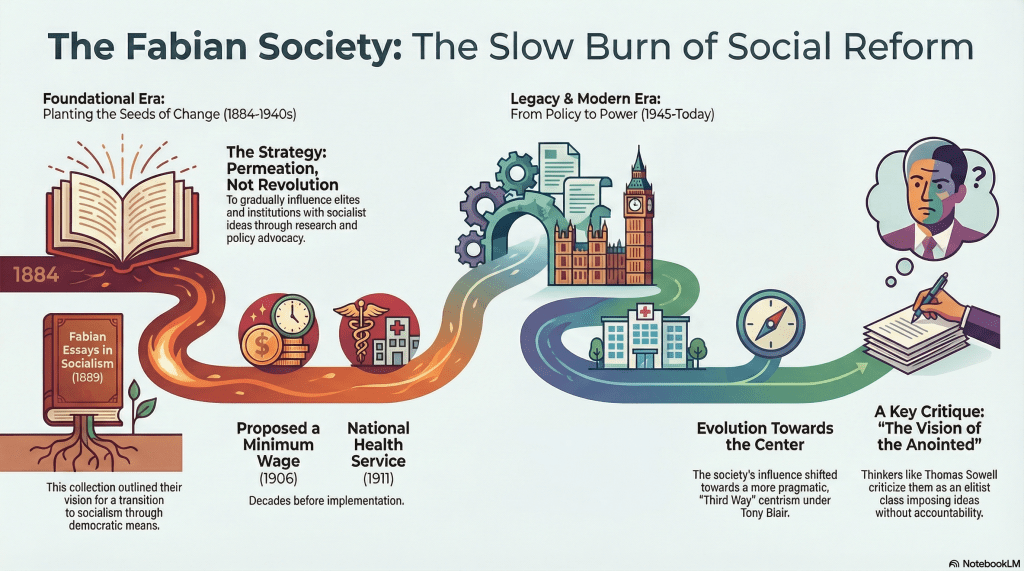
- Minimum Wage: Proposed in 1906 to ensure fair pay and encourage industrial investment over wage suppression.
- National Health Service: Outlined in a 1911 pamphlet, advocating universal healthcare access, which later inspired the NHS in 1948.
- Welfare State Reforms: Ideas from Beatrice Webb’s report and others pushed for social security, influencing the Beveridge Report and post-WWII Labour policies.
- Abolition of Hereditary Peerages: Suggested in 1917 to democratize the House of Lords.
These proposals embodied the society’s “permeation” strategy—gradually influencing elites and institutions rather than revolution—leaving a lasting legacy on democratic socialism.
“Fabian Essays in Socialism”
“Fabian Essays in Socialism” is a seminal 1889 collection of essays edited by George Bernard Shaw and published by the Fabian Society, marking a key moment in the development of democratic socialism in Britain. Written by seven prominent Fabians, the book advocates for gradual, reformist socialism through democratic means, education, and institutional permeation rather than revolutionary upheaval. It sold over 27,000 copies in its first two years, influencing the Labour Party and social democratic policies. The essays collectively outline the economic, historical, industrial, moral, and practical foundations of socialism, proposing transitions from capitalism to a more equitable society. Below, a summary of the essays.Exploration of Each Essay
- The Fabian Society and Its Work by William Clarke: This introductory piece sets the stage by explaining the society’s origins, principles, and activities. Main arguments emphasize gradual reform over revolution, inspired by Roman general Fabius Maximus’s strategy of delay and attrition. Key points include the society’s formation in 1883-1884 from splits in earlier groups like the Democratic Federation, influenced by Henry George’s land reform ideas; its diverse membership of intellectuals; and its methods of lectures, debates, and political permeation. Proposals focus on reorganizing society to emancipate land and capital from private ownership for communal benefit, including adult suffrage, taxation of unearned incomes, municipalization of industries, free education, and an eight-hour workday. Historical context draws from the exhaustion of mid-19th-century Liberalism, realistic literature (e.g., Dickens, Tolstoy), and economic shifts eroding laissez-faire individualism. It concludes by calling for unity between the educated middle class and workers for rational social evolution.
- The Basis of Socialism: Economic by G. Bernard Shaw: Shaw critiques private property and economic rent as sources of inequality. Main arguments highlight how fertile land generates unearned rent for landlords, exploiting tenants and leading to subsistence-level wages for workers. Key points distinguish useful wealth from “illth” (wasteful luxuries), refute Malthusian overpopulation by linking poverty to property systems, and argue capitalism perverts production toward elite indulgences. Proposals include nationalizing land and redistributing rent for public goods like insurance and capital investment, ending unearned incomes. Historical context references economists like Ricardo and Mill, plus colonial experiences showing property’s social harms. It opens with a land cultivation analogy and ends affirming socialism’s economic viability as “meliorism.”
- The Basis of Socialism: Historic by Sidney Webb: Webb traces socialism’s unconscious emergence through historical economic and political shifts. Main arguments posit that public control of services (e.g., utilities, education) already embodies socialist principles, evolving from feudalism through industrial revolution. Key points critique laissez-faire’s failures and highlight municipal mechanisms as precursors to full socialism. Proposals advocate leveraging existing institutions for gradual collectivization, destroying privilege via local governance. Historical context starts from pre-18th-century industry but is criticized (e.g., by William Morris) for ignoring earlier transitions like the 16th-century “Manufacturing Period” per Marx, where land displacement fueled exploitation. It concludes that society is already transitioning, needing conscious direction.
- The Basis of Socialism: Industrial by William Clarke: Clarke examines capitalism’s industrial flaws, focusing on exploitation and inefficiency. Main arguments expose “captains of industry” as contemptuous of the public, with examples from American commerce. Key points include how monopolies and overproduction perpetuate poverty despite technological advances. Proposals imply pushing excesses toward socialist reforms, though not explicit. Historical context draws from contemporary U.S. capitalism as a cautionary tale, influencing British views. Morris praises it as informative but warns against over-reliance on capitalist self-destruction.
- The Basis of Socialism: Moral by Sydney Olivier: Olivier grounds socialism in ethical imperatives. Main arguments frame it as a moral response to capitalism’s injustices, emphasizing human dignity and equality. Key points critique individualism’s selfishness and advocate collective welfare. Proposals focus on moral education to foster socialist values. Historical context ties to philosophical traditions, less tied to opportunism. Morris notes its relative strength in avoiding tactical pitfalls.
- The Organization of Society: Property Under Socialism by Graham Wallas: Wallas discusses property redistribution under socialism. Main arguments sympathize with communism but prioritize transitional social democracy. Key points define socialism as a property-holding system, critiqued by Morris as too mechanical, ignoring broader life aspects. Proposals include collective ownership to eliminate class divides. Historical context reflects debates between anarchism and state socialism. It concludes socialism enables ethical living beyond mere mechanics.
- The Organization of Society: Industry Under Socialism by Annie Besant: Besant envisions restructured industry for equity. Main arguments advocate worker cooperatives and state oversight to end exploitation. Key points stress democratizing workplaces and aligning production with needs. Proposals include nationalizing key industries and shortening workdays. Historical context draws from her labor activism (e.g., Match Girls’ Strike) and theosophical influences.
- Transition by G. Bernard Shaw: Shaw outlines practical steps from capitalism to socialism. Main arguments emphasize gradual reforms via legislation and education. Key points include using taxation and municipal powers to socialize wealth. Proposals: progressive taxes, public services expansion, and electoral reforms. Historical context builds on Victorian reforms, countering Marxist revolution.
- The Outlook by Hubert Bland: Bland assesses socialism’s future prospects. Main arguments predict its inevitability amid capitalism’s crises. Key points highlight political alliances and cultural shifts. Proposals urge permeation of parties and institutions. Historical context reflects late-19th-century optimism, influenced by European movements. It concludes with a call for patient, strategic action.
| Chesterton’s Critique of Fabian Social Reformism Gilbert Keith Chesterton (1874-1936) was an English author and philosopher. A contemporary of the Fabian Society, in his essay “The Drift of Domesticity” (from the book “The Thing”), it explains one of the main problems of social reformism.. “IN the matter of reforming things, as distinct from deforming them, there is one plain and simple principle; a principle which will probably be called a paradox. There exists in such a case a certain institution or law; let us say for the sake of simplicity, a fence or gate erected across a road. The more modern type of reformer goes gaily up to it and says, “I don’t see the use of this; let us clear it away.” To which the more intelligent type of reformer will do well to answer: “If you don’t see the use of it, I certainly won’t let you clear it away. Go away and think. Then, when you can come back and tell me that you do see the use of it, I may allow you to destroy it.” This paradox rests on the most elementary common sense. The gate or fence did not grow there. It was not set up by somnambulists who built it in their sleep. It is highly improbable that it was put there by escaped lunatics who were for some reason loose in the street. Some person had some reason for thinking it would be a good thing for somebody. And until we know what the reason was, we really cannot judge whether the reason was reasonable. It is extremely probable that we have overlooked some whole aspect of the question, if something set up by human beings like ourselves seems to be entirely meaningless and mysterious. There are reformers who get over this difficulty by assuming that all their fathers were fools; but if that be so, we can only say that folly appears to be a hereditary disease. But the truth is that nobody has any business to destroy a social institution until he has really seen it as an historical institution. If he knows how it arose, and what purposes it was supposed to serve, he may really be able to say that they were bad purposes, or that they have since become bad purposes, or that they are purposes which are no longer served. But if he simply stares at the thing as a senseless monstrosity that has somehow sprung up in his path, it is he and not the traditionalist who is suffering from an illusion.” |
“New Fabian Essays”
“New Fabian Essays” is a 1952 collection of eight essays edited by Richard H.S. Crossman, published by Turnstile Press in London and Praeger in the U.S. It serves as a sequel to the original 1889 “Fabian Essays in Socialism,” updating Fabian thought for the post-World War II era. Written in the aftermath of the 1945-1951 Labour government’s defeat, the book reflects on the achievements and limitations of democratic socialism in Britain, emphasizing adaptation to a mixed economy, Cold War realities, and global economic dependencies. The contributors—mostly young Labour intellectuals and politicians—aim to reinvigorate socialist debate, moving away from pre-war dogmas toward pragmatic reforms, welfare state consolidation, and internationalism. It sold modestly but influenced Labour’s revisionist wing, notably through figures like Anthony Crosland, whose ideas foreshadowed his seminal 1956 book “The Future of Socialism.” The collection critiques the Attlee government’s failures in economic planning while defending its welfare advancements, arguing for gradualism amid Britain’s declining imperial power and reliance on U.S. aid.
Key Essays
- Towards a Philosophy of Socialism by R.H.S. Crossman: As the opening essay, Crossman seeks to redefine socialist ideology beyond Marxism, incorporating ethical and democratic elements suited to post-war Britain. Main arguments critique totalitarian socialism (e.g., Soviet model) and advocate a “third way” philosophy blending liberty, equality, and fraternity, influenced by Christian ethics and pluralism. Key points include rejecting class war for consensual reform and addressing moral vacuums in secular socialism. Proposals emphasize revitalizing Labour’s vision through intellectual renewal and neutralism in foreign policy. Historical context reflects disillusionment after Labour’s 1951 defeat, with Crossman (a Labour MP and journalist) urging introspection on why socialism failed to inspire amid economic recovery.
- The Transition from Capitalism by C.A.R. Crosland: Crosland analyzes long-term economic shifts, arguing Britain has entered a “statist” phase—a mixed economy with welfare elements—rather than full socialism. Main arguments posit that capitalism’s evolution (e.g., managerial control over ownership) reduces traditional class conflicts, making revolutionary change unnecessary. Key points highlight Britain’s dependence on U.S. economic stability, predicting American capitalism could persist for decades unless disrupted by war or depression. Proposals include further nationalization only where efficient, prioritizing equality through taxation and social services over ownership. Historical context draws from post-1945 reforms like nationalization, critiquing Labour’s missed opportunities for bolder planning while affirming statism as a transitional step to socialism.
| Lee Kuan Yew on Fabians Lee Kuan Yew (1923 – 2015) was the first prime minister of Singapore from 1959 to 1990. “Speaking of Britain’s post-war Labour Government, Lee said They were going to create a just society for the British workers — the beginning of a welfare state, cheap council housing, free medicine and dental treatment, free spectacles, generous unemployment benefits. Of course, for students from the colonies, like Singapore and Malaya, it was a great attraction as the alternative to communism. We did not see until the 1970s that that was the beginning of big problems contributing to the inevitable decline of the British economy.” (Michael Barr (March 2000). “Lee Kuan Yew’s Fabian Phase”. Australian Journal of Politics & History. 46 (1): 110–26. doi:10.1111/1467-8497.00088.) |
Fabian Society Today
The society’s mission, which still works today, emphasizes creating “the political ideas and policy debates which can shape the future of the left.”
In 2025, it prioritizes issues like health inequalities, employment rights, skills training, poverty reduction, climate adaptation, and regional devolution. It advocates for pragmatic policies within a mixed economy, such as welfare enhancements and progressive taxation, while critiquing both neoliberalism and more radical leftist approaches.
| Fabianos and the amendment to Clause IV of the Labour Party Sir Anthony Charles Lynton Blair (1953-), a well know member of the Fabian Society, was Prime Minister of the United Kingdom (1997 – 2007) and Leader of the Labour Party (1994 – 2007). He played a central role in removing and replacing the Labour Party’s historic Clause IV as part of the party’s modernization in the mid-1990s. After becoming leader in 1994, Blair argued that the old Clause IV — long associated with a commitment to public ownership and the nationalization agenda of earlier Labour politics — was electorally and ideologically out of step with Britain’s contemporary economy and the party’s ambition to broaden its appeal. He made revision of the clause a key leadership objective to signal that Labour accepted a market economy while remaining committed to social justice. The change was enacted in 1995 when the party conference accepted a new formulation to replace the 1918 wording. The re-drafted clause removed the explicit pledge to common ownership and state control of industry, replacing it with language that affirmed the party’s commitment to a strong economy, enterprise and wealth creation alongside social justice, opportunity and co-operation. The new text emphasized using the market where it worked combined with a responsibility to tackle inequality, deliver public services and protect the vulnerable. The effect was both symbolic and practical: symbolically it declared that Labour had moved from a platform of wholesale nationalization toward a social-democratic approach that accepted regulated markets; practically it helped consolidate the “New Labour” project, reassuring centrist voters and many in business while provoking debate and resistance from the party’s traditional left. The Clause IV amendment remains a defining moment in Labour’s ideological realignment and in Blair’s legacy as a moderniser who reoriented the party’s constitutional principles. |
The Fabian Society in the Circular Diagramf of Western Political Mentalities
In the context of the diagram, the Fabian Society’s reformism bridges Democratic Leftists with adjacent groups: it shares democratic values and civil liberties with Classical Liberals (e.g., in supporting market elements within welfare frameworks), while overlapping with Radical Leftists on anti-capitalist goals but rejecting their revolutionary tactics. It stands in opposition to Radical Statists’ authoritarianism and Authoritarian Conservatives’ rigid hierarchies, favoring instead egalitarian policies achieved through electoral and institutional means. Empirically, this is seen in the society’s contributions to gradual socialist advancements, such as the establishment of the London School of Economics (co-founded by Fabians) and its impact on post-World War II welfare states.
Today, it continues as a policy-oriented organization affiliated with the Labour Party, producing research on issues like poverty, healthcare, and economic inequality.
| Intellectuals and Society Thomas Sowell, an American economist and social theorist, critiques the Fabian Society in the context of his broader attack on intellectuals who promote unverified “visions” over empirical realities. In his 2009 book Intellectuals and Society, Sowell portrays Fabians as exemplifying an “elitist managerial class” that favors top-down governance by experts, disconnected from market incentives and ordinary people’s needs. He argues that intellectuals like the early Fabians (e.g., Sidney and Beatrice Webb) embody the “vision of the anointed”—a self-congratulatory belief in their superior wisdom to redesign society, often leading to unintended harmful consequences like economic inefficiency and reduced freedoms. Sowell contrasts this with his “tragic vision,” which sees human nature is inherently flawed, limited, and self-interested, with profound implications for how societies should be structured. Sowell contrasts it with the “unconstrained vision” (or “vision of the anointed”), which assumes human nature is malleable and perfectible through enlightened intervention. The tragic vision emphasizes realism, trade-offs, and the wisdom of evolved institutions over grand utopian schemes, drawing from thinkers like Edmund Burke, Adam Smith, and Friedrich Hayek. Sowell specifically criticizes Fabians for their historical admiration of Soviet planning (e.g., the Webbs’ 1935 book Soviet Communism: A New Civilization?) and eugenics, viewing these as examples of intellectuals’ hubris in social engineering without accountability. He contends that their gradualist socialism prioritizes abstract ideals over practical outcomes, fostering dependency and stifling innovation. Key quotes from Intellectuals and Society and related works illustrating his criticisms: “Intellectuals may like to think of themselves as people who ‘speak truth to power’ but too often they are people who speak lies to gain power.” (Sowell applies this to Fabians, whom he sees as gaining influence through misleading narratives about equality and planning.) “The tests are not unfair. Life is unfair and the tests measure the results.” (Critiquing egalitarian policies like those Fabians advocated, arguing they ignore real-world disparities in favor of imposed outcomes.) “When people get used to preferential treatment, equal treatment seems like discrimination.” (Highlighting how Fabian-style welfare and redistribution can entrench dependency and distort perceptions of fairness.) “A society that puts equality—in the sense of equality of outcome—ahead of freedom will end up with neither equality nor freedom. The use of force to achieve equality will destroy freedom, and the force, introduced for good purposes, will end up in the hands of people who use it to promote their own power.” (Echoing Hayek but applied by Sowell to critique Fabian pursuits of equality through state mechanisms.) “It doesn’t matter how smart you are unless you stop and think.” (Sowell uses this to fault intellectuals like Fabians for not considering the unintended consequences of their policies.) Sowell’s work positions Fabians as part of a broader pattern where intellectuals amplify crises to justify interventions, often at the expense of liberty and economic growth. |
Conclusion
The society played a pivotal role in shaping the British Labour Party, influencing policies on public ownership, welfare, and education in the early 20th century. Its long history reveals a slow, not always consistent, transformation from a gradualist orientation of action in pursuit of socialist ideals to a more pragmatic vision, centrist vision, closer to the Third Way of Tony Blair (who is a member of the society), while remaining closely aligned with the interests of the Labour Party.
Questions for reflection
1. Does Fabian gradualism represent a more effective strategy for lasting social change than revolutionary approaches, considering that society influenced the creation of the British health system and the welfare state?
2. How does the Fabian strategy of “permeation”—infiltrating existing institutions with socialist ideas—compare with the contemporary tactics of political movements seeking transformation through the established system?
3. The founding of the London School of Economics by the Fabian Society in 1895 demonstrates how think tanks and academic institutions can shape long-term public policy – what parallels are there with organizations like the World Economic Forum today? Is it possible to think of institutions in the opposite direction (with a right-wing bias)?
4. Does the persistence of the Fabian Society for over 140 years, adapting from revolutionary socialism to centrist social democracy, suggest that ideological flexibility is essential for long-term political movements, or does it represent a betrayal of the original principles?
5. In what ways does the Fabian Society’s alignment with Tony Blair’s Third Way politics highlight the tensions between radical leftist ideals and pragmatic centrism, and what parallels can be drawn to internal divisions within contemporary leftist parties, such as the Democratic Party’s moderate versus progressive wings?
6. How might Thomas Sowell’s critique of the Fabians as an “elitist managerial class” in “Intellectuals and Society” resonate with contemporary populist criticisms of expert-led governance, particularly in debates over technocratic responses to issues like climate change or economic policy?


Leave a comment