
The circular diagram of Western political mindsets positions “moderate leftism” (also known as “democratic leftism”) as one of six main groups. This group advocates for the redistribution of property and income in the name of social justice, greater economic equality, and democratic governance achieved through gradual reforms rather than revolutions. Broadly speaking, there are three groups within this ideological strand: democratic socialism, social democracy, and the third way.
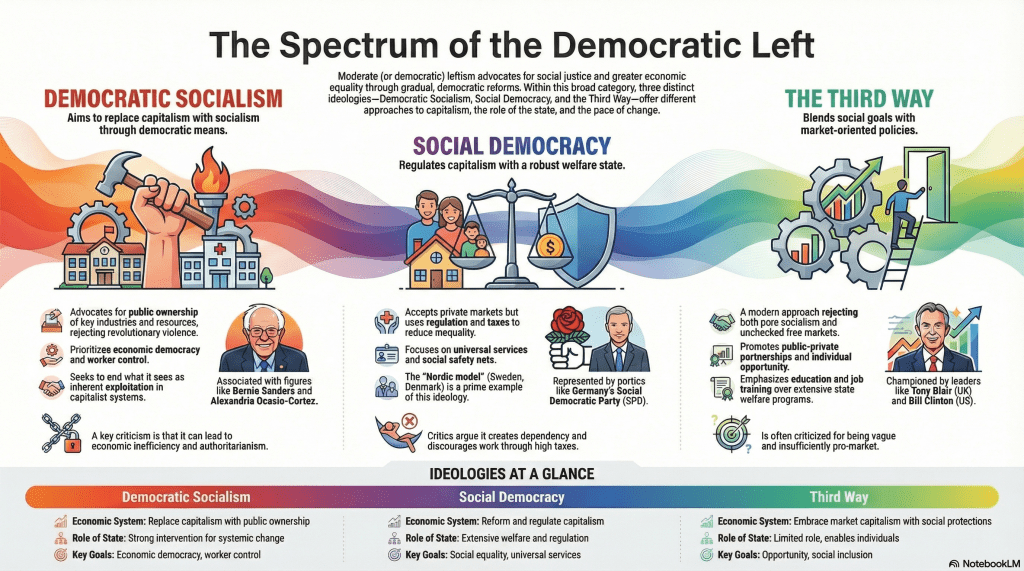
The three ideologies—social democracy, democratic socialism, and the Third Way—represent variations of leftist thought, all emphasizing social justice, economic equality, and democratic governance. They emerged from socialist traditions but differ in their approaches to capitalism, the role of the state, and the pace of reforms. Democratic Socialism seeks a fundamental shift toward collective ownership through democratic means, Social Democracy aims to mitigate the inequalities of capitalism through welfare reforms, and the Third Way modernizes social democracy by integrating market-oriented policies for a globalized world.
Democratic Socialism: Democratic Abolition of Capitalism
The philosophy of democratic socialism advocates a transition from capitalism to a socialist economy—where key industries and resources are publicly owned—using peaceful and democratic processes, such as elections and reforms, rather than violent revolutions. This current criticizes capitalism for being inherently exploitative and prioritizes worker control, universal healthcare, and wealth redistribution, aiming to achieve true equality. However, there is a strong rejection of “Marxism-Leninism” within this philosophy, as it argues that command economies ultimately belong to a small bureaucracy that treats the means of production as private property. What distinguishes democratic socialism is its emphasis on workplace democracy, ensuring that all employees have democratic control or practice self-management. While sharing with radical leftism the goal of reducing inequality, democratic socialism seeks to establish a socialist economy through democratic means, rejecting authoritarian or revolutionary approaches. Thus, there is overlap with radical leftists, but with a clear focus on democratic methods.
Prominent figures include Bernard “Bernie” Sanders (1941-) and Alexandria Ocasio-Cortez (1989 -) in the U.S., with historical roots in thinkers like Karl Marx and modern examples in parties like the UK’s Labour under Jeremy Corbyn.
Hugo Rafael Chávez Frías (1954-2013) have also articulated visions of democratic socialism, though, as expected and always happens with democratic socialists, Chávez’s implementation veered toward authoritarianism in practice.
Key Quotes:
- “What democratic socialism is about is saying that it is immoral and wrong that the top one-tenth of 1 percent in this country own almost 90 percent – almost – own almost as much wealth as the bottom 90 percent.” — Bernie Sanders.
- “Capitalism can not be transcended through capitalism itself; it must be done through socialism, true socialism, with equality and justice. I’m also convinced that it is possible to do it under democracy, but not in the type of democracy being imposed by Washington.” — Hugo Chávez.
| Criticism of Democratic Socialism Democratic socialism is often equated with broader socialism and criticized as a pathway to economic inefficiency, excessive government control, and loss of individual freedoms. Key criticisms include: – It promotes high taxes and wealth redistribution, which stifle economic growth, innovation, and personal incentive by punishing success and rewarding dependency. – It is seen as ideologically akin to authoritarian regimes like Venezuela or the Soviet Union, leading to failed economies, shortages, and erosion of democracy despite claims of being “democratic.” – Policies like universal healthcare and free education are labeled “pure socialism,” opposing capitalist principles and fostering a culture of entitlement over self-reliance. – It undermines private property and market dynamics, potentially resulting in inefficiency and reduced prosperity. |
Social Democracy: Regulated Capitalism and the Welfare State
Social democracy emphasizes building robust welfare states within a capitalist framework, labor rights, progressive taxation, and public services, without fully abolishing private ownership, maintaining democratic institutions and individual freedoms. It accepts market economies but regulates them to reduce inequality and provide social safety nets, as seen in Nordic models like Sweden and Denmark.
Key figures include Eduard Bernstein (1850-1932, who revised Marxism toward reformism) and leaders like Sven Olof Joachim Palme (1927-1986) of Sweden. It’s often associated with post-WWII European policies.
Modern examples include parties like Germany’s Social Democratic Party (SPD)
Key Quotes:
- “Political democracy cannot last unless there lies at the base of it social democracy. What does social democracy mean? It means a way of life which recognizes liberty, equality and fraternity as the principles of life.” — B. R. Ambedkar.
- “Socialism and democracy are not identical, but they are simply different expressions of the same principle; they belong together, supplement each other, and one can never be incompatible with the other. Socialism without democracy is pseudo-socialism, just as democracy without socialism is pseudo-democracy.” — Wilhelm Liebknecht.
| Criticism of Social Democracy Social democracy is criticized for expanding government intervention, generating economic burdens and reducing freedoms. The main criticisms include: – It relies on high taxes and extensive welfare states, which create dependency, discourage work, and burden productive citizens and businesses with unsustainable costs. – Regulations and redistribution hinder free markets, innovation, and entrepreneurship, causing stagnation and making economies less competitive globally. – It is opposed as antithetical to limited government and capitalism, with policies like universal services seen as “pure socialism” that erode individual responsibility. – Despite claims of moderation, it risks backsliding into radical leftism or inefficiency, as government control over the economy conflicts with natural hierarchies and market efficiency. |
Third Way: Left-Center Pragmatism
Emerging in the 1990s as a response to globalization, the Third Way blends social democratic welfare goals with neoliberal elements like deregulation, privatization, and entrepreneurship. It rejects both pure socialism and unchecked markets, promoting “opportunity for all” through education, job training, and public-private partnerships, while emphasizing individual responsibility over extensive state handouts.
Influential figures include Anthony Giddens (1938 – ,theorist), Anthony Charles Lynton Blair (1953 -, UK New Labour), and William Jefferson “Bill” Clinton (1946 – , U.S. “New Democrats”).
In the diagram, it bridges Democratic Leftists and Classical Liberals, as evidenced by examples like Fernando Henrique Cardoso (1931-)’s pro-market social reforms in Brazil.
Key Quotes:
- “The Third Way is about combining social solidarity with a dynamic economy, and that is what we have to do today.” — Tony Blair.
- “The Third Way represents the renewal of social democracy in a world where the views of the old left have become obsolete; while those of the new right are inadequate and contradictory.” — Anthony Giddens, from The Third Way: The Renewal of Social Democracy.
| Criticism of the Third Way The Third Way is criticized as a diluted and ambiguous compromise that still incorporates too much left-wing intervention. Criticisms often highlight: – It is vague and lacks substantive commitments, functioning as a centrist facade that doesn’t truly challenge leftist policies like welfare expansion or regulation. – By blending social justice with markets, it impedes laissez-faire capitalism through bureaucracy, taxes, and government overreach, stifling enterprise and economic freedom. – It leads to ineffective governance and a drift towards an insufficiently pro-market neoliberalism. |
Comparison
The table below compares the three ideologies across key dimensions. They share commitments to democracy and reducing inequality but differ in economic radicalism and policy focus.
| Aspect | Democratic Socialism | Social Democracy | Third Way |
| Economic System | Seeks to replace capitalism with socialism (public ownership of production means). | Reforms and regulates capitalism with welfare states; accepts private markets. | Embraces market capitalism with social protections; promotes globalization and competition. |
| Role of State | Strong state intervention for systemic transformation and equality. | Extensive welfare and regulation, but balanced with markets. | Limited state role; focuses on enabling individuals via partnerships and incentives. |
| Methods of Change | Gradual reforms via democracy; rejects revolution but aims for deep change. | Incremental reforms within existing systems; pragmatic compromises. | Pragmatic, centrist reforms; consensus-building over ideology. |
| Key Goals | Economic democracy, worker control, end to exploitation. | Social equality, full employment, universal services. | Opportunity, social inclusion, economic growth. |
| Historical Examples | U.S. Democratic Socialists of America; UK Labour (Corbyn era); Venezuela’s bolivarianism (Hugo Chávez). | Nordic welfare states (Sweden, Norway); post-WWII UK Labour. | UK under Blair (1997–2007); U.S. under Clinton (1993–2001). |

Leave a comment