
Introduction
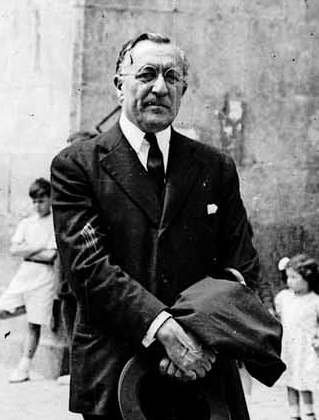
Ramiro de Maeztu y Whitney (1875 –1936), was a prominent political theorist. Born in Vitoria, Spain, to a Basque father and an English mother, he spent part of his childhood in Cuba and was educated in France before returning to Spain in the 1890s. He became a key figure between Spanish intellectuals who grappled with Spain’s national decline following the loss of its colonies in the Spanish-American War of 1898.
Figure: Ramiro de Maeztu y Whitney
Maeztu’s intellectual journey reflected a significant evolution. Early in his career, he was influenced by socialism, modernism, and thinkers like Friedrich Nietzsche, advocating for Spain’s regeneration through cultural and social reform. During his time in London as a correspondent, he shifted toward conservatism, influenced by British pragmatism and wartime experiences.
In his later years, Maeztu embraced Catholicism and traditionalism, becoming a theorist of Spanish nationalism. In works like Authority, Liberty, and Function in the Light of the War (1916), he argued for prioritizing authority and function over individual liberty, proposing a societal structure based on professional hierarchies and trade unions to combat corruption in secular systems. This reflected his belief that human reason alone could not resolve social issues, necessitating authoritative structures to enforce order and the common good.
| The Influence of St. Thomas Aquinas As Maeztu moved closer to integral Catholicism, he adopted Thomistic principles, particularly in his views on the common good, authority, and just rebellion. In Defensa de la Hispanidad, he invoked Aquinas to justify hierarchical order, qualify the limits of tyrannical government (allowing rebellion only in extreme cases), and insist that the well-being of the community takes precedence over individual rights. This Thomistic emphasis on the common good shaped Maeztu’s support for corporatism and a Catholic state in which authority is directed toward divine and communal ends, rather than popular or liberal impulses. |
Defensa de la Hispanidad.
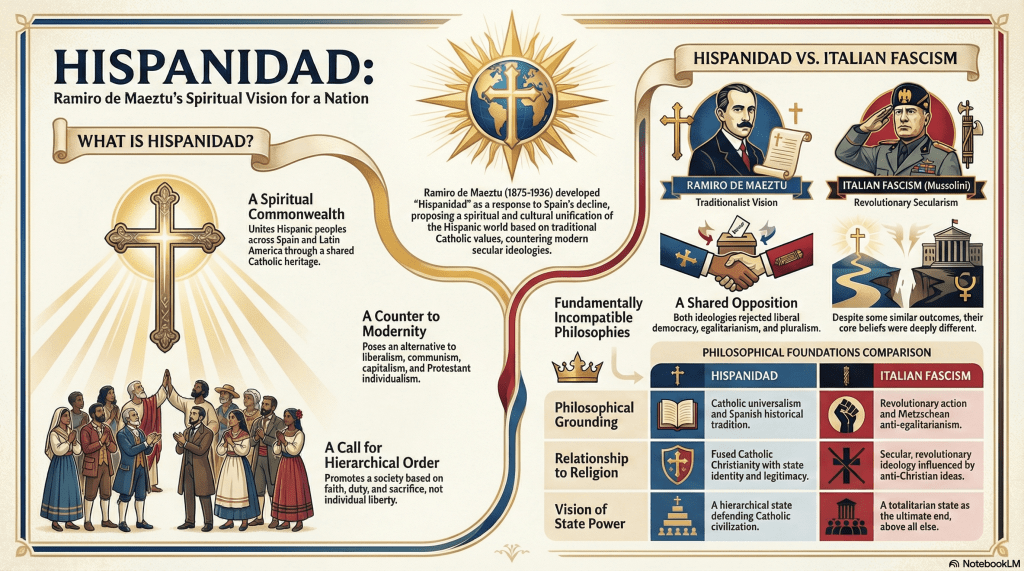
His most influential idea was “Hispanidad,” elaborated in Defensa de la Hispanidad (1934), which promoted the spiritual, cultural, and historical unity of Hispanic peoples across Spain and Latin America, rooted in Roman Catholicism as a counter to liberal democracy, communism, and Protestant individualism.
In Defense of Hispanicity, Maetzu articulates the concept of “Hispanicity” as the spiritual and cultural unity binding Spain and the Hispanic world, including Latin America. Maeztu presents this unity as rooted in the shared Roman Catholic heritage and the historical mission of the Spanish Empire during the 16th century. He argues that Hispanidad represents a counterforce to the materialism of modern ideologies like liberalism, capitalism, communism, and Protestant individualism, which he sees as responsible for the moral and economic decline of Western societies.
The book calls for Spain to reclaim its role as the spiritual leader of this Hispanic community, emphasizing a return to hierarchical, faith-based values to regenerate national and transnational identity. In the text, Maeztu draws on historical examples from the Spanish Golden Age to advocate for a universal mission where Catholicism serves as the foundation for social order and anti-modernist resistance. He envisions Hispanidad as a bulwark against the fragmentation caused by Enlightenment rationalism and industrial progress, promoting instead a communal ethos centered on duty, sacrifice, and divine purpose.
Ultimately, Defensa de la Hispanidad reflects Maeztu’s mature philosophy, blending conservatism with a call for Hispanic peoples to unite in defending their shared legacy against global secular threats.
| A comparison between Italian fascism under Mussolini and Rocco and the authoritarian conservatism of Maeztu. Often accused of being a precursor to fascism, although the authoritarianism of Ramiro de Maeztu and that of Mussolini and Rocco shared a fundamental opposition to liberal democracy, egalitarianism, and pluralistic governance, crucial philosophical and ideological differences ultimately made Maeztu’s structure incompatible with the revolutionary and secular totality of fascism, as the following table shows. | |||
| Aspect | Mussolini | Alfredo Rocco | Ramiro de Maeztu |
| Rejection of Democracy | Explicit and foundational; rejected sovereignty of people expressed through pluralistic Parliament | Systematic destruction of parliamentary system; establishment of absolute executive supremacy | Opposed republican democracy as spiritually corrupted and incapable of defending civilization |
| Opposition to Egalitarianism | Core principle; rejected egalitarianism of socialism in favor of Nietzschean übermensch concept | Rejected egalitarianism as basis for political organization; promoted class collaboration within hierarchical framework | Opposed materialist egalitarianism; promoted hierarchical social organization grounded in spiritual principles |
| Vision of State Power | Totalitarian state as ultimate end; subjugation of minds through propaganda and personality cult | State as instrument of executive authority; corporations subordinate to fascist state will | Centralized hierarchical state defending Catholic civilization and Spanish national unity |
| Role of Elite Leadership | Rule by elite; charismatic duce embodying fascist will; state as ultimate end | Elite drawn from nationalist and fascist constituencies; corporatist representatives selected by regime | Educated moral elites committed to national regeneration; monarchical hierarchy |
| Institutional Framework | National Fascist Party as totalitarian structure; destruction of pluralistic parliament | Corporate state replacing parliamentary system; Chamber of Fasces and Corporations; Acerbo Law establishing regime electoral dominance | Monarchical state; centralized authority defending Catholic values; suppression of regional identities |
| Philosophical Grounding | Revolutionary action; Nietzschean anti-egalitarianism; rejection of liberal rationalism | Constitutional and corporatist theory; rejection of popular sovereignty; state as consultative mechanism testing mass sentiment | Catholic universalism; Spanish historical tradition; spiritual regeneration through political authority |
| Relationship to Religion | Influenced by Nietzsche’s anti-Christian ideas; negation of God; secular revolutionary ideology | Nationalist conservatism; compatibility with Catholic conservatism but not primarily religious | Catholic Christianity as essential to Spanish identity and state legitimacy; fusion of religion and political authority |
| Concept of National Unity | National unity achieved through propaganda, personality cult, and totalitarian mobilization | National unity through corporatist organization subordinating economic interests to fascist state | National unity through Catholic faith and Spanish civilization; Hispanidad as spiritual commonwealth |
| Treatment of Individual Liberty | Subordination of individual to state; rejection of liberal individualism | Individual interests subsumed within corporatist structures controlled by state | Subordination of individual rights to national spiritual mission and hierarchical authority |
| Foreign Policy/Expansion | Spazio vitale (living space) requiring imperial expansion and conquest | Support for nationalist expansion; less explicit than Mussolini on imperial doctrine | Hispanidad as spiritual commonwealth; Latin American cultural leadership; not explicitly imperialist conquest |
| Relationship to Traditionalism | Simultaneously revolutionary and traditionalist; “Third Way” transcending left-right categories | Traditionalist defense of property rights and hierarchical class structures within fascist framework | Explicit traditionalism rooted in Catholic monarchy and Spanish imperial history |
Selected texts
Ramiro de Maeztu. DEFENSA DE LA HISPANIDAD. Translation from the original Spanish by Google Translate.
Past and future
Saturated with foreign readings, we look again with fresh eyes at the work of Hispanidad and can scarcely grasp its grandeur. By discovering the maritime routes of East and West, it forged the physical unity of the world; by establishing at Trent the dogma that assures all people of the possibility of salvation, and therefore of progress, it constituted the necessary unit of measurement for speaking with foundation of the moral unity of humankind.
Consequently, Hispanidad created Universal History, and there is no work in the world, outside of Christianity, comparable to its own. At times it seems to us that after our peoples have served an absolute ideal, it will be impossible for them to be content with the relative ideals of wealth, culture, security, or pleasure with which others are satisfied. And yet, we reject this idea, because an absolutism that excludes the relative and the everyday from its scope will be less absolute than one that manages to include them. The territorial ideal that replaced Catholicism in Hispanic nations also had not only its necessity but also its justification. The people who inhabit each geographical region must be held responsible for its prosperity. But above territorial matters rises the spirit of Hispanidad. Sometimes it is a great poet, like Rubén Darío, who makes us feel it. Sometimes it is an eminent foreigner who tells us, like Mr. Elihu Root, that: “I have had to apply Spanish and Anglo-American laws in territories of former Spanish rule and have observed the irreducible nature of the guiding principles of the legal mentality of both countries.” Sometimes it is purely the threat of independence of one Hispanic nation that stirs the pain of the others.
Then we perceive the spirit of Hispanidad as a light from on high. Disunited, scattered, we realize that freedom has not been, nor can it be, a bond of union. Peoples do not unite in freedom, but in community. Our community is not racial, nor geographical, but spiritual. It is in the spirit that we find both community and the ideal. And it is History that reveals this to us. In a certain sense, it transcends History because it is Catholicism. (…)
Final Summary of the Matter
In short, there are three possible understandings of humanity. The first is that of those who claim to be good, because goodness is somehow linked to divine grace; this is the view of peoples or individuals who attribute to themselves exclusive missions and privileges in the world. This is the aristocratic and particularist position. Then there is the leveling attitude of those who say there are no good or bad people, because absolute morality does not exist and what is good for the bourgeois is bad for the worker, so class differences and borders must be eliminated so that all people are equal. This is the egalitarian and universalist position, but a devaluing one. And finally, there is the ecumenical position of the Hispanic peoples, which tells all of humanity that all people can be good and need only believe in good and do it. This was the Spanish idea of the 16th century. While we were proclaiming it in Trent and fighting for it throughout Europe, Spanish ships were circumnavigating the globe for the first time to announce the good news to the people of Asia, Africa, and the Americas.
And so it can be said that the historical mission of the Hispanic peoples consists of teaching all people on earth that they can be saved if they so desire, and that their elevation depends solely on their faith and their will.
(…)
Human Equality
Our Hispanic sense tells us that any man, however fallen he may be, can rise again; but he can also fall, however high he may seem. In this possibility of falling or rising, all men are equal. It is through this that Ganivet can imagine his “diamond axis” or categorical imperative: “that it may always be said of you that you are a man.” Man is a ship that can always, always, while afloat, right its course. If the crew has neglected it, if its keel, sails, or rigging are in poor condition, it will be more difficult for it to withstand the storms. Righting the course will not be enough to reach port. Success belongs to God. What the navigator can do is change direction. In this metaphysical freedom or free will, all men are equal. But this is the only equality that is compatible with freedom. Political freedom fosters the development of inequalities. And in vain will the supposed right to equality be proclaimed in some Constitutions, such as the French Constitution of 1793, affirming that: “All men are equal by nature and before the law.” To say that men are equal is as absurd as proclaiming that the leaves of a tree are equal. No two are alike. And equality before the law has, and can have, no other meaning than that the law must protect all citizens in the same way.
If it has this meaning, it is because men are equal with respect to their metaphysical freedom, or capacity for conversion or fall. This is what makes them subjects of morality and law. If they were incapable of falling, morality would have no need to tell them anything. If they were incapable of conversion, it would be useless to tell them everything. The validity of morality depends on men’s ability to change course. This condition of human nature is what has also made law possible and necessary. There would be no laws if people could not obey them. They are imperative because people can equally choose not to obey them. And they are universal because in this capacity to obey them, all people are equal. Proclaiming the capacity for human conversion does not mean that people can go very far on the new path they choose to take. One who only repents at the hour of death will not go very far on the path to holiness. But if their conversion is sincere and total, they will travel on the wings of angels the path they cannot walk on their own. This capacity for conversion is the foundation of human dignity. Even the most misguided person may one day glimpse the truth and change their behavior. That is why they must be respected, even in their errors, as long as they do not constitute a social danger. But outside of this common capacity for conversion, there is no equality among people.
(…)
Summary
The crisis of Hispanidad is the crisis of its religious principles. There came a time when an influential segment of educated Spaniards ceased to believe in the necessity for the principles that should inspire their government to also be those of their religion. The first moment of the crisis manifested itself in the attempt to secularize the Spanish State, undertaken by the ministers of Ferdinand VI and Charles III. Even in this attempt, three distinct phases can be discerned, despite the wishes of its initiators: the phase of admiration for foreigners, especially France and England, and distrust of ourselves; the phase of loss of religious faith; and the purely revolutionary phase.
(…)
The Homeland is Spirit
Let us say, of course, that before being a being, the homeland is a value, and, therefore, spirit. If it were a being of which we were a part, we could not discuss it, just as we do not discuss its ontological elements. Each person is born where they are born and is the child of their parents. As for the ontological elements, Mr. Maura was right: “one does not choose one’s homeland.” But the homeland is, above all, spirit. And before the spirit, the human soul is free. Thus its Creator made it.
(…)
The Duty of Patriotism
The homeland is spirit. This means that the essence of the homeland is founded on a value or an accumulation of values, which bind the children of a territory to the land they inhabit. And we add that this definition, in the theoretical sphere, better than any other, ensures patriotic duties, precisely because it limits them to their normal scope, while at the same time satisfactorily resolving numerous problems that remain unresolved, both when only the ontological elements of the nation are considered—the land or the race—and when the homeland is founded on an undefined tradition, that is, a tradition that has not distinguished between good and evil.
The homeland is created by a value; in the case of Spain, the conversion of Reccared and the Visigothic monarchy to the religion of the conquered people. The homeland is founded on the spirit, that is, on good. It is founded on good and sustained by good, just as it is undone by evil; and for this reason, I do not believe it can be asserted that the defense of its being precedes its justice or injustice. Any act of justice strengthens it, any injustice weakens it. Glory glorifies it, shame shames it. In the world of individual life, God allows injustice to prevail in some cases. This also occurs in the history of nations, but only for a short time and with a purpose that later becomes clear. Father Vitoria was right when he stated that:
“When a war is known to be unjust, it is not lawful for his subjects to follow their King, even if he requests it, because evil should not be done, and it is more fitting to obey God than the King.”
(…)
Questions for reflection
1. Given that Maeztu’s authoritarianism was explicitly grounded in Catholic universalism while Mussolini’s fascism drew from Nietzschean anti-Christian philosophy, can these ideologies genuinely be characterized as fundamentally incompatible, or do their practical institutional outcomes—centralized power, rejection of democracy, suppression of individual liberty—suggest deeper compatibility despite philosophical differences?
2. Maeztu explicitly presented Hispanidad as a “third way” transcending both capitalist materialism and Marxist socialism, a formulation that paralleled fascist claims to represent a revolutionary alternative to both left and right. What substantive differences, if any, existed between Maeztu’s “third way” of Catholic nationalism and fascism’s similar claims, and why did both ideologies appeal to similar constituencies seeking alternatives to liberal democracy?
3. Maeztu’s doctrine of Hispanidad remains influential in contemporary Spanish and Latin American nationalist movements, yet modern contexts feature pluralist democracies, regional autonomy movements, and multicultural societies that differ fundamentally from the early twentieth-century context in which Hispanidad was formulated. Can Hispanidad be adapted to support democratic pluralism and regional autonomy, or does the concept inherently require centralized authoritarian enforcement?
4. Maeztu diagnosed Spanish national decline and proposed authoritarian political reorganization as the remedy, a diagnosis that resonates with contemporary populist and nationalist movements claiming that democratic institutions are insufficient to address national crises. Can frameworks addressing national cultural revival and moral regeneration be developed that do not converge toward authoritarianism, or does the very desire for comprehensive national transformation necessarily entail centralized state power?
5. How does Maeztu’s vision of a regenerated Spain through traditional Catholic values contrast with Rocco’s statist corporatism, which prioritizes legal integration of labor and capital under secular state control?
6. In light of ongoing geopolitical tensions, how could Maeztu’s defense of Hispanic unity as a counter to communism and liberalism offer insights into contemporary alliances or divisions within Latin America?
7. Maeztu was assassinated before the Franco regime fully crystallized, leaving ambiguous whether he would have endorsed or critiqued the vulgarization of his ideas under Franco.How should contemporary intellectuals assess their responsibility for how their ideas might be appropriated and distorted by subsequent political movements, particularly given the difficulty of controlling ideological reinterpretation after dissemination?
8. Consider the advance of Islam in Europe. Would this prove that Maetzu was right in his proposition that republics are incapable of defending (Western) civilization? In what sense could Maetzu’s proposals to structure a Christian community of Hispanic countries, based on an absolutist monarchy (or absolutist monarchies), be a solution to this problem?
9. Compare David Warren’s analysis and proposal (text to follow) with Maetzu’s, to identify their points of agreement and their differences.
| RECONQUISTA David Warren was editor of magazines and columnist in newspapers. On the website The Catholic Thing he wrote: (…) Islam has bloody borders, as Samuel P. Huntington wrote a decade before 9/11, and it always has. Wherever Islam meets non-Muslims, there is bloodshed. This is not the modern condition, only. It was true from the beginning. Islam spread by terrorism, by utter surprise, out of the blue. Nine-elevens were its constant strategy. Non-Muslims generally have a history of enmity with Muslim neighbors, and most have been slaughtered by Muslims in their turn. But Christians and Jews have been the principal victims, as both were psychotically identified in the Koran and the Hadiths. (…) But Islam would not even exist, except for its most essential practice: the universal punishment of apostasy by death. This is at the head of this religion’s many barbarous punishments, and lies behind every article of Sharia law. It is in open, violent conflict with all civilized legal traditions. Nor does “moderate Islam” offer any kind of relief from it, for moderate Muslims are just like “moderate” Christians – people who know nothing and care less about what they believe. Invariably, Muslim beliefs return to their disturbing origins, and to the control of fanatics. To the present day, in for instance Nigeria, where many, many thousand Christians have been butchered, and churches torched by the Boko Haram and other Muslim representatives. And there are 53 Muslim-majority nations besides, and several dozen where Muslims now form a considerable troublesome minority. Despite wonderful, but brief, cultural moments, the experience of Islam has been the same through the centuries. It is consistently violent, and every success has depended upon intimidation. Only violent men are attracted to it, and to its economies of piracy, slavery, and theft. This is what I learned, over all the years since I was first appalled by Islamic violence, as a child in Pakistan (and even though I appreciated the warmth of Muslim families). So how do we “reconquer” the Muslims? “We can’t,” is the answer from all our smug, post-Christian liberals. Surrender is their only coherent policy. Yet victory is nigh. For the invasion of Europe and America by Muslim immigrants is proving to be Islam’s biggest mistake. People who came from societies in which 99 percent of Muslims stayed Muslim have come to places where at least 20 percent convert, and most go Christian when they can, even in Iran. They were the best Muslims and become impressive Christians. The Reconquista will not require violence from us. It will cost us martyrdoms. But when we find the courage to tell Muslims the shocking truth, their religion will collapse. For the truth is steadfast: DEUS VULT! (https://www.thecatholicthing.org/2025/10/03/reconquista/?) |

.jpg)
Leave a comment