
Introduction.
In the United States, some left-wing democratic groups, which in Europe would be called social democrats, third way, or other names, like to call themselves liberals (and this is the term the media generally uses to refer to them). I will not adopt this nomenclature here for the simple reason that they have little in common with classical liberalism, and such nomenclature only serves to conceal the nature of their political positions. Furthermore, we will not discuss them here but in the chapter on moderate leftists.
| Aspect | Classical Liberalism | The self-proclaimed American Liberalism (social democracy) |
|---|---|---|
| View of Freedom | Negative freedom: absence of external constraints, emphasizing individual liberty and limited government intervention. | Positive freedom: enabling individuals through government support to achieve their potential, such as access to education and welfare. |
| Role of Government | Minimal state: government should primarily protect individual rights, property, and maintain order, seen as a potential threat to freedom. | Active state: government intervenes in economy and society to promote equality, social justice, and welfare programs. |
| Economic Policy | Laissez-faire capitalism: free markets, minimal regulation, emphasis on individual enterprise and competition. | Regulated capitalism: supports mixed economy with government oversight, progressive taxation, and social safety nets to reduce |
| Equality and Social Justice | Formal equality: equality before the law and opportunity, but not outcome; focuses on | Substantive equality: aims for greater social and economic equality through policies addressing disparities. |
| Ethical Foundations | Draws from natural law ethics, emphasizing inherent rights. | Often utilitarian, focusing on the greatest good for the greatest number, including collective welfare. |
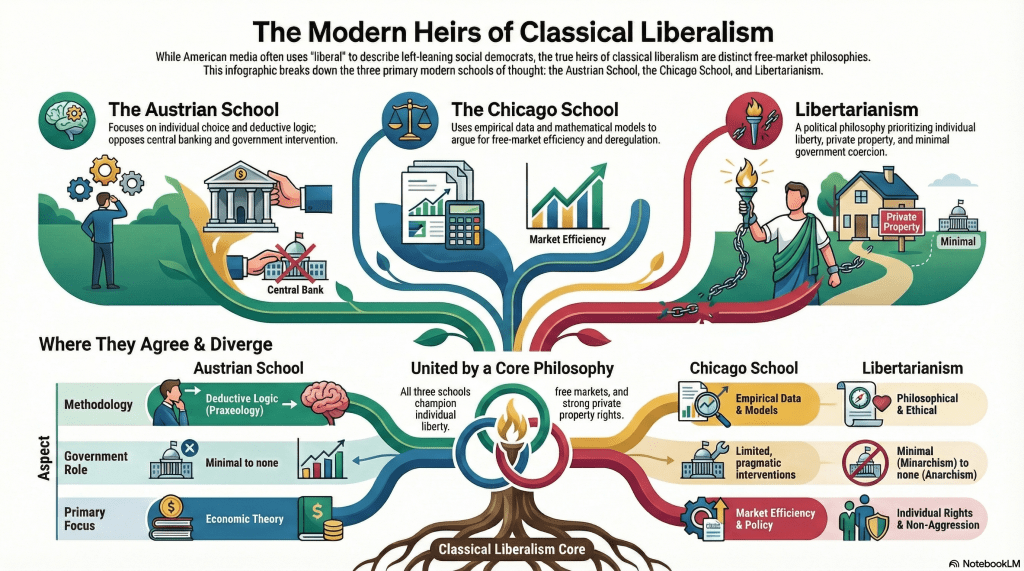
Within the subgroups of modern liberalism, which are the effective heirs of classical liberalism, we will focus on three key movements: the Chicago School, the Austrian School, and the Libertarians.
The Austrian School
The Austrian School of economics originated in the late 19th century in Vienna and focuses on methodological individualism, subjective value theory, and the role of entrepreneurship in markets. It argues that economic phenomena arise from individual actions and choices, emphasizing deductive reasoning (praxeology) over empirical data or mathematical models.
Austrians are critical of government intervention, central banking, and fiat currency, often advocating for laissez-faire policies, sound money (like the gold standard), and viewing business cycles as results of monetary distortions.
The Chicago School
The Chicago School, developed in the mid-20th century at the University of Chicago, applies neoclassical economic principles with a strong emphasis on empirical analysis, mathematical modeling, and free-market policies. It promotes the idea that markets are efficient and self-correcting, advocating for deregulation, antitrust reforms, and monetarism (stable money supply growth to control inflation).
While skeptical of excessive government intervention, it accepts some roles for the state, such as in monetary policy or addressing market failures through evidence-based approaches.
Libertarians
Libertarianism is a political philosophy that prioritizes individual liberty, voluntary interactions, and minimal (or no) government coercion. It draws from classical liberalism, emphasizing natural rights, private property, free markets, and the non-aggression principle.
They are a diverse group: some (natural-rights libertarians like Murray Rothbard) explicitly revive classical natural-rights reasoning; others (consequentialist libertarians) defend liberty for pragmatic or utilitarian reasons.
Libertarians oppose most forms of taxation, regulation, and welfare states, advocating for personal freedoms in social and economic spheres. Variants include minarchism (limited government for defense and courts) and anarcho-capitalism (no state, with markets providing all services).
| From classic to modern liberals’ ideas | ||
| Area | Classical Liberals | Modern Liberals |
| Economic Methodology and Value Theory | Relied on objective theories like labor theory of value (e.g., Adam Smith) and natural rights-based reasoning for economic principles, with less formal emphasis on individual subjectivity in valuation. | Introduced subjective value theory, marginal utility, and methodological individualism, emphasizing that value derives from individual perceptions and choices rather than inherent costs or labor; used deductive praxeology (Austrians) or empirical positivism (Chicago) for analysis. |
| Role of Government and Intervention | Advocated for limited government focused on protecting natural rights, enforcing contracts, and providing essential public goods like defense and justice, with some acceptance of state roles in infrastructure or moral governance. | Evolved to more stringent minimalism or rule-based interventions; Austrians oppose most interventions as distortions, Chicago accepts evidence-based roles like monetary rules, and libertarians range from minarchism to anarcho-capitalism, rejecting welfare states as coercive. |
| Critique of Socialism and Central Planning | Opposed legal plunder, mercantilism, and state overreach that violates rights, focusing on unseen policy effects and advocating free markets over centralized controls. | Provide deeper critiques via the knowledge problem and economic calculation impossibility, arguing central planning fails due to dispersed information; viewed socialism as leading to tyranny and inefficiency, with stronger warnings against any rationalist societal design. |
| Monetary Policy and Business Cycles | Supported free markets with a preference for sound money such as the gold standard, without developing theories of economic cycles; they focused on general non-intervention in trade. | Developed theories attributing cycles to monetary distortions (e.g., artificial low interest rates causing malinvestments); advocated ending or reforming central banks, with monetarism proposing steady money growth rules or private currencies. |
| Social Welfare and Redistribution | Emphasized protection of property and opposition to plunder but allowed limited state functions; did not systematically address modern welfare states. | Varied approaches: some support conditional minimal safety nets (Hayek) or efficient mechanisms like negative income tax (Friedman) for the needy, while others (libertarians) reject all government aid as theft; rejected “social justice” as incoherent and coercive. |
| Constitutional and Institutional Design | Stressed separation of powers, rule of law, federalism, and rights protections to limit government and prevent tyranny, with right to revolution if rights are violated. | Proposed more detailed reforms like bicameral systems prioritizing abstract laws, decentralization, and safeguards against majority rule; emphasized evolutionary institutions and spontaneous order over deliberate design. |
Points of Agreement
The Austrian and Chicago schools, along with libertarianism, share a commitment to free-market capitalism and limited government:
- Individual Liberty and Free Markets: All emphasize personal freedom, voluntary exchange, and the efficiency of unregulated markets in allocating resources.
- Critique of Government Intervention: They oppose central planning, excessive regulation, and socialism, arguing these distort incentives and lead to inefficiencies or tyranny.
- Property Rights: Strong defense of private property as essential for prosperity and autonomy.
- Anti-Collectivism: Rejection of collectivist ideologies that subordinate individuals to the state or society.
Differences
While aligned on markets, they diverge in methodology, scope, and extremism:
- Methodology: Austrians rely on deductive logic and reject empirical testing as unreliable for human action; Chicago economists use data-driven, positivist methods and mathematical models to test hypotheses. Libertarianism is more philosophical, focusing on ethics rather than strict economic methodology.
- Government Role: Chicago accepts pragmatic interventions (e.g., Friedman’s negative income tax or rule-based monetary policy); Austrians are more absolutist, favoring complete deregulation of money and banking. Libertarians vary but often go further, with some rejecting any state (anarcho-capitalists) versus minarchists who allow minimal functions.
- Scope: Austrian and Chicago are primarily economic schools; libertarianism extends to broader political and social issues, like drug legalization or anti-war stances.
- Monetary Policy: Austrians advocate ending central banks; Chicago (via monetarism) seeks to reform them for stability.
| Aspect | Austrian School | Chicago School | Libertarianism |
|---|---|---|---|
| Methodology | Deductive (praxeology) | Empirical/positivist | Philosophical/ethical |
| Government Intervention | Minimal to none; oppose central banking | Limited; accept some (e.g., monetarism) | Minimal (minarchism) to none (anarchism) |
| Focus | Economic theory, business cycles | Market efficiency, policy analysis | Individual rights, non-aggression |
| Extremism | Often radica(in the case of anarcho-capitalism) | Pragmatic, evidence-based | Varies from moderate to radical |
Main Authors
- Austrian School: Carl Menger (founder, subjective value theory), Eugen von Böhm-Bawerk (Capital and interest), Ludwig von Mises (Human Action), Friedrich Hayek (The Road to Serfdom, Nobel Prize), Murray Rothbard (Man, Economy, and State with Power and Market).
- Chicago School: Frank Knight (Risk, uncertainty and profit), Milton Friedman (Capitalism and Freedom, monetarism, Nobel Prize), George Stigler (regulation theory, Nobel Prize), Gary Becker (Human capital, Nobel Prize), Robert Lucas (Rational Expectations and the Theory of Price Movements, Nobel Prize).
- Libertarians: John Locke (classical roots, natural rights), Ayn Rand (Atlas Shrugged, objectivism), Robert Nozick (Anarchy, State, and Utopia), Murray Rothbard (anarcho-capitalism), David Friedman (The Machinery of Freedom).
| School/Philosophy | Main Authors |
|---|---|
| Austrian | Carl Menger, Ludwig von Mises, Friedrich Hayek, Murray Rothbard |
| Chicago | Milton Friedman, George Stigler, Gary Becker, Robert Lucas |
| Libertarianism | Ayn Rand, Robert Nozick, Murray Rothbard, David Friedman |
Classification on the Circular Diagram of Western Political Mindsets
All three are positioned in the “Classical Liberals” segment, adjacent to Moderate Conservatives (sharing free-market ideas) and Democratic Leftists (sharing democratic liberties), but opposite Radical Statists (opposing state supremacy).
- Austrian School: Classifies under Classical Liberals, due to its emphasis on individual autonomy, free markets, and limited government.
- Chicago School: Also under Classical Liberals, as it advocates economic freedom and minimal intervention.
- Libertarians: Primarily Classical Liberals, aligning with values of liberty, markets, and anti-statism; overlaps with anarcho-capitalist elements but fits the group’s focus on individual rights and laissez-faire.
This placement reflects their shared anti-authoritarian, pro-freedom stance within the diagram’s fluid continuum.
| Divergences in Social Welfare Policies (Negative Income Tax or Basic Income Support) Social Welfare Policies refer to government programs that provide income support or redistribution to combat poverty, such as through a negative income tax or guaranteed minimum income. – Austrian School (Friedrich Hayek): Supported a conditional, means-tested minimum income for those unable to work (e.g., the elderly or disabled), as a limited safety net within a free society, but opposed universal or unconditional schemes arguing they distort market incentives and promote unearned redistribution. – Chicago School (Milton Friedman): Advocated for a negative income tax as a universal and efficient replacement for existing welfare programs, providing cash transfers that phase out with earned income to incentivize work while reducing bureaucracy. – Libertarian (Murray Rothbard): Strongly opposed any form of government welfare or income redistribution, including a negative income tax, viewing it as coercive theft via taxation that violates property rights and perpetuates dependency without moral justification. |

Leave a comment