
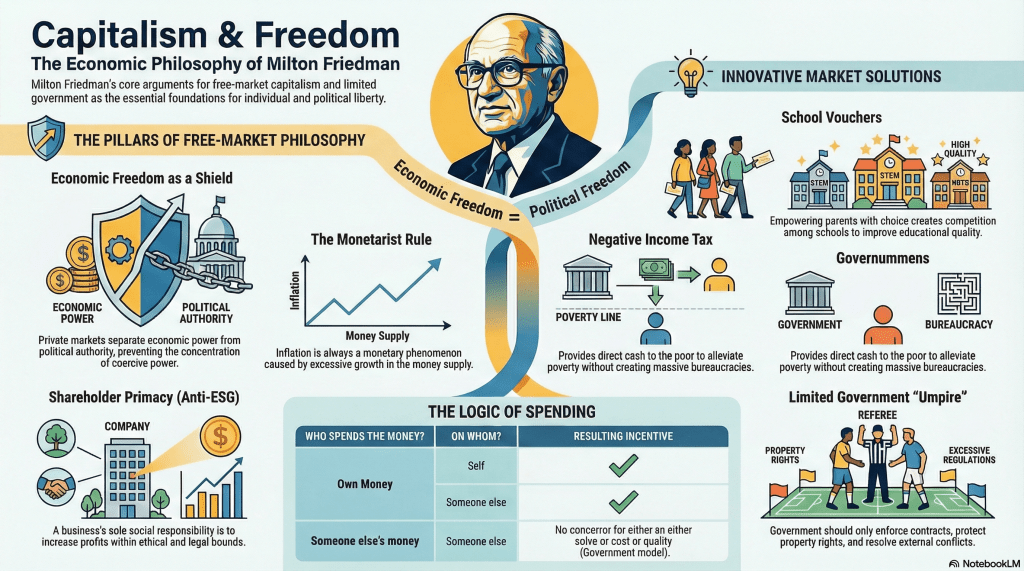
Main Ideas
Milton Friedman (1912–2006) was a prominent American economist and Nobel laureate (1976) known for his advocacy of free-market capitalism, limited government intervention, and the school of thought called monetarism.
Figure 33: Milton Friedman.

Source: https://commons.wikimedia.org/wiki/File:Portrait_Of_Milton_Friedman_(cropped).jpg
His ideas emphasized that individual liberty and economic efficiency are best achieved through voluntary exchanges in competitive markets, rather than through central planning or extensive regulation. Below are some of his core concepts:
- Monetarism and Monetary Policy: Friedman argued that inflation is primarily a monetary phenomenon caused by excessive growth in the money supply, and central banks should focus on steady, predictable increases in money to stabilize the economy. en.wikipedia.org He criticized Keynesian fiscal policies (government spending and taxation to manage demand) as ineffective in the long run, instead advocating for rules-based monetary control to prevent recessions and inflation. hoover.org For instance, he linked the Great Depression to a contraction in the money supply by the Federal Reserve.
- Free Markets and Limited Government: He believed competitive capitalism efficiently allocates resources and fosters innovation, while excessive government involvement distorts markets and erodes personal freedoms. edchoice.org Friedman supported policies like free trade, lower taxes on income and capital, deregulation, and privatization to reduce the government’s economic footprint. fraserinstitute.org +1 He opposed interventions such as price controls, minimum wages (in some contexts), and mandatory licensing for professions like doctors, arguing they create monopolies and limit opportunities.
- Economic Freedom as a Foundation for Political Freedom: Friedman posited that economic liberty—through private property and market exchanges—protects against coercive political power. freedomandcitizenship.columbia.edu He warned that concentrated economic control (e.g., via socialism) leads to concentrated political control, stifling dissent and individual rights.
- Innovative Policy Proposals: Among his practical ideas were a negative income tax (a precursor to modern earned income tax credits, providing cash to low-income individuals to alleviate poverty without bureaucracy), ebsco.com school vouchers to give parents choice in education and promote competition among schools, econlib.org a volunteer army instead of conscription, and freely floating exchange rates for international currencies. econlib.org These aimed to empower individuals while minimizing government distortion.
Friedman’s influence peaked in the 1980s, shaping policies under leaders like Ronald Reagan and Margaret Thatcher.
| Milton Friedman’s Opposition to ESG Milton Friedman is often cited as a critic of concepts such as environmental, social, and governance (ESG) investing and corporate practices. His opposition stems primarily from his 1970 New York Times essay, “The Social Responsibility of Business Is to Increase Its Profits,” where he argued that the primary duty of corporate executives is to maximize shareholder value within the bounds of law and ethical norms. Friedman viewed any deviation from this—such as pursuing broader social or environmental goals—as a misuse of corporate resources and a threat to free-market capitalism. This stance directly challenges ESG, which encourages companies to integrate environmental (e.g., climate action), social (e.g., diversity and labor rights), and governance (e.g., ethical board practices) factors into decision-making, often beyond strict profit motives. He contended that businesses are not moral agents with “responsibilities” like individuals; instead, executives are agents of shareholders and must prioritize profit maximization. Key points include: Profit as the Sole Legitimate Goal: Friedman famously stated that executives who spend company money on social causes (e.g., reducing pollution beyond legal requirements or promoting community welfare) are effectively imposing a “tax” on shareholders, employees, or customers without their consent. He argued: “The corporate executive’s role is to make as much money as possible while conforming to the basic rules of the society.” In the ESG context, this means opposing initiatives like voluntary carbon reductions or diversity quotas unless they demonstrably boost long-term profits—otherwise, they represent unauthorized redistribution of resources. Undermining Democracy and Free Markets: Friedman warned that allowing executives to pursue social objectives turns them into unelected policymakers, blurring the lines between business and government. This aligns with his broader critique of collectivism: ESG practices, by prioritizing stakeholders like the environment or communities over shareholders, could expands government-like roles for corporations, potentially inviting more regulation and eroding voluntary market exchanges. He emphasized there’s “no free lunch”—social actions impose costs that should be handled through political processes, not corporate discretion. Agency Problems and Oversight: A profit-focused mandate simplifies shareholder monitoring of executives, reducing “agency costs” where managers might pursue personal agendas under the guise of social good. ESG, with its multifaceted metrics, complicates this, potentially allowing executives to justify underperformance by citing non-financial goals. Friedman did acknowledge that businesses must comply with laws and ethical customs, and actions benefiting society (e.g., community investments) are permissible if they enhance profits. However, he opposed labeling these as “social responsibility” to avoid hypocrisy. Nuances and Common Misunderstandings: Friedman’s position is often caricatured as endorsing unethical profit-seeking at all costs, but this overlooks key qualifications. For instance, he explicitly required adherence to “ethical custom” and “open and free competition without deception or fraud.” Illegal or unethical actions (e.g., privacy breaches or environmental harm) would damage reputation and profits, making them incompatible with his doctrine. Overlap with Stakeholder Interests: Friedman recognized that profit-maximizing actions often align with broader benefits (e.g., attracting talent through amenities), showing his views aren’t strictly antithetical to stakeholder considerations but prioritize shareholder primacy. These nuances highlight that Friedman’s opposition isn’t to social good per se, but to executives freelancing it at shareholders’ expense. |
Capitalism and Freedom
“Capitalism and Freedom” (1962) is Friedman’s seminal work, arguing that competitive capitalism is essential for preserving political freedom and that government intervention often undermines both. Written during the Cold War, it critiques socialism and excessive welfare states while advocating for minimal government roles in a free society.
The book, inspired by lectures at the University of Chicago, combines economic theory with policy prescriptions to show how free markets decentralize power and protect individual liberties. Here’s an overview of its key arguments:
- Introduction and The Relation Between Economic Freedom and Political Freedom: Friedman asserts that economic freedom (via capitalism) is a prerequisite for political freedom, as it separates economic power from political authority, allowing markets to counterbalance government coercion. supersummary.com +1 He warns that collectivist systems concentrate power, threatening liberty.
- The Role of Government in a Free Society: Government should be limited to enforcing contracts, protecting property rights, maintaining national defense, and resolving externalities (like pollution), but not to paternalistic interventions that restrict choice. univ.ox.ac.uk Friedman emphasizes that voluntary cooperation in markets achieves better outcomes than mandatory government programs.
- The Control of Money: Echoing his monetarist views, he criticizes the Federal Reserve’s discretionary policies and proposes a rule for steady money supply growth (e.g., 3-5% annually) to avoid inflation and depressions. coursehero.com
- International Financial and Trade Arrangements: Advocates for floating exchange rates and free trade, opposing fixed rates and tariffs that distort global markets.
- Fiscal Policy: Friedman argues against using government spending and deficits for economic stabilization, as they lead to inefficiency and inflation; instead, focus on balanced budgets and low taxes.
- The Role of Government in Education: Proposes school vouchers to fund education through parental choice rather than public monopolies, promoting competition and efficiency while addressing inequality. coursehero.com
- Capitalism and Discrimination: Markets reduce discrimination because profit motives favor merit over bias; government interventions (like minimum wages) can exacerbate it by limiting opportunities for minorities.
- Monopoly and the Social Responsibility of Business and Labor: Criticizes monopolies (including unions) and argues businesses should maximize profits within ethical rules, not pursue vague “social responsibilities.”
- Occupational Licensure: Opposes mandatory licensing for professions, as it creates barriers to entry and protects incumbents at the expense of consumers.
- The Distribution of Income: Introduces the negative income tax as a way to guarantee a minimum income without disincentivizing work, replacing fragmented welfare programs.
- Social Welfare Measures and Alleviation of Poverty: Calls for reforming welfare to encourage self-reliance, criticizing existing systems for creating dependency.
- Conclusion: Reiterates that a free society requires economic freedom, and gradual reforms toward capitalism can enhance both prosperity and liberty.
Overall, the book warns against the “paternalistic” state and promotes individualism, noting that “the freer the market, the freer the people.”
Key quotes
On the Government and the Market:
“The government doesn’t have any money. The only power it has is to take from some and give to others.”
“Nothing is so permanent as a temporary government program.”
“Many people want the government to protect the consumer. A much more urgent problem is to protect the consumer from the government.”
“There is no such thing as a free lunch.“
“I am in favor of cutting taxes under any circumstance and for any excuse, for any reason, whenever it’s possible.”
On Free Market and Freedom:
“The great virtue of a free market system is that it does not care what color people are; it does not care what their religion is; it only cares whether they can produce something you want to buy. It is the most effective system we have discovered to enable people who hate one another to deal with one another and help one another.”
“A society that puts equality before freedom will get neither. A society that puts freedom before equality will get a high degree of both.”
“Underlying most arguments against the free market is a lack of belief in freedom itself.”
On Inflation and Monetary Policy:
“Inflation is the one form of taxation that can be imposed without legislation.“
“Inflation is always and everywhere a monetary phenomenon“.
On Spending and Incentives:
“”When a man spends his own money to buy something for himself, he is very careful about how much he spends and how he spends it. When a man spends his own money to buy something for someone else, he is still very careful about how much he spends, but somewhat less what he spends it on. When a man spends someone else’s money to buy something for himself, he is very careful about what he buys, but doesn’t care at all how much he spends. And when a man spends someone else’s money on someone else, he doesn’t care how much he spends or what he spends it on. And that’s government for you.”
“If you pay people not to work and tax them when they do, don’t be surprised if you get unemployment.“
On Policy Evaluation:
“One of the great mistakes is to judge policies and programs by their intentions rather than their results.“
“If you put the federal government in charge of the Sahara Desert, in five years there’d be a shortage of sand.“
Milton Friedman’s Enduring Relevance
Milton Friedman remains a pivotal figure in contemporary economic and political discourse. Nearly two decades after his death, his ideas continue to influence policymakers, thinkers, and public debates on inflation, education, government intervention, and individual liberty.
Friedman’s advocacy for free markets as a path to lifting people out of poverty continues to inspire libertarian and conservative thinkers. His proposal for school vouchers to promote choice and competition in education is particularly relevant, as school choice debates intensify. His ideas on replacing welfare with a negative income tax to reduce bureaucracy and dependency influence modern universal basic income discussions.
| Milton Friedman’s influence on Paulo Guedes’ ideas Paulo Guedes (1949-) is a Brazilian economist, co-founder of the investment bank BTG Pactual, and former Minister of the Economy under President Jair Bolsonaro (2019–2022). Friedman’s direct influence on Guedes is profound, stemming from Guedes’s education at the University of Chicago, where Friedman taught him macroeconomics and instilled neoliberal principles. As Minister of Economy (2019–2022), Guedes translated Friedman’s ideas into policy amid Brazil’s fiscal crisis: Pension Reform (2019): A flagship achievement, this overhauled Brazil’s unsustainable system to curb deficits, drawing from Friedman’s critiques of inefficient welfare and social security as poverty traps. Guedes negotiated with politicians to pass it, improving fiscal sustainability in line with Friedman’s emphasis on balanced budgets. Privatization Drive: Guedes accelerated sales of state assets (e.g., the largest renewable energy company in Latin America), echoing Friedman’s anti-monopoly stance and the Chilean model’s success under Pinochet (which Friedman indirectly influenced). This aimed to reduce debt and foster private enterprise, directly applying Friedman’s free-market principles. Tax and Fiscal Policies: Proposals for tax simplification and spending caps reflected Friedman’s advocacy for low taxes and monetary discipline to combat inflation. Guedes’s warnings on global stagflation and push for higher interest rates on state loans embody monetarism. Broader Economic Agenda: Guedes’s team, including other Chicago alumni, pursued deregulation and trade openness, often called “Milton Friedman’s Brazil Moment.” However, political hurdles (e.g., from Bolsonaro’s spending priorities) diluted some reforms, forcing compromises like COVID stimulus that Guedes viewed as temporary deviations. Overall, Friedman’s mentorship transformed Guedes into a neoliberal advocate, enabling policies that shifted Brazil toward market-driven growth, though adapted to local realities and not fully realized due to political constraints. |
Selected texts
Milton Friedman with the assistance of Rose D. Friedman. Capitalism and Freedom. The University of Chicago Press, Chicago, 1962.
Introduction
In a much quoted passage in his inaugural address, President Kennedy said, ”Ask not what your country can do for you ask what you can do for your country.” It is a striking sign of the temper of our times that the controversy about this passage centered on its origin and not on its content. Neither half of the statement expresses a relation between the citizen and his government that is worthy of the ideals of free men in a free society. The paternalistic “what your country can do for you” implies that government is the patron, the citizen the ward, a view that is at odds with the free man’s belief in his own responsibility for his own destiny. The organismic, “what you can do for your country” implies that government is the master or the deity, the citizen, the servant or the votary. To the free man, the country is the collection of individuals who compose it, not something over and above them. He is proud of a common heritage and loyal to common traditions. But he regards government as a means, an instrumentality, neither a grantor of favors and gifts, nor a master or god to be blindly worshipped and served. He recognizes no national goal except as it is the consensus of the goals that the citizens severally serve. He recognizes no national purpose except as it is the consensus of the purposes for which the citizens severally strive.
The free man will ask neither what his country can do for him nor what he can do for his country. He will ask rather “What can I and my compatriots do through government” to help us discharge our individual responsibilities, to achieve our several goals and purposes, and above all, to protect our freedom? And he will accompany this question with another: How can we keep the government we create from becoming a Frankenstein that will destroy the very freedom we establish it to protect? Freedom is a rare and delicate plant. Our minds tell us, and history confirms, that the great threat to freedom is the concentration of power. Government is necessary to preserve our freedom, it is an instrument through which we can exercise our freedom; yet by concentrating power in political hands, it is also a threat to freedom. Even though the men who wield this power initially be of good will and even though they be not corrupted by the power they exercise, the power will both attract and form men of a different stamp.
How can we benefit from the promise of government while avoiding the threat to freedom? Two broad principles embodied in our Constitution give an answer that has preserved our freedom so far, though they have been violated repeatedly in practice while proclaimed as precept.
First, the scope of government must be limited. Its major function must be to protect our freedom both from the enemies outside our gates and from our fellow-citizens: to preserve law and order, to enforce private contracts, to foster competitive markets. Beyond this major function, government may enable us at times to accomplish jointly what we would find it more difficult or expensive to accomplish severally. However, any such use of government is fraught with danger. We should not and cannot avoid using government in this way. But there should be a clear and large balance of advantages before we do. By relying primarily on voluntary co-operation and private enterprise, in both economic and other activities, we can insure that the private sector is a check on the powers of the governmental sector and an effective protection of freedom of speech, of religion, and of thought.
The second broad principle is that government power must be dispersed. If government is to exercise power, better in the county than in the state, better in the state than in Washington. If I do not like what my local community does, be it in sewage disposal, or zoning, or schools, I can move to another local community, and though few may take this step, the mere possibility acts as a check. If I do not like what my state does, I can move to another. If I do not like what Washington imposes, I have few alternatives in this world of jealous nations.
(…)
Chapter I. The Relation between Economic Freedom and Political Freedom
It is widely believed that politics and economics are separate and largely unconnected; that individual freedom is a political problem and material welfare an economic problem; and that any kind of political arrangements can be combined with any kind of economic arrangements. The chief contemporary manifestation of this idea is the advocacy of “democratic socialism” by many who condemn out of hand the restrictions on individual freedom imposed by “totalitarian socialism” in Russia, and who are persuaded that it is possible for a country to adopt the essential features of Russian economic arrangements and yet to ensure individual freedom through political arrangements. The thesis of this chapter is that such a view is a delusion, that there is an intimate connection between economics and politics, that only certain combinations of political and economic arrangements are possible, and that in particular, a society which is socialist cannot also be democratic, in the sense of guaranteeing individual freedom.
Economic arrangements play a dual role in the promotion of a free society. On the one hand, freedom in economic arrangements is itself a component of freedom broadly understood, so economic freedom is an end in itself. In the second place, economic freedom is also an indispensable means toward the achievement of political freedom.
(…)
Viewed as a means to the end of political freedom, economic arrangements are important because of their effect on the concentration or dispersion of power. The kind of economic organization that provides economic freedom directly, namely, competitive capitalism, also promotes political freedom because it separates economic power from political power and in this way enables the one to offset the other.
Historical evidence speaks with a single voice on the relation between political freedom and a free market. I know of no example in time or place of a society that has been marked by a large measure of political freedom, and that has not also used something comparable to a free market to organize the bulk of economic activity.
Because we live in a largely free society, we tend to forget how limited is the span of time and the part of the globe for which there has ever been anything like political freedom: the typical state of mankind is tyranny, servitude, and misery. The nineteenth century and early twentieth century in the Western world stand out as striking exceptions to the general trend of historical development. Political freedom in this instance clearly came along with the free market and the development of capitalist institutions. So also did political freedom in the golden age of Greece and in the early days of the Roman era.
(…)
The existence of a free market does not of course eliminate the need for government. On the contrary, government is essential both as a forum for determining the “rules of the game” and as an umpire to interpret and enforce the rules decided on. What the market does is to reduce greatly the range of issues that must be decided through political means, and thereby to minimize the extent to which government need participate directly in the game. The characteristic feature of action through political channels is that it tends to require or enforce substantial conformity. The great advantage of the market, on the other hand, is that it permits wide diversity. It is, in political terms, a system of proportional representation. Each man can vote, as it were, for the color of tie he wants and get it; he does not have to see what color the majority wants and then, if he is in the minority, submit.
It is this feature of the market that we refer to when we say that the market provides economic freedom. But this characteristic also has implications that go far beyond the narrowly economic. Political freedom means the absence of coercion of a man by his fellow men. The fundamental threat to freedom is power to coerce, be it in the hands of a monarch, a dictator, an oligarchy, or a momentary majority. The preservation of freedom requires the elimination of such concentration of power to the fullest possible extent and the dispersal and distribution of whatever power cannot be eliminated a system of checks and balances. By removing the organization of economic activity from the control of
political authority, the market eliminates this source of coercive power. It enables economic strength to be a check to political power rather than a reinforcement.
(…)
Questions for reflection
1. How did Milton Friedman establish the connection between economic freedom and political freedom in “Capitalism and Freedom” ?
2. What is the essence of Friedman’s monetarist theory expressed in the phrase “inflation is always and everywhere a monetary phenomenon,”?
3. How did Friedman justify his criticism of the government’s expanding role in the economy, especially regarding post-war social programs?
4. How does Friedman’s Negative Income Tax proposal relate to current Universal Basic Income debates?
5. How does the Chilean experience with “Chicago Boys” policies, inspired by Friedman, inform current debates about economic reforms in developing countries?
6. Explain Friedman’s advocacy for school vouchers: How do they promote competition in education and address issues in public schooling?
7. What is Friedman’s view on the social responsibility of businesses, as outlined in his 1970 essay “The Social Responsibility of Business Is to Increase Its Profits”?
8. How did Friedman link competitive capitalism to reducing discrimination, arguing that markets prioritize merit over bias?

.jpg)
Leave a comment