
Introduction
Adolf Hitler (1889 – 1945), born in Austria, experienced a challenging early life marked by academic failures and exposure to antisemitic and nationalist ideas in Vienna. He served in the German army during World War I, where he was decorated but deeply affected by Germany’s defeat, blaming it on Jews, communists, and the Weimar Republic. Joining the German Workers’ Party in 1919, he rose to lead the renamed Nazi Party by 1921, using his oratory skills to promote ultranationalism and antisemitism. His 1923 Beer Hall Putsch failed, leading to imprisonment where he wrote Mein Kampf. Rebuilding the party, he capitalized on the Great Depression’s economic chaos to gain electoral support, becoming Chancellor in 1933 through political maneuvering. He then consolidated power via the Reichstag Fire Decree, Enabling Act, and purges like the Night of the Long Knives, establishing himself as Führer by 1934.
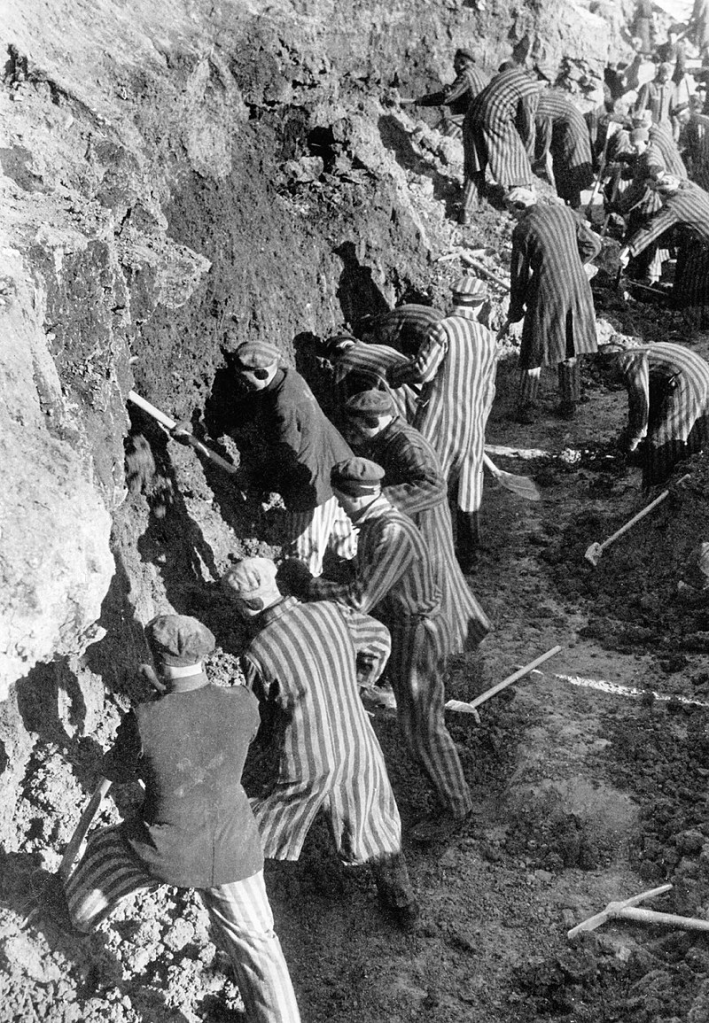
Figure. Sachsenhausen concentration camp, prisoners carrying out excavation work
Hitler was an early admirer of the Italian fascists and modeled himself after Mussolini less than a month after the March on Rome. His methods mirrored those of Benito Mussolini in several ways. Both employed paramilitary groups—the SA in Germany and Blackshirts in Italy—for street violence against opponents, exploited economic crises to promise national revival, and used propaganda to build cults of personality. They suppressed dissent through secret police, indoctrinated youth, and promoted fascism as an alternative to capitalism and communism, emphasizing state control and extreme nationalism. These similarities arose from shared post-World War I disillusionment and anti-Bolshevism, culminating in the Rome-Berlin Axis alliance.
| Hitler is a monster! Sir Winston Leonard Spencer Churchill (1874 – 1965), of the Conservative Party, served as Prime Minister of the United Kingdom from 1940 to 1945 and from 1951 to 1955. One of Hitler’s most important opponents, in a speech on June 22, 1941, he said: “Hitler is a monster of wickedness, insatiable in his lust for blood and plunder. Not content with having all Europe under his heel, or else terrorized into various forms of abject submission, he must now carry his work of butchery and desolation among the vast multitudes of Russia and of Asia. The terrible military machine, which we and the rest of the civilized world so foolishly, so supinely, so insensately allowed the Nazi gangsters to build up year by year from almost nothing, cannot stand idle lest it rust or fall to pieces. It must be in continual motion, grinding up human lives and trampling down the homes and the rights of hundreds of millions of men. Moreover it must be fed, not only with flesh but with oil.“ (Full speach at: https://www.youtube.com/watch?v=hii8umkBels) |
Adolf Hitler’s Core Ideas
Adolf Hitler’s ideological framework, as detailed in his 1925 manifesto Mein Kampf, centered on extreme nationalism, anti-communism, anti-liberalism, anti-capitalism, and a vision for Germany’s revival under authoritarian rule. He depicted Germany as a victim of the Treaty of Versailles, attributing its decline to internal and external enemies, and advocated for Lebensraum—territorial expansion eastward to secure resources for the German people, often displacing Slavic populations considered inferior. Hitler promoted a totalitarian state governed by the Führerprinzip, where individual rights yielded to national unity, supported by militarism, youth indoctrination, and propaganda. He rejected democracy, liberalism, and Marxism as divisive forces, drawing racial pseudoscience from 19th-century thinkers like Arthur de Gobineau and Houston Stewart Chamberlain, as well as occult influences from the Thule Society.
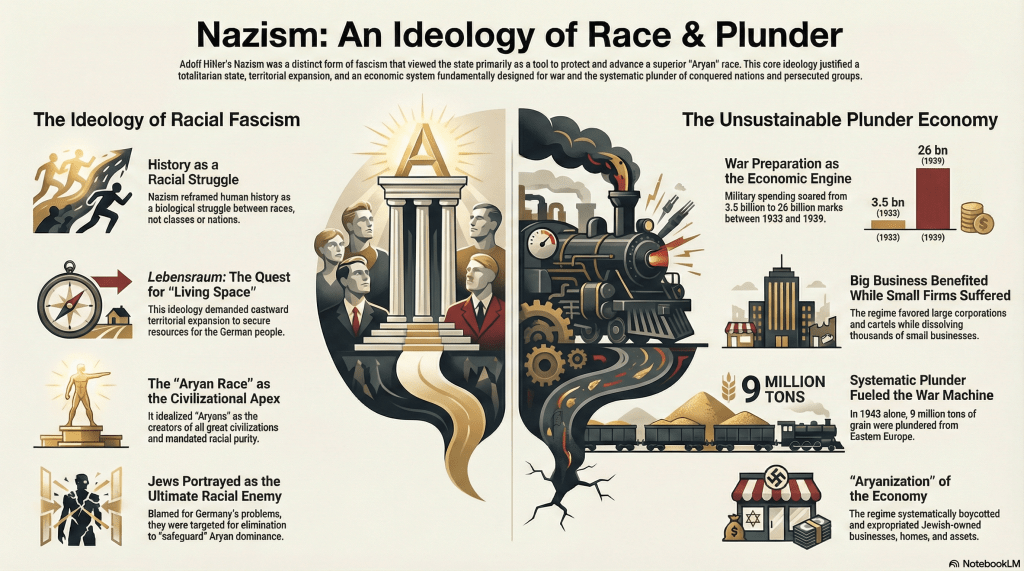
At the core of Hitler’s worldview was a racial theory that reframed human history as a struggle between races, rather than classes, with cultural progress tied to racial purity over environmental, cultural or educational factors. He idealized the “Aryan” race, particularly Nordic Germans, as the pinnacle of humanity, crediting them with building great civilizations from ancient Rome to modern Europe. Hitler warned that Aryans must affirm their superiority to prevent decline through notions of equality, and he argued that racial mixing inevitably led to the collapse of empires by corrupting superior bloodlines.
Hitler portrayed Jews as the ultimate racial enemy—a parasitic, subversive force incapable of creation but adept at manipulation through finance, Bolshevism, and cultural destruction—blaming them for Germany’s 1918 defeat and economic hardships. He advocated for their exclusion or elimination as a biological necessity to safeguard Aryan dominance. Other groups, including Slavs, Roma, and Africans, were placed lower in a racial hierarchy and viewed as threats to genetic purity and national vitality. This ideology extended to eugenics, emphasizing “racial hygiene” through sterilizing the “unfit” and promoting Aryan reproduction to forge a master race.
| The White Rose Resistance Group The White Rose Resistance Group was a nonviolent resistance group formed in 1942 by students at the University of Munich, including Hans Scholl, Sophie Scholl, Alexander Schmorell, Willi Graf, Christoph Probst, and Professor Kurt Huber. Motivated by moral outrage over Nazi atrocities, such as the Holocaust and euthanasia programs, the group produced and distributed six pamphlets exposing the regime’s crimes, calling for resistance, and appealing to the German conscience. Arrested in February 1943, its leading members were tried for treason and executed. In the second pamphlet, published in late June 1942, they wrote about German apathy: “We don’t want to write about the Jewish Question in this leaflet, we don’t want to compose a defending speech – no, we just want to mention a fact as a short example, the fact that since the conquest of Poland three hundred thousand Jews have been murdered in this country in the most bestial way. Here we see the most terrifying crime against human dignity, a crime that is unparalleled in the entire history of mankind. The Jews, too, are human beings – no matter what position one takes on the Jewish Question – and against human beings a crime of this dimension has been perpetrated. Someone might say that the Jews deserve their fate. This assertion would be a monstrous presumption; but let us assume that someone said this – what position has he then taken on the fact that the entire Polish aristocratic youth has been annihilated (May God grant that this is not yet the case!)? In what way, they would ask, did something like this happen? All male offspring of noble lineage between the ages of fifteen and twenty were transported to concentration camps in Germany and sentenced to forced labour, and all the girls of this age group were sent to Norway, into the brothels of the SS! Why tell you these things, since you are fully aware of them – or if not of these, then of other equally grave crimes committed by this frightful subhumanity? Because here we touch on a problem which involves us deeply and forces us all to take thought. Why does the German people behave so apathetically in the face of all these abominable crimes, crimes so unworthy of the human race? Hardly anyone wonders or worries about it. It is accepted as a fact and put out of mind. And once again the German people slumbers on in its dull, stupid sleep and encourages these fascist criminals, giving them the opportunity to carry on with their savageries; and of course they do so. Should this be a sign that the Germans have become brutalized in their most basic human feelings, that no chord within them cries out at the sight of such deeds, that they have sunk into a fatal coma from which they will never ever awake?“ (Full text at: https://www.weisse-rose-stiftung.de/white-rose-resistance-group/leaflets-of-the-white-rose/) |
Race as a Central Element in German Fascism (Nazism)
In German fascism or Nazism, race was not just an aspect, but the foundational element that distinguished it as a racial nationalism instead of a purely political movement. Hitler integrated race into all facets of ideology and governance, viewing the state as a tool to protect and advance the Aryan Volk (people’s community), with a biological determinism that organized society in a racial hierarchy: Aryans at the top, with Germans as the purest form, followed by other Europeans, and “subhumans” like Jews and Slavs at the bottom. Racial purity was essential for national survival, leading to policies of population “purification” through exclusion, forced labor and genocide, emerging from Hitler’s early influences by Social Darwinism, which he adapted into a program of racial war.
In the 1930s, under the Nazi regime, race dictated education (teaching Aryan superiority), economy (Aryanization of Jewish businesses) and foreign policy (invasions justified as reconquest of space from inferiors). The Holocaust, resulting in the murder of six million Jews and millions of others, was the maximum expression of this ideology, framed as a defensive racial struggle, with eugenics programs like Aktion T4 (euthanasia of the disabled) and Lebensborn (breeding of “pure” children) incorporating race into the state machinery. Unlike other fascist variants, Nazism’s racism was systematic and genocidal from its core, not an add-on.
| Who Stands Firm? Dietrich Bonhoeffer (1906 – 1945) was a Lutheran pastor from Germany. He died in a concentration camp by the Nazis. In his text “Who Stands Firm?” (in “After Ten Years: An Account at the Turn of the Year 1942–1943“. Translation by Barbara and Martin Rumscheidt), he criticizes the failures of various human responses to evil: reasonable people, with limited vision, achieve nothing amidst colliding forces; ethical fanatics attack superficial symbols and fall into traps; those who rely on conscience become divided and self-deceptive to avoid despair; obedient individuals cling to commandments but ultimately serve evil by avoiding personal responsibility; free actors compromise principles but risk tolerating worse evils; and those who pursue private virtue must ignore injustice, leading to restlessness or hypocrisy. Ultimately, only those who sacrifice reason, principles, conscience, freedom, and virtue in faithful and obedient response to God’s call can stand firm as truly responsible individuals: “Who stands firm? Only the one whose ultimate standard is not his reason, his principles, conscience, freedom, or virtue; only the one who is prepared to sacrifice all of these when, in faith and in relationship to God alone, he is called to obedient and responsible action. Such a person is the responsible one, whose life is to be nothing but a response to God’s question and call. Where are these responsible ones?“ |
Nazi Economy
The Nazi economy achieved a dramatic transformation from 1933 to 1939, reducing unemployment from 4.8 million to 300,000 through aggressive rearmament programs that became the central economic engine. Military spending increased from 3.5 billion marks to 26 billion, financed through innovative mechanisms like Mefo Bills, which allowed the regime to circumvent legal borrowing restrictions. The regime extensively privatized state assets while abolishing trade unions and replacing them with the German Labor Front (DAF), which eliminated workers’ rights to strike or organize. Large corporations like IG Farben actively collaborated with the regime, even establishing factories using slave labor in concentration camps.
| Favoring Large Corporations The Nazi regime promised to protect small businesses, but failed to deliver on these commitments. Small and family-owned businesses felt increasingly neglected as the government prioritized big business interests. Nazi “anticapitalism” primarily targeted Jewish-owned businesses through systematic boycotts beginning in April 1933, forcing the vast majority out of business by the late 1930s, while non-Jewish businesses and major international corporations like General Motors, Ford, and IBM actively collaborated with and profited from the regime. As an example, the October 1937 policy mandated the dissolution of all corporations with capital under $40,000 (about 40,000 Reichsmarks) and barred new ones with less than $200,000, as part of the Stock Corporation Law of 1937, extending earlier measures like the 1933 Act for the Formation of Compulsory Cartels (forcing firms into cartels) and a 1934 dividend cap at 6% to favor larger reinvestments. Aimed at consolidating power in large cartels and monopolies to support rearmament, autarky, and war preparation, it reflected Social Darwinist ideology prioritizing “stronger” big enterprises. This devastated small businesses, causing the collapse of about one-fifth of small corporations and restricting their competition and formation—despite prior Nazi electoral backing from them—while benefiting giants like IG Farben and Krupp with subsidies, contracts, credit access, 70% production dominance by 1937, and up to 50% manager income hikes from 1933–1939 via rearmament. Ultimately, it transformed the economy into a dirigiste model focused on military priorities, stifling small business innovation and widening inequalities. |
This economic model was fundamentally unsustainable, designed exclusively for war preparation and conquest rather than long-term stability. The pursuit of autarky (economic self-sufficiency) and Lebensraum justified territorial expansion to obtain raw materials, while “invisible unemployment” masked economic realities by excluding women, Jews, and other groups from statistics. Even Albert Speer’s efficiency improvements in armaments production from 1942 onwards, which raised aircraft production to 37,000 annually by 1944, came too late to alter the war’s outcome. The economy would inevitably collapse without continuous war and plunder of occupied territories.
| Plunder Economy Nazi plunder represented an industrial systematization of wealth extraction, with the systematic expropriation of the Jewish people and the transfer of their homes, businesses, works of art, financial assets, musical instruments, books, and even household furnishings to the Reich. After the initiation of Operation Barbarossa, Eastern Europe was plundered by Nazi forces,” with 9 million tons of grain, 2 million tons of fodder, and 662,000 tons of meat shipped back to Germany in 1943 alone. Poland lost approximately 516,000 individual pieces of art, including 2,800 paintings by European painters, with the total cost of Nazi theft estimated at $20 billion, or 43% of Poland’s cultural heritage. |
Key Quotes from Mein Kampf
On Fascism
“The appearance of a new and great idea was the secret of success in the French Revolution. The Russian Revolution owes its triumph to an idea. And it was only the idea that enabled Fascism triumphantly to subject a whole nation to a process of complete renovation.”
“The fight which Fascist Italy waged against Jewry’s three principal weapons, the profound reasons for which may not have been consciously understood (though I do not believe this myself) furnishes the best proof that the poison fangs of that Power which transcends all State boundaries are being drawn, even though in an indirect way. The prohibition of Freemasonry and secret societies, the suppression of the
supernational Press and the definite abolition of Marxism, together with the steadily increasing consolidation of the Fascist concept of the State–all this will enable the Italian Government, in the course of some years, to advance more and more the interests of the Italian people without paying any attention to the hissing of the Jewish world-hydra.”
“At that time–I admit it openly–I conceived a profound admiration for the great man beyond the Alps, whose ardent love for his people inspired him not to bargain with Italy’s internal enemies but to use all possible ways and means in an effort to wipe them out. What places Mussolini in the ranks of the world’s great men is his decision not to share Italy with the Marxists but to redeem his country from Marxism by destroying internationalism.”
| Contrast with Italian Fascism Italian fascism under Benito Mussolini fundamentally prioritized the state, national unity, and cultural identity over biological race as its ideological core. Emerging in the early 1920s, the movement focused on corporatism—integrating labor and capital under state control—along with anti-communism and the revival of a “new Roman empire.” The nation was defined by shared history, culture, and consciousness rather than blood purity. Mussolini initially rejected racial biology, declaring in the 1920s and 1930s that “pure races” did not exist and labeling antisemitism a “German vice.” Italian identity was inclusive, allowing assimilation into “italianità” (Italianness), which enabled Jews to participate actively in the early Fascist Party, with exemptions for World War I veterans even under later restrictions. Racism in Italian fascism was pragmatic and secondary, primarily linked to imperialism rather than core doctrine. In colonies like Ethiopia, invaded in 1935, segregation laws enforced white superiority to “civilize” Africans and prevent miscegenation, but not to exterminate them. Anti-Slavic policies in areas like Slovenia involved ethnic cleansing and internment camps, resulting in thousands of deaths, yet these were motivated by territorial expansion and anti-partisan efforts, not racial extermination. The regime emphasized “spazio vitale” (vital space) for national growth, viewing Italians as a unified “Aryan-Mediterranean” people superior through political consciousness rather than genetics. A notable shift occurred in 1938 with the Manifesto of Race and Racial Laws, which banned Jews from public life, intermarriage, and property ownership, largely as an opportunistic move to align with Nazi Germany via the Axis Pact. This 1938 pivot was not ideologically driven—Mussolini later expressed regret in 1943—and Italian racism remained cultural and psychological, rejecting Nordicist ideas that demeaned Southern Italians. Enforcement was inconsistent and lacked the genocidal intensity of Nazism, with no systematic mass extermination under Mussolini; Jews faced internment or exclusion but not widespread murder until the 1943 German occupation of northern Italy. In contrast to Nazism’s race-centric ideology, which fueled biological policies and genocide, Italian fascism treated race as a secondary tool for nationalism and empire-building, intensifying it only under external pressure, making German fascism uniquely racialist. |
On Nationalism
“As a State the German REICH shall include all Germans. Its task is not only to gather in and foster the most valuable sections of our people but to lead them slowly and surely to a dominant position in the world.“
“We National Socialists have to go still further. The right to territory may become a duty when a great nation seems destined to go under unless its territory be extended. And that is particularly true when the nation in question is not some little group of negro people but the Germanic mother of all the life which has given cultural shape to the modern world. Germany will either become a World Power or will not continue to exist at all. But in order to become a World Power it needs that territorial magnitude which gives it the necessary importance to-day and assures the existence of its citizens.“
| The whole world is divided between human slavery and human freedom—between pagan brutality and the Christian ideal. Franklin Delano Roosevelt (1882–1945) was the 32nd president of the United States from 1933 until his death in 1945. On May 27, 1941, in a radio address announcing an unlimited national emergency, he said: “The first and fundamental fact is that what started as a European war has developed, as the Nazis always intended it should develop, into a world war for world domination. Adolf Hitler never considered the domination of Europe as an end in itself. European conquest was but a step toward ultimate goals in all the other continents. It is unmistakably apparent to all of us that, unless the advance of Hitlerism is forcibly checked now, the Western Hemisphere will be within range of the Nazi weapons of destruction. (…) Yes, even our right of worship would be threatened. The Nazi world does not recognize any God except Hitler; for the Nazis are as ruthless as the Communists in the denial of God. What place has religion which preaches the dignity of the human being, the majesty of the human soul, in a world where moral standards are measured by treachery and bribery and fifth columnists? (…) Today the whole world is divided between human slavery and human freedom—between pagan brutality and the Christian ideal. We choose human freedom—which is the Christian ideal. No one of us can waver for a moment in his courage or his faith. We will not accept a Hitler-dominated world. And we will not accept a world, like the postwar world of the 1920’s, in which the seeds of Hitlerism can again be planted and allowed to grow. We will accept only a world consecrated to freedom of speech and expression—freedom of every person to worship God in his own way—freedom from want—and freedom from terror. (…)“ (Full speach at: https://www.presidency.ucsb.edu/documents/radio-address-announcing-unlimited-national-emergency) |
On Antisemitism
“The black-haired Jewish youth lies in wait for hours on end, satanically glaring at and spying on the unsuspicious girl whom he plans to seduce, adulterating her blood and removing her from the bosom of her own people. The Jew uses every possible means to undermine the racial foundations of a subjugated people. In his systematic efforts to ruin girls and women he strives to break down the last barriers of discrimination between him and other peoples.“
“How much the whole existence of this people is based on a permanent falsehood is proved in a unique way by ‘The Protocols of the Elders of Zion’, which are so violently repudiated by the Jews…For the Jewish peril will be stamped out the moment the general public come into possession of that book and understand it.”
“And so I believe to-day that my conduct is in accordance with the will of the Almighty Creator. In standing guard against the Jew I am defending the handiwork of the Lord“
| Encyclical Mit Brennender Sorge The encyclical Mit brennender Sorge, issued by Pope Pius XI in 1937, was a direct response to the growing oppression and racist ideology of the Nazi regime in Germany. Written in German, unlike the traditional Latin, the encyclical was read in Catholic churches throughout Germany, highlighting the seriousness of the message. The document vehemently condemned the idolatry of the State and the religious persecution promoted by Nazism, affirming that true Christian faith could not coexist with the racist and totalitarian ideology of Hitler’s regime. The encyclical also criticized the violation of the Reichskonkordat, an agreement between the Holy See and Germany that guaranteed the freedom of the Catholic Church, but which was systematically disrespected by the Nazi government. Mit brennender Sorge highlighted the incompatibility between Christianity and Nazi racial doctrines, emphasizing that race and blood could not be the criteria for determining morality or human dignity. The encyclical reaffirmed the centrality of God and Christian faith in moral and social life, rejecting any attempt to replace religion with a political ideology. This document was one of the first public pronouncements by an international authority to openly criticize the Nazi regime, demonstrating the courage of Pope Pius XI in confronting oppression and injustice. The encyclical had a significant impact, strengthening moral and spiritual resistance among German Catholics and highlighting the Catholic Church’s position against the inhumane policies of Nazism. Here are some excerpts: “8. Whoever exalts race, or the people, or the State, or a particular form of State, or the depositories of power, or any other fundamental value of the human community – however necessary and honorable be their function in worldly things – whoever raises these notions above their standard value and divinizes them to an idolatrous level, distorts and perverts an order of the world planned and created by God; he is far from the true faith in God and from the concept of life which that faith upholds. (…) 10. This God, this Sovereign Master, has issued commandments whose value is independent of time and space, country and race. As God’s sun shines on every human face so His law knows neither privilege nor exception. Rulers and subjects, crowned and uncrowned, rich and poor are equally subject to His word. From the fullness of the Creators’ right there naturally arises the fullness of His right to be obeyed by individuals and communities, whoever they are. This obedience permeates all branches of activity in which moral values claim harmony with the law of God, and pervades all integration of the ever-changing laws of man into the immutable laws of God. (…)“ (Full encyclical at: https://www.vatican.va/content/pius-xi/en/encyclicals/documents/hf_p-xi_enc_14031937_mit-brennender-sorge.html) |
On Race and Racial Purity
“The stronger must dominate and not mate with the weaker, which would signify the sacrifice of its own higher nature. Only the born weakling can look upon this principle as cruel, and if he does so it is merely because he is of a feebler nature and narrower mind; for if such a law did not direct the process of evolution then the higher development of organic life would not be conceivable at all.”
“If Nature does not wish that weaker individuals should mate with the stronger, she wishes even less that a superior race should intermingle with an inferior one; because in such a case all her efforts, throughout hundreds of thousands of years, to establish an evolutionary higher stage of being, may thus be rendered futile.”
On Propaganda
“All propaganda must be presented in a popular form and must fix its intellectual level so as not to be above the heads of the least intellectual of those to whom it is directed.“
“The receptive powers of the masses are very restricted, and their understanding is feeble. On the other hand, they quickly forget. Such being the case, all effective propaganda must be confined to a few bare essentials and those must be expressed as far as possible in stereotyped formulas.“
| For the Nazis, there is no objective truth Eric Arthur Blair (1903-1950) was an English writer (known as George Orwell, his pseudonym). In his essay “Looking Back on the Spanish War,” he criticizes Nazi propaganda sold as if it were history: “I know it is the fashion to say that most of recorded history is lies anyway. I am willing to believe that history is for the most part inaccurate and biased, but what is peculiar to our own age is the abandonment of the idea that history could be truthfully written. In the past people deliberately lied, or they unconsciously coloured what they wrote, or they struggled after the truth, well knowing that they must make many mistakes; but in each case they believed that ‘the facts’ existed and were more or less discoverable. And in practice there was always a considerable body of fact which would have been agreed to by almost everyone. If you look up the history of the last war in, for instance, the Encyclopaedia Britannica, you will find that a respectable amount of the material is drawn from German sources. A British and a German historian would disagree deeply on many things, even on fundamentals, but there would still be that body of, as it were, neutral fact on which neither would seriously challenge the other. It is just this common basis of agreement, with its implication that human beings are all one species of animal, that totalitarianism destroys. Nazi theory indeed specifically denies that such a thing as ‘the truth’ exists. There is, for instance, no such thing as ‘science’. There is only ‘German science’, ‘Jewish science’ etc. The implied objective of this line of thought is a nightmare world in which the Leader, or some ruling clique, controls not only the future but the past. If the Leader says of such and such an event, ‘It never happened’ – well, it never happened. If he says that two and two are five – well, two and two are five. This prospect frightens me much more than bombs – and after our experiences of the last few years that is not a frivolous statement.“ |
Conclusion
The Nazi regime’s economic and social policies reveal a system built on deception, exploitation, and unsustainable militarization that drew condemnation from moral authorities like Pope Pius XI’s 1937 encyclical Mit brennender Sorge. While the regime achieved dramatic reductions in unemployment through massive rearmament spending that increased from 3.5 billion to 26 billion marks between 1933 and 1939, this recovery was fundamentally unsustainable and directed exclusively toward war. The Nazis broke promises to small business owners while favoring large corporations through lucrative government contracts and extensive privatization, abolishing trade unions to empower employers and collaborating with major international companies. Most devastatingly, the regime systematically destroyed Jewish economic life through boycotts and violence, culminating in Kristallnacht in 1938, which saw 7,500 Jewish businesses destroyed and the Jewish community fined one billion Reichsmarks for the damage inflicted upon them. This economic model, dependent on conquest and plunder, could only survive through continuous warfare and inevitably collapsed under its own moral and financial bankruptcy.
Questions for reflections
1. How did the Nazi regime use economic recovery and employment statistics to build legitimacy while simultaneously preparing for an unsustainable war economy? What does this reveal about the relationship between short-term political gains and long-term economic stability?
2. The Nazis promised to protect small businesses but instead favored large corporations through government contracts and privatization. What factors might explain why a regime would break promises to its middle-class supporters while empowering corporate elites?
3. How did the destruction of Jewish businesses through Kristallnacht and subsequent policies benefit non-Jewish Germans economically? What does this reveal about how economic incentives can drive participation in or complicity with persecution?
4. The Nazi regime abolished trade unions while claiming to represent workers through organizations like the German Labor Front. How can authoritarian systems use the appearance of worker representation while eliminating actual worker power?
5. How did Adolf Hitler’s emphasis on racial purity in Mein Kampf distinguish Nazism from Italian fascism under Mussolini, and what does this reveal about the role of ideology in shaping fascist regimes?
6. In what ways did Hitler’s rise to power through economic crises and propaganda mirror Mussolini’s methods, and what lessons can we draw about the vulnerabilities of democracies in times of instability?
7. How did Pope Pius XI’s encyclical “Mit Brennender Sorge” confront Nazi racial theories and state overreach, and what does it suggest about the role of religious institutions in resisting totalitarianism in modern contexts, such as debates over church-state separation?
8. International corporations collaborated with the Nazi regime for profit despite its human rights abuses. How should modern corporations balance profit motives with ethical considerations when operating in or with authoritarian states? What accountability mechanisms exist today?
9. The Nazis masked unemployment by excluding women, minorities, and other groups from official statistics. How do contemporary governments use statistical methods to present favorable economic narratives, and what groups might be rendered “invisible” in modern economic data?
10. Kristallnacht involved neighbors looting and destroying the businesses of other neighbors based on their identity. What social and economic conditions enable communities to turn against their own members, and what warning signs exist in contemporary societies that might indicate similar risks?
| The Armenian Genocide The Armenian Genocide, which took place between 1915 and 1923 during the final years of the Ottoman Empire and into the early Turkish Republic, was a systematic campaign of mass murder, deportation, and cultural erasure targeting the Armenian Christian minority. Orchestrated by the ruling Committee of Union and Progress (CUP), also known as the Young Turks, it resulted in the deaths of an estimated 664,000 to 1.5 million Armenians through methods including death marches into the Syrian desert, mass shootings, starvation, and forced labor. The genocide was precipitated by World War I tensions, with Ottoman leaders accusing Armenians of disloyalty and collusion with Russia, using this as a pretext for ethnic cleansing to create a homogeneous Turkic state. It began with the arrest and execution of Armenian intellectuals on April 24, 1915 (now commemorated as Genocide Remembrance Day), and escalated into widespread atrocities involving local militias, Kurdish tribes, and special paramilitary units. The events also affected other Christian groups like Assyrians and Greeks, leading to profound demographic shifts in Anatolia and long-term trauma for survivors, many of whom fled to form global diasporas. Central to the Armenian Genocide was the Ottoman plunder economy, where the extermination of Armenians was inextricably linked to the systematic seizure and redistribution of their wealth to bolster the crumbling empire and fund the emerging Turkish nationalist project. Under laws such as the “Abandoned Properties” decree of 1915, Armenian homes, farms, businesses, churches, and personal assets—valued in the billions in modern terms—were confiscated by the state and auctioned or given to Muslim Turks, refugees, and CUP loyalists. This economic dispossession not only incentivized participation in the killings by local elites and ordinary citizens driven by class resentment and greed but also served as a foundational mechanism for modern Turkey’s capitalist economy, transferring wealth from a prosperous Armenian middle class to a new Turkish bourgeoisie. Unlike mere wartime looting, this plunder was institutionalized through bureaucratic commissions that cataloged and liquidated assets, ensuring the genocide’s dual role as both ethnic purification and economic restructuring amid imperial decline. |
11. What conditions are necessary for a state not satisfied with the plundering of its own citizens to resort to the plundering of other countries as an economic model?
12. The Mongol Empire under Genghis Khan expanded rapidly across Asia and Europe in the 13th century, accumulating wealth primarily through the pillage of cities, the extraction of tribute from conquered territories, and control over trade routes, rather than through internal production or innovation. Estimates ranged from tens of millions to 40–60 million dead. Mongol armies frequently engaged in mass murder during sieges and conquests, with cities suffering immense casualties. The scale of the conquests and the brutality of the war are known to have led to immense destruction and the collapse of societies in the affected regions.
What are the similarities and differences between the mindset of Mongol leaders and that of the Nazis?
13. During Roman expansion, several emperors relied heavily on the plunder of conquered territories, the most notable being Trajan (98–117 CE), who expanded the empire to its greatest extent through the Dacian Wars, seizing vast treasures of gold and silver that financed monumental projects like the Forum and social welfare programs. Vespasian (69–79 CE) rebuilt post-civil war finances by plundering the Temple in Jerusalem during the Jewish War, using the spoils to build the Colosseum and promote stability through propaganda. His son Titus (79–81 CE) oversaw the siege of Jerusalem, channeling the plunder into the completion of the Colosseum, lavish games, and disaster relief. The Severan dynasty, particularly Septimius Severus, dramatically increased military spending and relied on the spoils of war to maintain the loyalty of the legions through substantial donations.
During the Gallic Wars (58-50 BC), Julius Caesar claimed to have killed one million Gauls and enslaved another million. Caesar sold entire populations as slaves, including 53,000 inhabitants of the city of Aduatuci directly to slave traders on site. The Bar Kokhba Revolt (132-136 AD) resulted in approximately 580,000 Jews killed. The Siege of Jerusalem (70 AD) caused between 20,000-30,000 deaths according to conservative modern estimates, with 97,000 people enslaved. The Dacian Wars (101-106 AD) resulted in 500,000 prisoners of war according to Criton of Heraclea. The final destruction of Carthage (146 BC) resulted in the enslavement of the remaining 50,000 inhabitants after the Roman siege. The total demographic impact was catastrophic in many regions, with several areas experiencing nearly complete depopulation, such as Judea after the Bar Kokhba Revolt, where Jewish settlements were virtually eradicated.
What are the similarities and differences between the mindset of Roman leaders and that of the Nazis?
14. What has happened in Western societies that this kind of mentality is no longer socially and publicly acceptable? Do people with such a mentality still exist?
15. Consider the following proposition: “Communism turns its own citizens into slaves of the state. Nazism turns citizens of other countries into slaves of the Nazi state.”
In what sense does this statement capture a fundamental distinction in their operational focus: communist regimes, particularly under Stalin in the Soviet Union, predominantly subjected their own citizens to forced labor and repression as part of internal purges, collectivization, and ideological control, while Nazism under Hitler relied heavily on the enslavement of populations of conquered foreign territories to fuel its war economy and expansionist goals?


Leave a comment